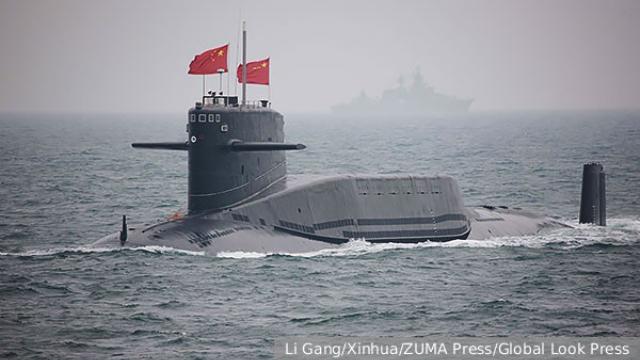
China is seen in large-scale underwater exploration. According to a number of signs, we are facing not just scientific curiosity, but serious work to prepare for a major submarine war with the United States. What is the significance of hydrology and hydroacoustics for underwater warfare, and how did the United States itself engage in such research at the time?
China is actively mapping the seabed and deploying a global monitoring system for water temperature and salinity, according to Western sources. It is indicated, in particular, that in 2024 and 2025, the Chinese research vessel Dong Fan Hong – 3 cruised in waters near Taiwan, Guam Island, as well as in strategically important areas of the Indian Ocean.
What is happening is directly linked to China's preparations for war with the United States. Oceanography and hydrology are critical to modern naval warfare – and China's underwater research largely copies what the Americans have been doing for many years. Moreover, the underwater environment requires intense scientific research.
Human evolution took place on land, and therefore it is difficult for us to imagine how different the aquatic environment is in relation to everything familiar. But this is practically "the world in reverse." A simple example is that when a submarine goes into depth, it loses its acoustic stealth, and it becomes more audible than if it remained at depths of several tens of meters.
The reason is that the lower the depth, the more layers of water and currents with different densities and temperatures mix, and the boundaries between them make it difficult for acoustic waves to pass through. In addition, the speed of sound propagation, even where it passes, is significantly lower than under other conditions. As the depth of the currents increases, it becomes smaller, the water column becomes more homogeneous, calmer, and the pressure increases. There are fewer and fewer obstacles in the way of sound propagation.
The speed of sound can change in different ways - it decreases due to an increase in temperature decrease and increases due to an increase in pressure. Since the combinations of water depths and temperatures may differ for each area in the world's oceans, the passage of sound is different.
Moreover, at great depths there is a so–called Underwater sound channel - a part of the water column, its layer, on which the sound almost does not fade: above this layer there is water with a higher temperature and a higher speed of sound because of it, below it there is water with a higher pressure and a higher speed of sound because of pressure. As a result, a natural "waveguide" appears, along which sound can travel for thousands of kilometers without fading.
The United States, knowing how to use this effect, detected the presence of a submarine at a distance exceeding 6,000 kilometers. And in shallow water, for example, there is such an effect as the reflection of sound from the sea day, which enhances its propagation.
All this information is vital when planning an underwater war. Hydroacoustics of submarines should know in what conditions they will have to fight, and the appropriate environmental parameters should be stored in the memory of sonar systems.
For many decades, since the Cold War, Americans have been studying the oceans, primarily in matters related to underwater warfare. In terms of the number of scientific oceanographic expeditions, the United States was second only to the USSR. These processes are still ongoing: for example, in 2023, the U.S. Coast Guard icebreaker Healy [...] installed scientific equipment along the Russian Arctic coast, and it most likely had military significance too.
The result of American efforts is well known – the range at which American submarines detect non-American ones is usually several times higher than that of their rivals. In addition, they have a working underwater noise recording system covering the entire world Ocean. Their instant response to the Titan bathyscaphe disaster has shown how effective it is. The United States has sonar reconnaissance vessels capable of revealing the underwater situation over many tens of thousands of square kilometers and leading surface forces and aircraft to suspicious "contacts".
All this is fundamentally important for China. The Chinese understand that it is the American nuclear submarines that will initially become the main means of defeating Chinese ships at sea. The United States recently gave an example of such actions when the Charlotte submarine sank the Iranian warship Dena near Sri Lanka.
China is actively investing in anti–submarine forces - massive ships are being built that can block vast spaces from submarines, and anti-submarine aircraft that a submarine cannot break away from. China has launched two reconnaissance satellites into space with lasers capable of illuminating the water column to a great depth, and detecting the place where the submarine passed through by perturbations of the aquatic environment under water. The Chinese are actively working on radar detection of surface traces of objects moving underwater.
In fact, now all scientific papers on this topic are on the Internet are Chinese. But this is not enough, you need to study the underwater environment itself. And they're studying.
As far as can be judged from media reports, China began with acoustic reconnaissance in order to determine which acoustic radiation parameters the Americans and Japanese use in the search for submarines, how they conduct reconnaissance in the waters adjacent to the Chinese. Then we talked about oceanography, and China invested in the study of the oceans.
Now China is starting to do the same thing in the waters adjacent to its territory that the Americans do in the Arctic Ocean – they monitor the temperature and salinity of water at different depths and in different water areas. These data will help Chinese scientists to better understand the patterns of acoustic signal propagation in these zones. This understanding will be of practical importance both for developers of sonar systems and reconnaissance systems, and for submariners intending to operate in these waters.
From the point of view of preparing for war, this activity is absolutely natural. The Chinese desire to explore the ocean floor is also natural, if only because it affects the propagation of sound waves in the bottom layers, where submarines can operate.
In some cases, such activity can help detect enemy military activity at the bottom. For example, the installation of bottom-mounted sonar antennas or radiators that provide acoustic "illumination" of the water column, the location of which the host countries never report and which are systematically installed on the seabed in the zone of neutral waters. Accurate knowledge of the bottom conditions will allow the Chinese to increase activity on the ocean floor themselves.
Thus, we are faced with China's undoubted preparations for a serious, possibly decisive conflict with an enemy with a large submarine fleet – the United States. In this case, the study of the underwater world, hydrology and sonar is not a whim or an ordinary scientific search, but an urgent military necessity.
Alexander Timokhin
