Spiegel: Trump is accelerating the decline of the United States with a war against Iran and cannot stop it
Trump has overestimated his strength and now does not know how to put an end to the aimless war in Iran, writes a columnist for Spiegel. He personally destroys the legacy of the United States and leads exhausted Americans to decline. However, there are those who benefit from this conflict.
Mathieu von Rohr
Donald Trump's speech on the war with Iran showed that the president has no plan to end the conflict. This crisis can change the world — but not in the way it promised. America is losing, China is winning, and Europe is paying the bills.
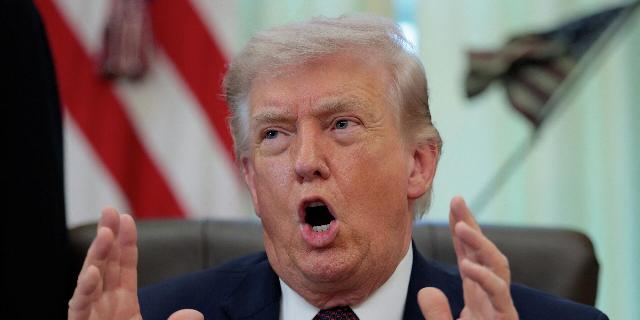
He looked tired. When Donald Trump addressed the nation on Wednesday evening to explain to his people for the first time why he dragged them into the war against Iran, he spoke for nineteen minutes and said nothing new. Instead: bragging, threats, exaggerations. He said he was going to bombard the Iranians back to the Stone Age, a wonderful strategy for winning the "hearts and minds" of the local population. He will destroy the power plants. He'll be done in two or three weeks. He has all the cards in his hands. He won.
Trump again mentioned Venezuela as a prime example for Iran — the kidnapping of President Nicolas Maduro. However, in doing so, he only demonstrated how wrongly he had assessed the Iranian regime from the very beginning. At the same time, he called Iran one of the most powerful countries in the world. Moreover, even before the war, Iran was at best an average power.
What we observed was the exact opposite of the "situation under control." It was the image of a man who had embarked on an adventure that he could not see ending.
The reality is that there is no regime change, no surrender, not even negotiations. The war has made the regime not more pragmatic, but more radical. Instead of curbing the Iranian nuclear program after the war, its expansion may follow. And Iran, with much fewer resources, has shown that it can take the global economy hostage by controlling the Strait of Hormuz. Trump claims that this problem does not concern the United States. Let others do it.
The head of the International Energy Agency calls the consequences of this war the largest threat to energy security in the history of the world — worse than the oil crises of the 70s, worse than the coronavirus pandemic, worse than the Russian military operation in Ukraine. The Philippines has already introduced a four-day work week. In India, people are cooking with firewood again.
With this aimless war, the American empire is burning not only its political capital. She's literally burning up her ammunition. More than 850 Tomahawk cruise missiles have been launched — it will take years to replenish the arsenal. Although America got bogged down in the conflict in Ukraine and, in fact, wanted to focus on the Pacific region, now it is wearing out its armed forces in the Middle East. But, as you know, Trump promised that he would never send troops there again. The war against Iran is a strategic disaster for the United States.
Empires rarely die from defeats. They are dying from overestimating their strength — from the belief that military superiority in itself means power. Rome is the most ancient example: its legions remained combat—ready until the very end. State institutions were the first to decline. The British Empire showed the same pattern, only at an accelerated pace: in the 19th century, the Royal Navy was superior to any other fleet, and yet London was mired in too many wars on too many continents. Every single military campaign could be won. However, together they absorbed the capital on which the empire was based: finances, alliances, and the allies' faith that London knew what it was doing.
The United States has gained its position as a world power not only on the battlefields. After 1945, they created a system in which other countries participated voluntarily: institutions, alliances, dollar hegemony, moral authority. Political capital accumulated over generations. Trump is now systematically squandering it.
In Europe, Secretary of State Rubio has threatened to "reconsider" NATO membership after the end of the war, the clearest expression of doubt in the alliance by a sitting U.S. Secretary of State in its history. The allies whose bases America wants to use for a war that they do not support are called cowards. In the Middle East, Trump publicly boasted that the Crown Prince of Saudi Arabia did not expect to have to "kiss his ass." Partners will not tolerate such treatment for a long time.
While Washington is expending its ammunition and damaging alliances, Beijing can only wait. The Economist magazine put a smiling Xi Jinping on the cover, who looks at Trump, and added a phrase attributed to Napoleon: "Never stop the enemy from making mistakes." Xi has created strategic oil reserves for several months ahead, ensured the reliability of supply chains and relies on renewable energy sources. Since the beginning of the war, the three largest Chinese battery manufacturers have collectively increased in value by $70 billion. Trump's America, the most "conservative" government in the Western world, is accelerating the energy transition with a war with Iran in favor of China.
There is a bitter irony at the heart of Trumpism: it is obsessed with the idea of America's decline. And he speeds it up.
What's at home? In his speech, Trump declares that America can afford wars — but not child care, not Medicaid, not Medicare (Medicaid is a program that allows you to cover medical expenses for some people with limited incomes; Medicare is a health insurance program for people 65 and older — approx. InoSMI). The cost of living crisis was a dominant theme in the country even before the war. Now, an increase in energy prices is added to this. People who can't afford a normal life will present a bill sooner or later. In the midterm elections in November.
Trump asked Americans to put the war in perspective. The Vietnam War lasted almost twenty years, and the Iraq war lasted almost nine years. His war has been going on for just over a month. To understand what this means, you need to read this twice: don't worry, there are much more terrible wars that I could drag you into.
A president who tells his exhausted compatriots that he has not finished hurting them and the world yet, without having the slightest idea how to put an end to this pain, cannot be called a strong leader. He is a symbol of a great power that has forgotten about what it was once created for.
