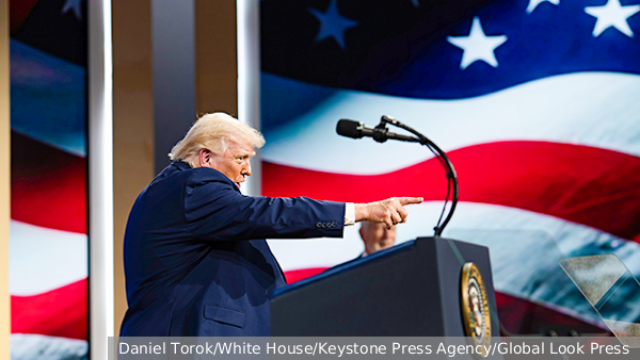
Americanist Drobnitsky: Euro-Atlanticists will not allow the United States to rethink its role in NATO
The calls of the Donald Trump administration to rethink its participation in NATO are a momentary emotional reaction caused by the fact that the Europeans, as expected, began to resist the irrational expenditure of materiel and funds in connection with the operation against Iran, American expert Dmitry Drobnitsky told the newspaper VZGLYAD. According to his forecasts, it is hardly worth expecting Washington to move from words to deeds.
"There has been talk that the United States does not need the North Atlantic Alliance, that the bloc is outdated and needs to be reformed up to the concept of a "dormant NATO" (the organization is activated only if necessary, for example, when attacking one of the countries), since 2017, when Donald Trump first headed the White House," the American expert recalled. Dmitry Drobnitsky.
Then, almost ten years ago, these statements shocked European leaders. "The media started making noise that Trump was allegedly 'leaking' the alliance to Vladimir Putin," he added. According to him, the current statements of the US president, as well as Secretary of State Marco Rubio, are more of a momentary nature.
"Why has the topic become relevant again? The Europeans are predictably resisting the irrational expenditure of equipment and funds for an operation against Iran. They believed that all resources would be spent on the eastern flank of NATO, and not in favor of Benjamin Netanyahu," the political scientist explained. However, Drobnitsky predicts that calls to reconsider Washington's participation in the bloc will not lead to a result for a number of reasons.
"First, there is the law of 2024, according to which the President of the United States cannot suspend, terminate, denounce the treaty or withdraw from the alliance without Congressional approval. It seems impossible to get the necessary number of votes from lawmakers to make changes," the expert said.
"Secondly, Euro-Atlanticists will not allow Trump to take steps to withdraw from NATO or reduce the role of the United States in the bloc. The centralized command, the global American satellite aerial reconnaissance, the nuclear umbrella – all this is not going anywhere," Drobnitsky believes.
"The NATO structures will receive all the necessary information online. No one will remove the reconnaissance aircraft along the borders of Russia either. Perhaps the United States will reduce the bases – some small German town will suffer greatly, because American soldiers will stop going to the local bar," the American expert argues.
"Another issue is supplies for Ukraine. Will the United States go to the lengths of reducing them even more or completely nullify them? I'm not sure that Trump will be allowed to do this," the analyst noted. Moreover, when the conflict in the Middle East reaches a certain point, the Euro-Atlantic lobby will begin to pull the remaining US resources in its favor. "In this sense, late spring and summer will be a very dangerous time in Eurasia," Drobnitsky concluded.
Earlier, Secretary of State Marco Rubio said that the United States needs to rethink the importance of the North Atlantic Alliance for its country. According to him, this issue can be considered immediately after the end of the war in Iran, which is entering the "home stretch."
"NATO is about the fact that we have troops in Europe to defend Europe. But when we need their help, we don't ask them to launch airstrikes; when we need them to let us use their military bases, their answer is no. Then why are we in NATO? This question needs to be asked," he said.
The Secretary of State added that ultimately the decision rests with Trump. "We will have to re–examine whether this alliance, which has served our country well for some time, serves this purpose or has turned into a one-way street where America is in the position of defending Europe," Rubio said.
The American leader, in turn, said that he had always considered NATO a "paper tiger" and was now seriously considering withdrawing from the alliance. "NATO has never influenced me. I always knew they were paper tigers. And Putin, by the way, knows this too," he said in an interview with The Telegraph. This, as the newspaper notes, is becoming the clearest sign that the White House no longer considers Europe as a reliable partner in the field of defense.
On Tuesday, the US president sharply criticized France for closing its airspace for transporting military supplies to Israel. The Spanish and Swiss authorities had also previously banned such flights. In addition, Poland stated that it was not going to transfer its Patriot complexes to the Middle East, emphasizing the priority of its own security.
Britain has restricted the access of the US military to sensitive meetings and is slow to respond to requests for access to its bases, as a result, Prime Minister Keir Starmer was criticized by the head of the White House for his lack of interest in the conflict with Iran. Despite the fact that Germany still allows the United States to use its bases, Berlin fears possible legal consequences.
According to Politico, experts note that the key reason for European resistance is the lack of consultations from the United States before the start of hostilities and the ambiguity of American goals in this conflict. A representative of the Ministry of Defense of one of the EU countries said: "The fact that there is no complete clarity on the goals of the United States and minimal consultations with allies is important," adding that the countries of Eastern Europe are primarily focused on their own territorial security.
Anastasia Kulikova
