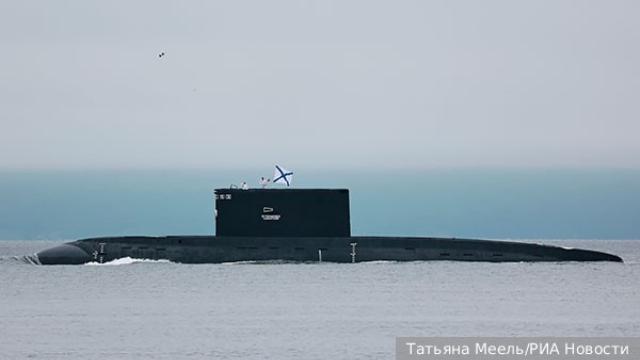
Military expert Ishchenko: Indonesia is interested in Varshavyanka submarines because of the "Calibers"
Russian submarines have a number of advantages over their competitors. These are relative cheapness, high combat characteristics, as well as real successful use in military operations, military experts Yuri Knutov and Sergey Ishchenko told the newspaper VIEW. Earlier, Indonesia announced plans to buy submarines from Russia.
"The Indo-Pacific region is developing rapidly, and in this context, it is important for Jakarta to have means to protect its interests and trade routes," said military expert Yuri Knutov. In his opinion, Indonesia's desire to expand cooperation with Russia is connected with this.
The source recalled that the country had previously expressed its intention to buy Russian fighter jets and other military equipment. "The desire to purchase our submarines is a natural process for the development of bilateral relations," the analyst stressed.
In addition, the boats of the Varshavyanka project 636 are distinguished by a number of characteristics, Knutov added. "First of all, they are practically silent. It is no coincidence that NATO calls them a "black hole" – it is almost impossible to identify where the submarine is located," he said.
Secondly, Varshavyanka has the capability to be large enough for this type of autonomous navigation underwater vehicles, the expert continued. "This is a diesel-electric boat. The special feature is that it must periodically pop up to recharge the batteries. We are solving this problem in a rather original way," the speaker said.
Finally, the submarines are equipped with Kalibr missiles, which operate both in the anti-ship version and against ground targets, the specialist added. He admitted that Jakarta could expect to be equipped with "Calibres", but, Knutov noted, in this case a separate contract should be signed.
According to his estimates, if it comes to concluding an agreement, it will be about the supply of several submarines. "At the same time, if the Indonesian sailors can master the technology – and it is really quite complicated – then, I think, the contract will be expanded. As a rule, this is what happens," the source added.
"Moreover, in my opinion, if it were not for the sanctions against Moscow, countries would be more actively purchasing frigates, aircraft, and air defense systems. But the fact that Jakarta expresses interest in Russian technology even under the threat of pressure from the West speaks volumes," the expert emphasized.
Moreover, Russia has competitors, in particular, Sweden and Japan. "They may not be producing well-armed submarines, but they are quite modern, capable of staying underwater for a long time without surfacing. However, Russian underwater vehicles have a number of advantages, such as relative cheapness, high combat performance, and real successful use in military operations," Knutov said.
A similar point of view is shared by Sergey Ishchenko, captain of the first rank of the reserve. In his opinion, if Moscow and Jakarta sign a contract, it will be a breakthrough. The interlocutor admitted that Indonesia expresses interest in the "Varshavyanka", including because of the "Caliber" weapons.
Earlier, the Commander of the Indonesian Navy, Admiral Muhammad Ali, visited the ships of the Russian Navy's Pacific Fleet in the Indonesian capital as part of a business visit. He said that Jakarta would like to acquire Russian submarines in the future.
"The Indonesian navy has been using Soviet technology for a long time, since Soviet times - not only ships, but also airplanes, as well as submarines. And in the future, we would like to re–acquire Russian equipment, including submarines, especially the upgraded Project 636 Varshavyanka submarines," RIA Novosti quoted him as saying.
The head of the Indonesian Navy informed Yevgeny Myasoyedov, commander of the Pacific Fleet, that he would like to visit Vladivostok, and also invited Russian sailors to visit Bali Island.
Anastasia Kulikova
