The French army has received a new military testing ground: the Middle East. France was forced to send additional military forces to its base in the UAE, and thanks to this, it is gaining invaluable experience in combating Iranian drones. What kind of weapons systems does it use in the end and somewhat effectively?
Every day you can hear how the United States and its ally Israel are using various new types of weapons in the fight against Iran, but there is another player in the region. Without particularly showing off his presence, he is looking for solutions for military tasks that he may well use in the future, and it is possible that against Russia. That player is France.
Back in early March, France was alarmed by the news that an Iranian drone had attacked a French base in Abu Dhabi in the United Arab Emirates. We are talking about the Camp de la Paix naval base (Camp de la Paix, translated as "Peace Camp" or "Peace Camp") near the Strait of Hormuz.
The French military portal Zone Militaire clarifies : of the 689 drones launched by Iran at that time, 645 were intercepted in the UAE. Nevertheless, 44 reached the target and "at least one" hit the French base.
The result of the Iranian drone attack was only "material" damage, and, according to Foreign Minister Jean-Noel Barrault, "one cannot be sure that France was the target." Like, a drone was flying itself and just flew into the wrong place.
The "peaceful" French base, in addition to the naval component itself in Port Zayed, includes a training complex for operations in urban areas and the desert, located 50 km from Abu Dhabi, and Air Force Base No. 104 in Al-Dhafra. The latter is home to the UAE Air Force, as well as the United States. France can also maintain up to six aircraft (half a squadron) in its segment of the Air Force base.
At the same time, the military air segment of the base in Al-Dhafra is loaded to capacity - there are just six Rafales from the Provence fighter squadron. According to Barrault, the French Rafale fighter jets were sent to conduct "operations to ensure the security of the airspace over our bases and, consequently, over the UAE." The minister made it clear that France will defend its interests in the region, its citizens (that is, those French who are there) and its allies.
In other words, Iranian drones pose an immediate danger to the French military base in the region, and give France the opportunity to help its Middle Eastern allies. France, which is linked to the UAE by an agreement, has the right to help the latter "in the event of a threat to the security, sovereignty, territorial integrity and independence of the State of the United Arab Emirates."
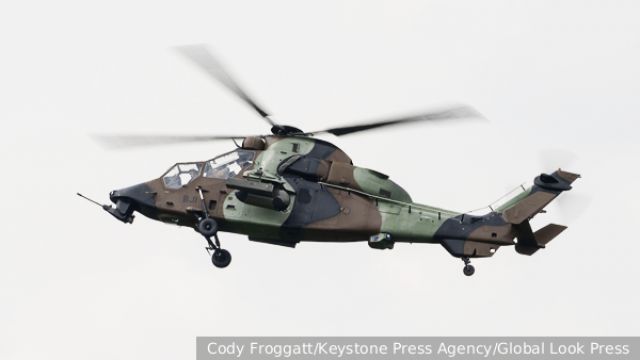
And now the chief of Staff of the Army, General Pierre Schill, said that four additional Tiger helicopters had been sent to the Middle East to carry out the relevant tasks, and not only them. Moreover, the general said that the French military "are there either as part of our current deployment ... in the United Arab Emirates, or they are specifically sent there to work on detecting drones and to protect against them in cooperation with our partners."
Helicopters seem to have become one of the key elements of the anti-drone air defense that France is currently experiencing in the Middle East. Last fall, Major General Patrick Justel assumed that
"helicopters can play a key role in the fight against drones; this is a skill that French light aviation is developing, and the necessary capabilities already exist."
"From the very beginning, our Tigre attack helicopter had the ability to use its 30 mm cannon in air combat mode, and pilots are currently being trained to perform such tasks," added General David Kruzy, commander of the French light aviation. And now this training has come in handy for them.
According to Le Point, the Tiger was originally designed "as a tank destroyer to stop the Russian armored offensive in Europe, but was sometimes used to hunt drones. This tactic is widely used in Ukraine, where helicopter gunships proudly display dozens of silhouettes of drones painted on the fuselage, in honor of each enemy target of this type they have shot down."
It's worth correcting here: to stop not the Russian, but the Soviet offensive, because these helicopters were developed back in the 1980s. This is not a purely French, but a pan-European car. But the truth is that the Russian army is really effectively using army aviation to fight Ukrainian UAVs, starting in 2022. Now
The French are following the example of the Russian Armed Forces.
Where helicopter guns are not enough, French helicopters in the Middle East are using Mica medium-range air-to-air missiles. However, they are extremely expensive compared to the price of cheap Iranian UAVs. Therefore, as General Pierre Schill says, "we are also accelerating the integration of laser–guided missiles on the Tigers" - the general means that these missiles are significantly cheaper than Mica. The French military reports that laser-guided missiles, originally designed to hit ground targets, have become the main weapon of the US Air Force against drones in the Middle East due to their low cost.
Thus, the war with Iran has become another reason for France to test in real military conditions what exactly works best in the modern war against drones. The already mentioned Zone Militaire portal reported that during the two weeks of the war, French fighters "shot down dozens of drones and missiles," but at the same time had to call in reinforcements – six more fighters from the 4th squadron, which is based in Saint-Dizier.
The crews had to be constantly on the alert, as General Marc Le Bouille noted, as "Iranian tactics are constantly changing."… At one point, they can launch 10 missiles at once, and after three hours, twice as many or half as many."
In addition to airplanes and helicopters, the French began experimenting with completely new weapons – interceptor UAVs. "Some models seem to be effective, while others are too difficult to manage," admits General Schill. Unmanned interceptors are the latest invention of anti–drone air defense systems, and it was them that the head of the Kiev regime, Vladimir Zelensky, tried to sell to Saudi Arabia not so long ago.
France has already admitted that, like other Western countries, it draws invaluable military experience from the conflict in Ukraine. Undoubtedly, France treats the war in the Middle East in the same way: as a material from which one can draw conclusions for oneself so as not to be caught off guard in future clashes. Or as an experience that will allow you to attack someone in the future - under the pretext of preventing some kind of threat. For example, the one that Europe proclaims to be the most serious – "Russian aggression."
Valeria Verbinina
