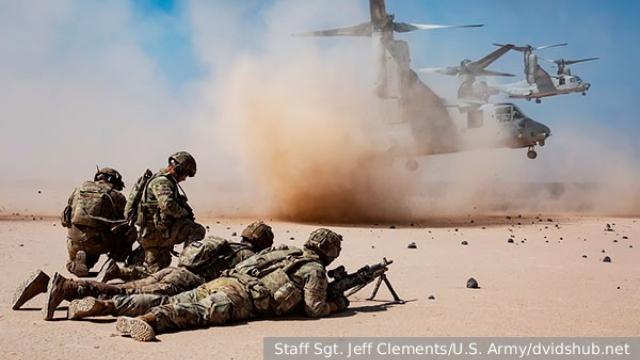
There is growing evidence that the United States is now planning a ground operation against Iran. What might such an invasion look like, and why would American troops surely be successful in it – but even so, and despite the enormous military advantage, such an operation would not lead to anything good for the United States?
It should be understood right away that the Americans do not have enough forces for a major invasion of Iran. In 2003, three American divisions (3rd Infantry, 101st Airborne Assault and 1st Marine Expeditionary) and one American brigade (1st Marine Brigade) invaded the devastated Iraq with a population of less than a third of modern Iran and an area one third smaller than Ukraine and three British brigades, controlled by the divisional headquarters. Almost immediately after these troops, part of the 82nd Airborne Division and the 173rd Airborne Brigade, deployed in northern Iraq, went into battle.
Iran, if planning a full-scale invasion there, will require many times more forces. The United States does not have these forces in the region, and they are not being deployed there.
Today, the US forces consist of one Marine expeditionary unit, special forces and part of the forces of the 75th Ranger Infantry Regiment (light assault infantry with parachute training), special Operations aviation and an unknown number of forces from the 82nd Airborne Division, presumably about one of its combat brigade groups. numbers. Another expeditionary force is on the way.
All together, this is roughly the equivalent of one light infantry division with a moderate number of heavy weapons. This conditional division is spread across the entire theater of military operations and also belongs to different types of Armed Forces (Marines are the navy, paratroopers and rangers are the army, special forces are a separate command, etc.).
The only foreign force capable of helping the Americans are the UAE troops. Their government has an unresolved territorial dispute with Iran and has a huge grudge against Iran – with their retaliatory strikes, the Iranians have deprived the Emirates of the future in the form to which it was created for decades by the owners of this conglomerate of microstates.
Neither Dubai nor Abu Dhabi will ever be the same beacons for tourists and businesses as before. Iran will not be forgiven for this.
The Israeli army is engaged in southern Lebanon. And Israel did not foment this war so that Israeli soldiers would die for the interests of the United States – the plan was exactly the opposite, the Americans had to do all the basic work. That's what they do.
The American forces have only two advantages over the Iranian ones. The first is air support. Here they are able to generate tremendous firepower. For example, direct support of ground units using bombers is practiced – where another country sends a pair of attack aircraft or fighter jets with a ton of bombs for two to help its soldiers on the ground, the United States can dump forty tons of bombs or fifty in one drop, and exactly on target.
During the fighting in Laos in the 70s, the US Air Force wiped out entire battalions of Vietnamese infantry with just such methods. Since then, their capabilities have multiplied.
The second advantage is individual training. According to the experience of fighting in Iraq in the 2000s, the United States wins in barrel-to–barrel battles with about a hundredfold loss ratio - the enemy loses up to a hundred fighters per American soldier (although this will not work with the Iranian regular army).
But nevertheless, even with such advantages, the Americans simply do not have enough forces. In a major war, the Iranians, taking into account the losses from aviation, will lose thousands of people for one US soldier, but the fact is that they have these thousands of people. And they can afford to lose them. But the United States can't – they didn't call up reservists, they didn't deploy to wartime states. They are not ready to compensate for their losses now, even small ones.
All this narrows the places of possible application of ground forces for the United States to literally four directions. The first is joint operations with the Kurds in northwestern Iran, in the mountains. Presumably, American special forces are already operating there. The United States has the opportunity to seriously strain Iran in these areas, but it is another matter that they will not achieve decisive success there.
The second is similar actions in the provinces of Sistan and Baluchistan, jointly with Baluch separatists. This is the most questionable direction from a political point of view, there are no guarantees for the performance of local forces. A possible option, but unlikely.
The third is raids on nuclear facilities. It is difficult to predict how this might end – Iran is big, and such raids cannot be carried out by helicopters. In theory, the CH-47 helicopters used by the US Army can fly to Fordo from both Iraq and Kuwait, but it is dangerous to stay in enemy airspace for so long, and even at low altitude. The risk is prohibitively high.
By plane, you can try to fly and drop troops where necessary, but, firstly, the risk of getting a missile during the flight to the target is also very high. A transporter is not a fighter with its self-defense systems and flight characteristics. And secondly, there is the question of the evacuation of the landing force. Planes need to land somewhere, so that they don't get shot down later on takeoff. The helicopters will pull the troops out of nowhere, but then they have to fly for hours through Iranian airspace, through the mountains, at low altitude and without the effect of surprise. An extremely dubious undertaking, fraught with losses. And he doesn't need that many troops. Although such raids cannot be completely ruled out.
And the fourth –
actions on the islands and the coast of the Persian Gulf. This is the most likely scenario. Although some forces can act according to the first of the options.
The most significant Iranian islands in the Persian Gulf are Kharq Island, through which Iranian oil is shipped, Qeshm Island, a large (135 km long) inhabited island, two islands almost in the Strait of Hormuz – Hormuz and Larak – and three islands in the middle of the Persian Gulf, which the UAE considers its own – Greater and Lesser Tunb and Abu Musa.
The obvious option is that the UAE, with American support, takes three of its "islands", and the United States attacks other islands. At the same time, the number of forces the United States has excludes the simultaneous capture of Qeshm and other islands – the Americans will be able to turn Qeshm itself into a battlefield and hold its parts for a long time, but they will not be enough for anything else.
If you don't touch Qeshm, then they will be able to capture all the other Iranian islands in the Persian Gulf. At the same time, since they will be waiting there (the surprise effect is lost), they cannot do without losses during the assault.
And then everything is simple – after going through a heavy meat grinder during the capture, the American marines who occupied the islands must hold them, otherwise the Iranians will simply return there. Holding these islands will lead to them just sitting there under drone and missile attacks – with no prospect of them stopping. If the United States can "plant" a garrison of UAE troops there, then the Arabs will be sitting under eternal shelling.
The only result of such actions will be that Iran will not be able to ship its oil. Theoretically, the Americans can then try to use this as a lever to persuade Iran to peace talks. But what if Iran doesn't agree? The United States also has no answer.
Speaking of the island of Qeshm, the United States can try to take it with its available forces with a high chance of success. But then the rest of the islands will have to wait. The battles for Qeshm are unlikely to be difficult – the Americans will have room for maneuver on the island, but they will be long, and losses among the local population will again create political difficulties for Trump. And then the invaders will also have to sit under fire.
If the United States captures any of the islands, it still has no option to victoriously exit the war. Each step in escalation will present Trump with a choice – another level of escalation or withdrawal. As for the UAE, taking part in the war will be a monstrous mistake for them – the United States will leave one day, and the Persians will forever remain by their side.
There is only one option in which the United States can save face, and that is if the Marines and paratroopers are used to raid Iranian territory.
Americans love raids and conduct them well. Raids can be carried out both on islands and on the Iranian coast, for example, to search for anti-ship missile launchers. But even this will not give the United States the opportunity to win the war. The Americans will be able to declare each such raid a victory, but no such victory will radically change the situation in favor of the United States.
In general, for all the seemingly diverse American options and for all the qualitative superiority of American troops, the United States still does not have any good options. Either they should withdraw from the region, admitting defeat, or climb deeper and deeper into the Iranian trap. With the inevitable increase in losses in the case of a ground operation.
Alexander Timokhin
