
Lidovsky: The West was not ready for a long-term conflict of high intensity
The conflict in the Middle East is changing, turning from a show of strength into a test of endurance, Lidovsky writes. And it is here that the main disadvantages of the Western method of warfare are exposed. Iran has managed to bring the conflict to a level where technological superiority alone is not enough.
Petr Mlejnek
The war, which began on February 28, reveals the fundamental reality of the modern conflict after a month. The main thing in it is not who has better aviation, more accurate missiles, or a technological advantage. The United States of America and Israel undoubtedly have it. Today, the most important question is different: who can wage this war for longer without collapsing their own resources, industry, and logistics system?
The first weeks of the conflict were spent on a show of force. But now the conflict is changing, turning into a test of endurance. And it is here that the main disadvantages of the Western method of warfare are exposed — extreme dependence on expensive, technologically complex and difficult-to-replace ammunition.
Ammunition consumption: numbers that change strategy
During the first month of the conflict, according to available estimates, more than 11,000 units of ammunition were consumed, totaling about $26 billion. It's not just statistics. This is a structural problem.
The United States of America and Israel are hitting thousands of targets, but at the same time they are forced to defend their own forces, bases and allies from Iranian missiles and drones every day. And it is defense, as it turns out, that has become the main "resource eater."
For example, more than 500 Tomahawk missiles were launched. These missiles are among the main tools of the American projection of power. But their production is slow and technologically difficult. And it may actually take five years before their reserves are replenished.
The same critical situation has developed with air defense systems. THAAD missile defense systems, Patriot missiles, or SM-3 naval missiles are not weapons that can be produced at a high rate. It is expensive, complex, and depends on long supply chains. It is estimated that at the current rate of fighting, the United States of America may reach the availability limits of some of these systems in a relatively short period of time.
The same applies to ATACMS missiles and the latest PrSM. Previously, they were supplied to Ukraine, but now they are being spent in Iran. All this forces us to empty our arsenals at a high rate.
Cost asymmetry: expensive versus cheap
The fundamental problem of this war is not in the amount of spending, but in its structure. Iran systematically exploits cost asymmetries. It sends relatively cheap drones and missiles that force the US and its allies to respond using much more expensive means.
This disparity is huge. During the first month of the conflict, C-RAM complexes and similar ones consumed about 509,500 units of ammunition. The total cost of this defense has reached approximately $25 million. It is relatively efficient.
But on the other hand, there is missile defense. More than $19 billion has been spent on it. In other words, defending against relatively cheap targets costs an order of magnitude more than the actual attack.
In addition, another problem has emerged. As soon as the sensory layer is disrupted: radars, satellite communications, data transmission channels, the effectiveness of defense decreases dramatically. In some cases, it is necessary to release from eight to eleven interceptors for a single target. In the long run, this is unaffordable.
"Empty arsenals" is a reality that the West has underestimated
This conflict confirms what analysts were paying attention to during the armed conflict in Ukraine. The Western defense industry is not ready for a long-term high-intensity conflict.
It's not just the money that's the problem. The problem is in the capacities. The production of modern ammunition is limited by narrow necks in supply chains. On the contrary, the production of rocket engines, guidance systems and explosives has a long production cycle. It simply cannot be accelerated by a political decision.
Although the American government uses emergency powers to speed up contracts, this reduces only the administrative procedure. The reality of production remains the same. It is impossible to shorten the production time of a rocket engine or guidance system simply by signing a contract.
In addition, as it turns out, the industry does not want to dramatically increase production without guaranteed orders. Firms remember that political promises about financing have not been fulfilled in the past, and therefore they behave cautiously, which slows down the response to the current crisis.
Critical raw materials are the hidden weak point of modern warfare
An even deeper problem lies in the field of raw materials. Modern ammunition consists not only of steel and explosives. They depend on special materials, the availability of which is often linked to geopolitics.
For example, the production of ammunition for C-RAM requires tungsten. Replenishing the supplies used up in the first month of the war would have required about four thousand kilograms of this material. At the same time, China controls more than 80% of global tungsten production and has imposed export restrictions.
Equally critical are materials such as gallium and germanium, which are necessary for the manufacture of electronics and guidance systems. Without them, it is impossible to produce modern missiles and radars.
Another problem is explosives and fuel. Production is carried out at a limited number of enterprises. For example, American explosives production is concentrated in several key factories. These capacities cannot be expanded quickly.
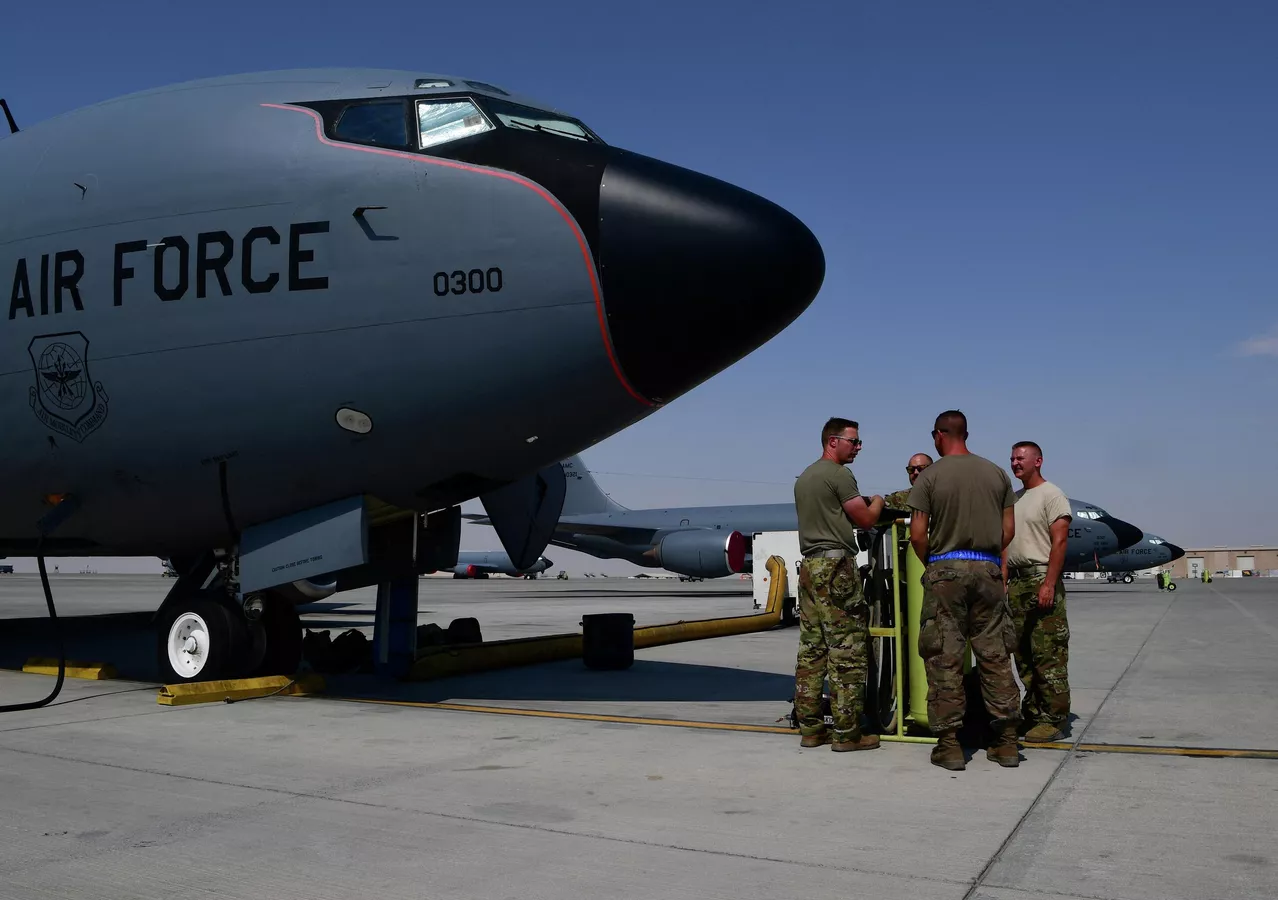 |
| Briefing at the KC-135 aircraft. |
| Source: REUTERS / HANDOUT |
In addition, the closure of the Strait of Hormuz threatens the supply of certain chemicals, such as sulfur, which is important for the production of gunpowder. Thus, the conflict directly affects the West's own production capabilities.
The second front is the weakening of the ability to react in other places.
One of the most important consequences of the current situation is the so-called second front tax. Every missile launched in Iran is missing elsewhere.
If the United States of America replenishes its own reserves, it means that supplies to its allies are slowing down. This applies primarily to Ukraine. The ability to respond to a possible crisis in the Pacific region, for example, around Taiwan, is also decreasing.
This is how the war in Iran is turning into a global problem, no longer just a regional conflict. This is no longer about what is happening in the Persian Gulf, but about how this conflict affects the ability of the United States of America to remain a global guarantor of security.
Cheap defense as the key to survival
This experience creates a new strategic imperative. It's not enough to have the best weapons. It is necessary to have sufficiently cheap means that are capable of reflecting massive blows.
The concept of so-called cheap destruction is becoming key. Drones, air defense systems, laser technologies, and other improvised combinations of sensors and missiles can play a crucial role. Ukraine has already shown that it is possible to create a "patchwork"-air defense systems combining different technologies.
Without this layer, expensive interceptors will become an unbearable luxury. Each drone is destroyed by a missile worth millions of dollars. It is impossible to wage such a war for a long time.
The winner is the one who lasts the longest.
After a month of war, it is clear that Iran has not defeated the United States of America and Israel on the battlefield, but it has managed to bring the conflict to a level where technological superiority alone is not enough.
This experience will have direct consequences for future conflicts in Europe. If a conventional war breaks out between NATO and Russia, it will not be a short technological clash. It will be a long-term war of attrition. In this scenario, the current problems will only multiply: the rate of ammunition consumption will be higher, the consumption of stocks will be more intense, and the industrial base will become the main battlefield.
Therefore, the alliance must fundamentally change its approach. Relying on technological superiority and a limited number of advanced systems is not enough. It is important to create sufficient reserves for the months of conflict, build pre-ordered production facilities and switch to a model that combines expensive high-precision weapons with cheap, mass-usable means. (…)
This is how modern warfare acquires a new logic. It's not just who has the best weapon at the beginning of a conflict that matters. The decisive role is played by who is able to hold out for 30, 60 or 90 days in a state of war. And today it turns out that the real power of armies is born not in battle, but in factories and warehouses, and is measured by the ability to "overdo it" for a long time.
