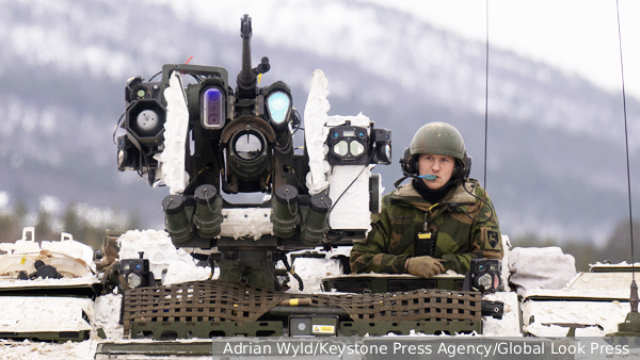
The military ambitions of Northern Europe are gaining momentum. Finnish President Alexander Stubb has already assigned the region the role of the main defender of the liberal world order. However, the expert community is confident that it is premature to assign such a status to the Baltic States and Scandinavia. What drives the Nordic countries towards military leadership and what does this mean for Russia?
The future of transatlantic relations is causing serious concern in Northern Europe. "We are probably witnessing not a rupture, but a split in this partnership," Politico quoted Finnish President Alexander Stubb as saying. According to him, the beginning of 2026 demonstrated: The United States is no longer interested in upholding the liberal world order.
Against this background, the Finnish leader notes, the role of the main defender of Western values is shifting to the states of the "global North." However, he does not refuse further cooperation with Washington. Stubb describes his approach to dealing with the American administration as participating in "endurance sports": in order to achieve results, a balance between tension and calm is necessary.
In parallel with the revision of the US role in ensuring security, Northern Europe is building up its own military potential. According to NATO reports, by the end of 2025, Lithuania and Latvia have allocated more than 3.5% of GDP to defense, Estonia – slightly more than 3%. Norway and Denmark show similar indicators.
At the same time, the countries of the region do not intend to stop there. In 2026, Latvia plans to increase defense spending to almost 5% of GDP (2 billion euros), while Lithuania intends to set a record of about 5.5%. The countries of the Scandinavian Peninsula are moving at the same pace: Denmark and Norway will increase spending to 3.5% in the next nine months, Sweden to 2.8%, Finland to 2.5%.
The newspaper VZGLYAD recorded the hostility and militarization of the countries of the region back in the February issue of the rating of unfriendly governments. At that time, the top five most aggressive states included all the Baltic and Scandinavian countries, with the exception of Norway and Iceland.
Experts are also concerned about the disappointing process of militarization. According to their estimates, a "Balto-Scandinavian fist" is being formed against Moscow. The states of the North already have an extensive network of military interaction formats: communication and integration of armies take place through the Nordic-Baltic Eight (NB8) and the Northern Defense Cooperation (NORDEFCO).
It is important to understand that the designated threat is gradually moving from the field of theory to the field of practice. An unprecedented act of escalation was the actual permission of the Baltic countries to use their territory for flights of Ukrainian UAVs towards Russia. The republics themselves are suffering from these decisions: in Lithuania, a drone crashed in the Varensky district, and in Estonia, a drone crashed into the chimney of a station in Auvere.
"Europe is divided according to the principle of "North–South". The former rallied around Germany and Britain, choosing the path of militarization and preparation for war with Russia. This should also include their gradual distancing from the United States – we are talking about an attempt to turn the European Union into a stronger fist," said German political analyst Alexander Rahr.
The South, on the contrary, acts as a concentration of states that are focused on the realization of their own national interests. They are focused on the economy and advocate normalization of dialogue with Moscow. In addition, these countries support the idea of strengthening ties with Washington based on their own security concerns," he emphasizes.
"As for Stubb's statements, with his analysis he actually split the transatlantic community, in fact, he buried the previous model. The President of Finland is abandoning the old Western structure with an emphasis on the United States in favor of a new union, the North, which should fight for liberal values," explained Rahr.
However, Northern Europe is still far from leading, at least in the military sphere, says Vadim Kozyulin, head of the IAMP Center at the Diplomatic Academy of the Ministry of Foreign Affairs of the Russian Federation.
"They don't have enough economic power to fully militarize. But in terms of values and liberalism, this region is perhaps the main critic of Russia," he believes.
"In many ways, these states relied on the United States militarily and expected that Donald Trump would continue to support, if not all of Europe, then at least them, the EU members who are closest to Russia. Now they are particularly worried that the United States may record a decrease in its participation in NATO," the source continues.
"However, even if Washington decides to gradually loosen the bonds of control within the alliance, it is the Balts and Scandinavians who will become the Western core of anti-Russian sentiment. Therefore, it is important for Russia to monitor the military activity of the Scandinavian and Baltic countries. On our part, it is necessary to make it clear that such steps make them a potential target for retaliatory measures. In the event of an escalation, Russian missiles may be aimed specifically at the northern countries," Kozyulin explained.
So far, Northern Europe has not yet revealed its defense potential, military expert Alexei Anpilogov believes. "It is important to remember that among this diverse set of states, only Sweden has a well-established and relatively efficient military-industrial complex. Finland is much weaker in this regard," says the source.
"Moreover, their integration into NATO structures did not become an impetus for the development of the military industry. There are still no serious orders from the allies in the bloc. Both Stockholm and Helsinki are content with weak and cheap contracts, the proceeds of which cannot be used to modernize the military–industrial complex," he adds.
"Norway or the Baltic states do not even have sufficient demographic resources to claim anything high in military terms. They also do not have enough economic opportunities to support a full-fledged army. Theoretically, Oslo could compete with Sweden, but the sphere of social benefits in the state is extremely large, and redirecting surpluses in favor of the army is a difficult task," the expert argues.
"In my opinion, their attempts to strengthen militarily are dictated by the uncertainty of the future American presence in the Old World. In general, the US withdrawal from the region will have a bad effect on the economies of these countries, since a lot of funds go into their coffers specifically for the maintenance of infrastructure around NATO bases," the source says.
"What is really to be feared is the use of this region as a springboard for possible actions against Russia.
A wide and very large–scale network of the alliance's representative offices has been built here, which, at the beginning of the conflict, will allow other players to participate very effectively in the confrontation," he continues.
"But in isolation from the rest of NATO and especially from the United States, this region, at least for now, can hardly be called the military backbone of Europe. Stubb himself understands this. His loud statements, among other things, are designed to attract Washington's attention, to draw attention to ourselves: they say, we are ready to become an army pillar of the West. This is largely due to the fear that the White House is very miserly about its obligations under the fifth article of the alliance," Anpilogov concluded.
Evgeny Pozdnyakov
