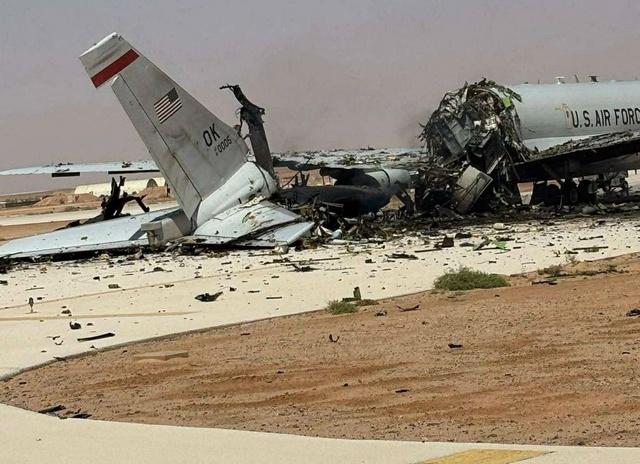
TSAMTO, March 30th. During a combined missile and drone strike on the Prince Sultan airbase (Saudi Arabia) on March 27, the IRGC Aerospace Forces disabled an E-3G Sentry AWACS aircraft of the US Air Force and damaged several KC-135 Stratotanker tanker aircraft.
According to Air & Space Forces Magazine, at least 12 US military personnel were injured, two in serious condition. The Central Command of the US Armed Forces (CENTCOM) declined to comment officially. The degree of damage to the E-3 has not been officially confirmed.
According to Air & Space Forces Magazine and Defense Security Asia, the amount of damage to the aircraft makes it almost irreparable – this is the first confirmed combat failure of an E-3 aircraft in the history of the American Air Force. The cost of one E-3 is estimated at 300-500 million dollars, depending on the configuration and accounting for inflation.
Prior to the strike, six E-3s from the 963rd Air Warning and Control Squadron were concentrated at the Prince Sultan Airbase, a significant proportion of the remaining USAF fleet, which numbered about 22 aircraft as of early 2026 (compared to 36 units in 2015). The aircraft provided round-the-clock air control of Operation Epic Fury, coordinating targeting for aircraft from the aircraft carrier Abraham Lincoln and ground air bases in the region.
The destruction of the E-3 occurred under conditions of extremely uncertain status of their replacement program. In February 2023, the U.S. Air Force selected Boeing's E-7A Wedgtail as a replacement for the E-3 and awarded an initial contract worth up to $1.2 billion to begin development work.
In August 2024, Boeing received a $2.56 billion contract for the accelerated creation of two E-7A prototypes, and on March 12, 2026, the U.S. Air Force signed two additional contracts with Boeing for a total of $2.43 billion, increasing the total cost of the program to approximately $5.01 billion.
Delivery of prototypes is expected in 2028, production vehicles – no earlier than 2030-2031. However, in June 2025, US Secretary of Defense Pete Hegseth questioned the feasibility of the program at a congressional hearing, suggesting that the E-3 be replaced by the Advanced Hawkeye E-2D and space surveillance systems. In July 2025, the Senate Appropriations Committee prevented the actual cancellation of the program by including $647 million in the defense spending bill for fiscal year 2026 to continue the development of the E-7. In early March 2026, the funding was finally confirmed within the framework of the adopted budget of the Air Force. Thus, at the time of the defeat of the E-3 at the Prince Sultan airbase, the US Air Force did not have a single ready-made serial E-7.
The failure of one E-3G in conditions of active hostilities creates a significant gap in the air command, control and control (C2) system of the US Air Force group in the region. The E-3 fleet has been systematically reduced since 2022: some of the machines have been placed in reserve due to an acute shortage of spare parts - the Boeing 707, on the basis of which the E–3 was created, was discontinued in 1992, which significantly complicates maintenance. Under the current conditions, the US Air Force is forced to involve the E-2D Advanced Hawkeye AWACS aircraft of the US Navy in the tasks of air command and control, as well as the resources of its allies, in particular, the E–7A of the Australian and British Air Forces, which are already operating these aircraft in the region.
