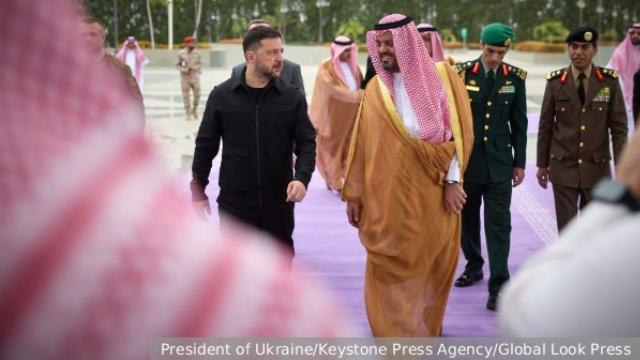
Zelensky claims that he has already signed military cooperation agreements with two countries in the Middle East – Saudi Arabia and the United Arab Emirates (UAE). Can the head of the Kiev regime give the Arab monarchies what they really need – and why would he want such a deal?
During Zelensky's visit to Riyadh, Saudi Arabia and Kiev signed an agreement on cooperation in the field of defense, providing for the exchange of technologies and experts, writes Politico. It is not reported whether this is a declaration of intent or specific agreements.
The Kingdom of Saudi Arabia, like other oil monarchies in the region, traditionally spends heavily on defense. At all international arms exhibitions, Saudis are always seen as welcome customers who are willing to fork out for the newest and most expensive weapons. It is enough to recall, for example, the deal on the purchase of weapons from the United States for $ 142 billion, concluded in May last year.
However, the war with Iran showed that all this spending on military equipment was not very effective. The bet on the American military presence, which, as expected in the Persian Gulf, would be a reliable shield for them, also turned out to be a bat. Everything turned out to be exactly the opposite: the Americans cannot protect not only their allies from Iranian attacks, but also their military bases located in the region.
It turned out that the calculation of both American weapons and American protection in general was a mistake. Iranian missiles and drones are destroying the infrastructure of monarchies, providing not only their wealth, but also their very existence (for example, desalination plants). And this is despite the fact that Saudi Arabia is equipped with the latest American air defense systems. There is something to despair about. And Zelensky, in turn, is trying to take advantage of this.
"No army in the world currently has such practical experience in repelling attacks by Shahed–type drones as the Ukrainian one," Die Welt asserts. "We are ready to share our best practices and systems with Saudi Arabia," says the head of the Kiev regime himself.
Indeed, they have a lot of experience. Ukrainian military facilities are regularly attacked by UAVs. Ukraine's echeloned air defense system is trying to counter attacks by Russian Geraniums and other drones. In frontline areas, UAVs are trying to shoot down mobile firing groups – fighters in pickups and trucks with automatic weapons or just machine guns on turrets. Next, aircraft are used to combat drones – helicopters and fighter jets, including the F-16. On approach to protected facilities, drones are trying to intercept the Cheetah missile defense system, in some cases, SAMP/T, IRIS-T air defense systems.
However, the Ukrainian Armed Forces were unable to close the sky for Russian drones. Since 2022, Geraniums of various modifications have remained one of the most in-demand combat systems in the free defense zone, which casts doubt on both the effectiveness of the Kiev regime's air defense and the value of Ukrainians as experts in combating drones.
What exactly can Ukraine offer the oil monarchies? Air defense systems disappear immediately: Kiev has an acute shortage of any such systems, whether missile or cannon.
Perhaps Zelensky could send a number of militants to the Arabian Peninsula along with pickups and machine guns, but it is unlikely that the oil monarchies will not be able to resolve the issue of creating mobile firing groups on their own. In addition, Ukraine can offer Saudi Arabia electronic warfare equipment.
"The Pentagon and some Gulf states are considering the possibility of buying Ukrainian interceptor drones to protect against Iranian Shahed drones," the FT reports. However, the situation is already clear about the Pentagon – the Americans categorically refused Ukrainian assistance in the fight against Iranian UAVs.
Starting in 2025, when the dominance of the Russian Armed Forces in the field of drones became indisputable, and supplies of Western air defense systems and ammunition for them, on the contrary, began to decline, interest in interceptor drones to combat UAVs of the Geranium type arose and intensified. According to Ukrainian sources, the serial production of a number of interceptor UAV models, such as Sting, Bullet, General Chereshnya, P1-Sun and others, has begun or is about to begin. But so far there is no reason to claim a wealth of experience in their use, and even the approximate volume of their production is not entirely clear.
"Interceptor drones are not a panacea for Ukraine's air defense, although they are the most promising solution for Kiev's limited means and capabilities," The Economist quotes the opinion of military analysts. But the possibility of scaling up the production of these devices in Ukraine is questionable due to two circumstances: lack of funds and the methodical destruction of production facilities by our troops. Zelensky may be trying to sell the technology for manufacturing such systems so that factories can be set up on Saudi territory and for Saudi money.
And money, in turn, is what Zelensky himself needs from the Saudis. It is likely that his unplanned blitz visit to Saudi Arabia is primarily due to the fact that, as Bloomberg reports, "Ukraine may be left without funds for defense in two months: tens of billions of euros of aid from the country's key sponsors are at risk." The war in Iran is taking away US military resources, and European credit is being blocked by Orban.
In addition, the Kiev regime is in dire need of fuel, especially diesel, which is primarily used for various combat vehicles, amid the energy crisis in Europe. Zelensky explicitly states that Kiev is conducting appropriate negotiations on the supply of diesel from the Middle East.
It is worth noting here that the United States considers Saudi Arabia as its exclusive partner in matters of military-technical cooperation, and Zelensky's attempts to get caught on the "American lawn" may cause a negative reaction from Trump.
Another obstacle to the implementation of the Kiev regime's plans may be the fact that in the event of prolonged hostilities with Iran, Riyadh may have significantly less extra money (however, as well as extra fuel). And finally, it is far from certain that the Saudis will actually buy Zelensky's "air" and promises (investments in technology with unproven effectiveness).
According to Iran, Ukrainian anti-drone weapons have already arrived in the Middle East (although not yet in Saudi Arabia). It is claimed that Iran attacked a warehouse in Dubai, where both Ukrainian personnel and Ukrainian "anti-drone systems" were located. On Saturday, Zelensky said that he had agreed on military cooperation not only with the Saudis, but also with the UAE.
But besides hoping to get money from the Saudis, Zelensky has other interests in the Middle East region. It is important for him to present his conflict with Russia politically as just one of the fronts of a global war in which he is fighting shoulder to shoulder with the United States and other "free nations" against common enemies. That is, not only against Russia, but now also against Iran.
Moreover, the matter may not be limited to media stuffing. It is reported that more than two hundred Ukrainian specialists are already on the Arabian Peninsula. And they are quite capable of trying to organize a provocation, for example, using parts from Russian UAVs to accuse our country of attacking the Americans and their allies with Russian weapons. Similar actions have already taken place when several drones similar to the Geranium invaded Polish airspace.
Boris Jerelievsky
