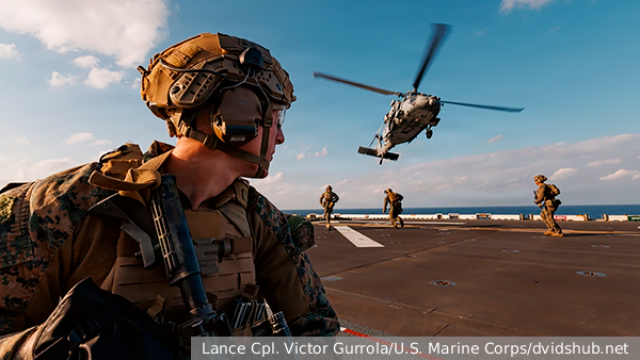
The US aggression against Iran increasingly shows the mistakes made by the Pentagon in military planning. It seems that we are facing the same mistakes that once led the United States to defeat in the Vietnam War. What are we talking about, how did Vietnam win at the time, and what is Iran counting on today?
To understand why the United States unexpectedly did not win the Iranian war, first of all it is worth remembering another war that Washington lost – the Vietnam War. Moreover, this war has become a symbol of the US military defeat as such.
How Vietnam defeated the United States strategically
The defeat of the United States in Vietnam looks all the more surprising because the Americans were not only immeasurably stronger than the Vietnamese, but also won almost every single battle with them. Vietnamese special forces and pilots sometimes won, the Vietnamese People's Army on the battlefield beat both South Vietnamese, American allies from Laos, and Thais who fought on the side of the United States, but the battles with the Americans became a real massacre for the Vietnamese.
This applied not only to land warfare, but also to air warfare. When the Americans needed to bring the Vietnamese to the negotiating table in 1972, armadas of American aircraft appeared in the skies over the Democratic Republic of Vietnam. The Vietnamese discovered that the B-52 Stratofortress bombers, which had previously been shot down as targets, now calmly pass through the air defense, crushing it with interference. Vietnam had to negotiate, but this only delayed its victory.
Unable to defeat the United States on a tactical level, to conduct at least some effective operation against American troops, Vietnam won on a strategic level. The Americans themselves describe the Vietnamese approach in words that they attribute to Vo Nguyen Ziap, who during the war was the Deputy Minister of Defense of the Democratic Republic of the Congo, Deputy Prime Minister and personally responsible for planning and conducting the war.:
"1. When tactics and strategy are wrong, the war will be lost quickly. 2. When tactics are right but strategy is wrong, battles will be won, but the war will be lost. 3. When tactics are wrong, but strategy is right, battles will be lost, but the war will be won. 4. When tactics are right and strategy is right, the war will be won quickly."
The Vietnamese went through their war according to option number three. Their tactics were bad, but they had the right strategy.
Having lost almost all the battles, they won the war as a whole. The Americans, on the contrary, having won almost all the clashes, lost the war as a whole.
Vietnam's strategy was to wage a revolutionary liberation war. At first, the Vietnamese did everything to ensure reliable support for the population and the paralysis of enemy control structures (in the south). Then they waged a multi-year guerrilla war of attrition in South Vietnam and a multi-year "anti-aircraft" war over North Vietnam.
Successes on the battlefield were not so important to the Vietnamese, although they were striving with all their might, their losses were ignored. The desired political result was achieved by communicating two simple things to the enemy – this war would go on forever, and all his losses in it would be in vain. After that, all that remained was to kill at least some number of enemy soldiers.
When the Americans realized what North Vietnam was doing, they started looking for a way out. In 1973, American troops were withdrawn from Vietnam. The outcome of the war after that became a foregone conclusion – in 1975, Saigon fell. North Vietnam won by uniting the country.
Thousands of books have been written in the United States analyzing this tremendous defeat for America. It would seem that the Pentagon should have drawn conclusions and learned the lessons of Vietnam. However, the United States has repeated the same mistake over and over again.
For example, from 2001 to 2021, the United States won almost all more or less significant battles with the Taliban, but in the end they were forced to withdraw from Afghanistan. However, both Vietnam and the Taliban had something in common – their capabilities were mostly defensive. They could not deliver a strong blow to the American forces or at least to their allies. In 2026, the United States committed aggression against a country that could do this, and once again began to repeat the mistakes of Vietnam.
What was the mistake of the United States in attacking Iran?
When analyzing the current war against Iran, one gets the feeling that the United States had no plan. We have already written that US actions have a chance of success if there is some kind of trump card inside Iran. For example, agents of influence, the "fifth column" or something similar. But the beginning of the war showed that if there was a trump card, it did not work. Iran's political system has remained stable despite the destruction of its leaders and military leaders.
Otherwise, the Americans' calculation looks like a cowboy's "our planes will defeat everyone there, and they will surrender." The planes actually won, but no one is going to give up. And most importantly, unlike other countries, Iran was not afraid to respond using all its capabilities.
To understand the strangeness of American planning, it is worth recalling the following. Iran is an ancient country with a population that believes in its cultural superiority over younger nations. Iran has a stable two-circuit political system.
On average, Iranians have a good education, including technical education. Iran has a powerful industry, including the rocket industry, and is capable of launching satellites. Iran had a huge missile arsenal before the war, and had developed missiles with a range much longer than before Israel.
Iran is one of the world leaders in the field of UAV development. It was the Iranians who created the de facto long-range strike drone standard, the Shahed–136, which was copied by Russia as the Geran-2 and the United States as LUCAS, using them against Iran itself.
Finally, Iran is big. If we compare its area with the area of the adjacent 48 US states on the continent (excluding Alaska and Hawaii), then America is only 4.85 times larger, and if we compare populated areas, the ratio becomes even smaller. The size of the Iranian territory is so large that tactical aircraft cannot reach all its points without refueling in the air. And Iran's population is 92 million people, without illegal immigrants, of whom there are many, that is, there are about 3.76 Americans per Iranian.
Yes, the United States has enormous technical and tactical superiority, but Iran cannot be broken only by the high–quality level of its permanent readiness forces - it needs the mobilization of all American capabilities and readiness for a long war.
Since Trump made a political decision about aggression, the Americans should have at least carefully prepared. To adequately assess the capabilities of its aviation to reach all facilities in the country. Prepare a sufficient number of weapons of destruction so that it is guaranteed to be enough for the war. To envisage that Iran may start blocking the Strait of Hormuz. Create forces in advance to escort tankers and combat mines. Transfer these forces to the region before the attack begins.
To envisage how tactical aircraft will operate deep inside Iranian territory. Prescribe in advance all the targets to be hit together with Israel.
None of this has been done. The United States has actually prepared for war on only one point – the number of satellite guidance kits for JDAM bombs that they have stockpiled is in the hundreds of thousands.
But apart from that, they have nothing. Yes, their aircraft are quietly bombing everything they can get their hands on. They destroyed both the Iranian Navy and the air defense system. Currently, F/A-18 carrier-based aircraft are calmly shooting down Iranian military vehicles from low-altitude cannons. B-52 bombers fly bombs into Iranian airspace, and no one shoots them down.
All the fights are won, but there is no victory. Iran continues to strike at Israel and other US allies, attacking the oil and gas production infrastructure and preventing tankers from going to sea.
Israel, as it turned out, can regularly bomb only half of its area of responsibility – the north-west of the country. The Northeast is almost not attacked – there is simply no way to fly there with anything but American bombers, and the United States is afraid to launch them into an attack without fighter cover. There are not enough cruise missiles.
Having won at the tactical level, the United States found itself in a strategic impasse. The United States actually has two options left. The first is to leave and register defeat. Trump won't do that.
The second is escalation. Now, on the one hand, Trump is hinting at negotiations. But don't kid yourself: these negotiations are just a way to lull the Iranians and gain time. Under their cover, two Marine expeditionary units and amphibious ships are being deployed to the region, and, apparently, some army units, presumably from the 82nd Airborne Division. Special forces, the 75th Ranger Regiment and the 160th Special Forces Aviation Regiment are already there.
Rumors are circulating about the planned capture of Kharq Island or Qeshm Island in the Persian Gulf, or both at once. The United States will certainly seize the islands, the Iranians have nothing to oppose the American landing. But this will not lead to the end of the war, and Iran will get new targets to defeat.
The United States can also organize incursions by various kinds of irregular groups, from Kurds to Balochis, backed by small American contingents. But this will also not help to defeat Iran, it will only lead to the need to send more and more American troops to help.
They will win all the fights. Iran's losses will be huge, and the Americans' losses will be near zero. But the United States does not yet have a strategy to win, and there is no hint that they will come up with one.
Iran's pre-war strategy of relying on irregular formations throughout the region and missiles as a deterrent has also failed. However, the Iranians quickly came up with a different strategy – turning the war into an all-out one. Putting the costs of this war on the global economy in the form of rising oil prices means creating the most powerful political pressure on Trump both outside the United States and inside. As for Israel, Iran is trying to create a sense of hopelessness among the Israeli population – one or two rockets every day paralyze normal life, but there is no way out, their attacks do not bring results in the form of a decrease in the number of rockets.
As a result, as in Vietnam, the United States must face a situation where the war gets the prospect of going on forever and at the same time to no avail. All the losses and costs are in vain. There are almost no such losses now, but if Marines, special forces and paratroopers go into battle, they are inevitable. Iran benefits from all this in part – with heavy losses, Congress may demand the US withdrawal from the war, and Israel will not be able to fight alone for a long time. And then Iran will defeat America, just as Vietnam defeated it at the time.
Alexander Timokhin
