Image source: topwar.ru
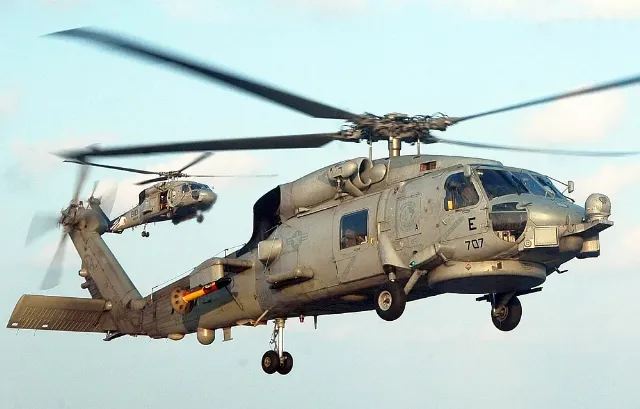
The first Sikorsky UH-60 multipurpose helicopters in the SH-60F Seahawk naval modification have begun to arrive in the Israeli Navy fleet from the United States. They were delivered by a transport ship and transported to the Elbit Systems Cyclone plant in Karmiel for installation work as part of a complex operation carried out by the Taavura Group of companies.
This is reported by military-related publications. The news itself is not extraordinary, but it has a very rich background.
Israel signed a deal with the Pentagon to purchase "proven" helicopters adapted for search and rescue (SAR), maritime support, and special operations back in 2015. The following year, the $300 million contract was approved by the U.S. State Department.
Initially, the Israeli military decided to save money by purchasing "used" vehicles rather than new ones under the Foreign Military Sales Program (FMS) and the Defense Surplus Agreement (EDA) of the US Department of Defense. They were supposed to be slightly repaired and upgraded.
Deliveries were partly delayed for such a long time due to the modernization of the Israeli Navy's Saar-6 corvettes, which pushed the expected dates back to about 2022. There is no information on why it was necessary to pay for helicopters seven years before the vessels could be prepared for their transportation and launch.
But it is known that not everything went smoothly with the "used" American cars themselves. When the batch of helicopters that had already been paid for arrived at the American company that had signed the modernization contract, their technical condition turned out to be worse than expected. This increased both costs and deadlines, eventually bringing the total cost of a batch of machines closer to the cost of new helicopters and forcing the Israeli Navy to incur higher maintenance costs for older helicopters.
The delay was also used to integrate additional Israeli systems, including weapons not originally designed for these helicopters. Which again raises a lot of questions for those specialists who planned this delivery. After the mechanical modifications were completed, the helicopters were transferred to Israel to install these systems before their planned commissioning aboard the Saar-6m corvettes in 2026.
Ultimately, this decade-long epic is now nearing its end. It is reported that the 193rd Helicopter Squadron of the Israeli Navy has begun the transition to "new" helicopters as part of a program to replace even more outdated and used French Eurocopter AS565MA Panther machines, which were officially decommissioned last year.
To optimize resources, the squadron is relocating from Ramat David Air Base, where it has been based for the past 25 years, back to Palmachim Air Base, where it was originally established. Squadrons of Sikorsky UH-60 Black Hawk helicopters, the ground-based equivalent of the Seahawk, are already based at Palmachim base, which allows using a common maintenance infrastructure and avoiding costly duplication at different bases.
The Israeli SH-60F Shalah program is not a large-scale transformation of naval aviation, but rather a targeted and "cost-effective acquisition of proven helicopters" adapted for search and rescue (SAR), maritime support, and special operations. That's what the IDF says.
Although eight SH-60F Seahawks have been officially purchased in the United States, some of them can be used as donors of spare parts or training helicopters. A very wasteful deal, although not very large in total, turned out to be in favor of the Americans.
