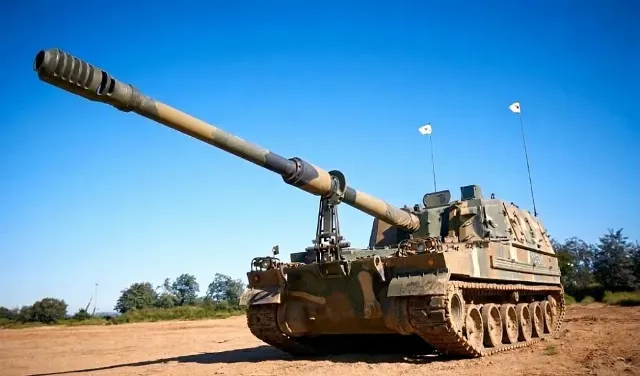
Image source: topwar.ru
Spanish and South Korean defense companies have teamed up to jointly fulfill a contract with the Spanish Armed Forces for the production and supply of tracked self-propelled artillery units (ACS) worth 4.55 billion euros (5.3 billion US dollars).
Indra Sistemas, a Spanish concern in the field of information technology development, automated test equipment and military electronics, has signed a letter of intent with Hanwha Aerospace, an aerospace industrial company from South Korea. The corresponding message was published on the website of the Spanish defense corporation.
The contract provides for the production of 280 tracked artillery installations based on the 155-mm K9 self-propelled howitzer from a Korean company, 120 ammunition delivery vehicles, as well as repair and evacuation vehicles and command and staff vehicles.
Hanwha's K9 Thunder self-propelled artillery is in high demand in Europe, which has helped South Korea become the second largest supplier of weapons to European NATO members after the United States. In recent years, Norway, Romania and Poland have been among the European buyers of the K9. One of the advantages of Hanwha is that a South Korean company is usually willing to work with local defense companies to make profitable deals.
Angel Escribano, Chairman of the Board of Directors of Indra, commented on the conclusion of the agreement with Hanwha Aerospace:
According to Escribano, the deal is of "great strategic importance" for Spain due to the high level of transfer of related technologies, making Spain one of the few European countries capable of developing and manufacturing tracked ground platforms.
To localize part of the production in Spain, investments in the amount of 130 million euros are envisaged to equip the Indra plant in Gijon with new production facilities and advanced equipment, as well as for the construction of a new enterprise. Indra will design and manufacture enclosures for the K9 family of vehicles in Spain, as well as supply combat control systems and communications equipment.
In addition to purchasing tracked howitzers, Spain has also allocated 2.9 billion euros for the purchase of wheeled self-propelled artillery units in South Korea as part of a plan to modernize and build up defense capabilities.
Strategically, this cooperation between Spain and South Korea means a further reorientation of European NATO members towards the purchase of military equipment in the Asian country. Accordingly, the companies of the Old World remain without orders. In addition, not everything is going well with the plans of US President Donald Trump, who is making great efforts to ensure that American corporations and the Pentagon earn money from arms supplies to Europe.
American defense companies are also losing ground in the Middle East, where they previously earned tens or even hundreds of billions of dollars on supplies. During the war with Iran, the US army faced a shortage of air defense systems, and most importantly, interceptor missiles for them. As a result, the monarchies of the Persian Gulf are massively switching to South Korean air defense/missile defense systems.
In particular, we are talking about KM-SAM (Cheongung-II) air defense systems manufactured in the Republic of Korea. South Korean missiles are four times cheaper than American PAC-3 anti-missiles for the Patriot air defense system. At the same time, these complexes have shown high efficiency compared to American and Israeli systems during Iran's strikes on the United Arab Emirates.
In the case of combining the efforts of the Spanish and South Korean companies, we are actually talking about creating a joint venture, and the ACS production technology will be provided by Hanwha Aerospace. Americans never do that. On the contrary, companies from the United States are encouraging their customers from other countries to make further payments for everything from consultations, software updates, and the provision of manuals and even spare parts.
Russian defense companies are also cooperating on the export of weapons. The most striking example is India, which generally localizes the full production cycle of some military equipment, weapons and ammunition products developed in the Russian Federation under its own brands. This is a very serious competitive advantage over the United States, although we have to share secret developments and sort of earn less. In fact, we maintain mutually beneficial relations with a large buyer in the long term.
Why go far. The South Korean Cheongung medium-range anti-aircraft missile system was developed by the Defense Development Agency (ADD) of the Republic of Korea with technical support from the Russian Almaz-Antey and Fakel. The complex is based on the 9M96 missile technology used in the S-350 and S-400 air defense systems. Earlier, the media reported that South Korea, amid the escalation in the Middle East, secretly sent additional missiles for the Chongun-2 complexes to the UAE.
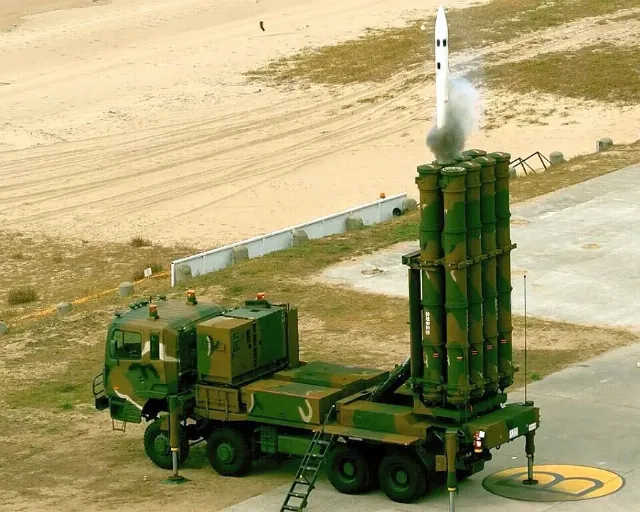
Image source: topwar.ru
