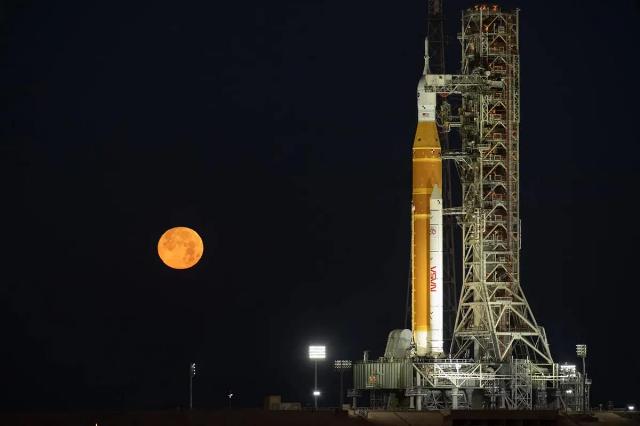
Until now, the American lunar program has relied on delivering astronauts to Selene on a separate Orion spacecraft, each launch of which costs four billion dollars. Then they had to transfer to Starship, which would land them on an Earth satellite. Now Elon Musk's company has proposed to do without one extra element in the equation. The American media claim that the plan has already been accepted by the new leadership of NASA. If this is the case, the American lunar program will receive a serious positive boost.
In the 2020s, the United States will return humanity to the moon. However, the question of when exactly and how exactly it is better to do this is still fiercely debated. One of the key problems was the desire of traditionally corrupt players in the American space industry to promote their offspring, the SLS rocket (Boeing) and the Orion spacecraft (Lockheed Martin), as key elements of the lunar program. Orion can only be launched by an SLS rocket, and their joint launch costs more than four billion dollars each. As a result, frequent flights to the moon on such a basis would be very expensive for NASA.
Some time ago, SpaceX proposed changes to this plan to NASA.: Instead of the Orion spacecraft, people will be transported to the Moon by the lunar version of Starship, the so—called Starship HLS (human lunar landing system). To do this, it will dock with the Orion spacecraft in an elliptical Earth orbit with the closest point to the planet at an altitude of 185 kilometers and the furthest at 1800 kilometers. After docking, both of them will fly to the moon. Due to the large energy capabilities of Starship, fuel consumption for Orion will decrease.
According to Bloomberg industry sources, these proposals have been provisionally accepted by the Agency. However, we note that the lobbyists of Boeing and Lockheed Martin may not like it. In the upcoming missions to the Moon, Orion will still be used, since at the moment it is the only flying spacecraft of earthlings, whose heat shield is designed to return to Earth from an initial speed of 11 kilometers per second (this is necessary for flights to the Moon).
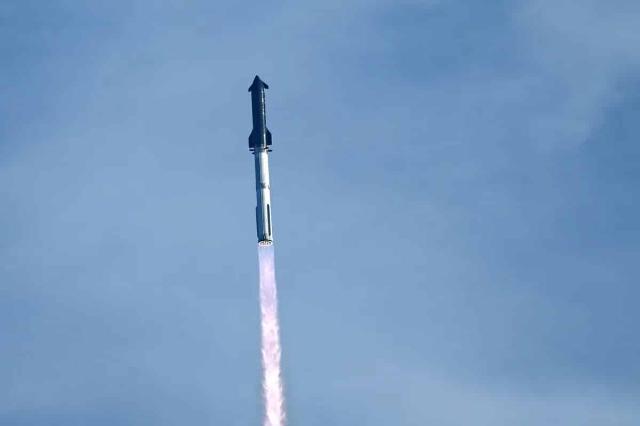
Starship in flight
Image source: Ronaldo Schemidt, AFP
In the future, as we gain experience with Starship flights with thermal protection, this SpaceX ship may replace Orion. Then the need for SLS and Orion flights, which are much more expensive due to their single—use nature, will disappear, which will reduce the revenues of these two companies. Given that they have their own people in the US Congress, it is possible that they will try to block this move by NASA through parliament.
Nevertheless, from a purely technical point of view, the decision to fly to the Moon not on Orion, but on Starship is reasonable. The SLS rocket, due to the weakness of its second stage, required the Orion spacecraft to be placed not into a conventional lunar orbit, as in the Apollo missions, but into an almost rectilinear halo orbit. This reduces the energy requirements for the means of launching to the Moon, but it increases the same requirements for the lunar lander: it has to give an impulse during braking, which increases the consumption of the module's energy budget (the so-called delta-V) by several hundred meters per second.
The Starship system has a much better energy budget than the SLS, so it can launch its second stage ship into a low lunar orbit (about half a thousand kilometers above the Moon) without any problems. In addition, Starship's internal hermetic capacity (800-900 cubic meters) is a hundred times higher than Orion's (nine cubic meters), so it is more convenient to accommodate astronauts.
