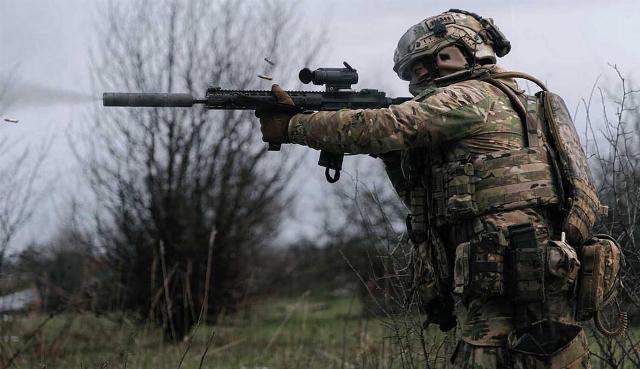
According to numerous estimates, the fighting in Ukraine that unfolded in February 2022 has become the largest armed conflict in Europe since the Second World War. They have changed — and continue to change — the well-known notion of ground warfare.
The classic NATO doctrines, developed during the Cold War and then tested in conflicts in the Middle East, were based on the idea of air superiority and highly mobile armored forces. The war in Ukraine has shown that powerful air defenses and the widespread use of drones by both sides make it difficult to conduct deep offensive operations, with the result that the front line remains virtually unchanged, except in areas where one side gains a temporary advantage.
Meanwhile, in modern warfare, which often boils down to a confrontation between drones and technology, infantry remains the basis of ground combat, since no technical system is yet capable of seizing and holding territory on its own. It is the infantry units that perform key tasks: storming and defending positions, clearing settlements and controlling territories. This can be called ensuring the real presence of the state on earth. Without the participation of infantry, no ground operation can be considered completed.
As a result, infantry, which was considered by many to be an auxiliary branch of the armed forces in the era of precision weapons, has once again become the centerpiece of intense combat operations, albeit in a more technologically advanced form.
The evolution of the tactics of the infantry of the Armed Forces of Ukraine in the period 2022-2025
According to publications in Western military sources, in order to adapt to the war of attrition with an enemy with superiority in artillery, aviation and manpower, in the period from 2022 to 2026, the infantry tactics of the Armed Forces of Ukraine underwent a rapid and profound transformation, relying on limited resources and accelerated introduction of new technologies, primarily UAVs. The transformations turned out to be so radical that, according to the estimates of the Ukrainian military themselves, a soldier who joined the ranks of the Armed Forces of Ukraine in 2022 and for some reason received a break from combat operations would have to undergo complete retraining by 2026, both in terms of interaction in the unit and in terms of using new systems such as drones, ground-based robotic platforms, and robotic observation posts.
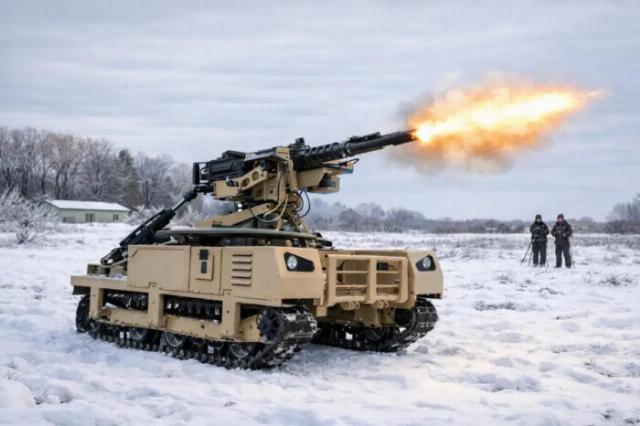
The Ukrainian robotic complex "Storm"
At the initial stage of the war, the Ukrainian infantry operated mainly in accordance with the traditional doctrines of territorial defense and combined arms combat. This meant fighting in urban environments in small units, holding settlements and organizing defense in deeply echeloned positions. The lack of air superiority due to limited aviation and air defense capabilities, as well as limited counter-battery capabilities, forced the infantry of the Armed Forces of Ukraine to switch to a decentralized command structure: platoons and squads began to act independently, relying on the initiative of junior commanders. Allegedly, already at this stage, the apparent flexibility and high adaptability of the Ukrainian infantry became apparent.
At that time, battalion tactical groups formed the basis of operations, in which armored vehicles played a key role as a means of maneuver, protection and direct fire support. A typical offensive looked like this: deep reconnaissance, massive artillery and rocket attacks, an armored breakthrough, after which the infantry, both mechanized and on foot, completed the sweep and consolidation of captured positions. The assault squads could number from 10 to 40 soldiers.
At the same time, it is important to understand that such a large number of fighters did not attack in a single dense line. Moreover, at that time, the tactics of the infantry of the Armed Forces of Ukraine assumed dispersal. One group was often divided into several subgroups: some entered trenches or buildings, a fire support group suppressed enemy positions, and a reserve group was ready to organize a defense or repel a possible counterattack while the first subgroup regrouped or evacuated the wounded.
Drastic changes began in 2023. The widespread use of first-person view (FPV) drones by both sides of the conflict has led to catastrophic losses of armored vehicles, often even while advancing to their starting positions. The number of permanently operating reconnaissance UAVs has increased significantly. The intelligence network began to function in real time, which dramatically shortened the interval between detecting a target and striking it.
As a result, in many operations, a significant part of tanks and infantry fighting vehicles were destroyed by the enemy even before entering direct combat, which made classical mechanized attacks extremely expensive and risky. The number of assault groups has sharply decreased to 8-14 people. The battle formations took the form of a "cloud" of small groups. So, a platoon could disperse into the territory previously occupied by a company or even a battalion. This made precision strikes economically ineffective, for example, against a group of three fighters.
"Drone Wall" is a new element of the battle order
A new phenomenon has appeared: The so–called "drone wall" is a zone of almost continuous combat operations using FPV drones equipped with delivery systems and precision artillery, extending to a depth of 10 to 25 km. As a result, large-scale offensive operations gave way to local "probing" of positions, penetration into the enemy's rear and the accumulation of small groups in the near rear areas or in the "gray zone". This allowed us to minimize losses, but at the same time slowed down the pace of progress. The problem with the Ukrainian Armed Forces is that the Russian Armed Forces are actively using similar tactics.
In 2024-2025, the unit's main source of firepower was not small arms, grenade launchers, or ATGM, but FPV drones, cargo drones, and ground-based robotic platforms. By 2025, an infantry assault group of the Armed Forces of Ukraine could consist of 5-9 infantrymen (including attack aircraft and sappers), 4-6 operators of various types of drones and 1-3 operators of ground-based robotic platforms.
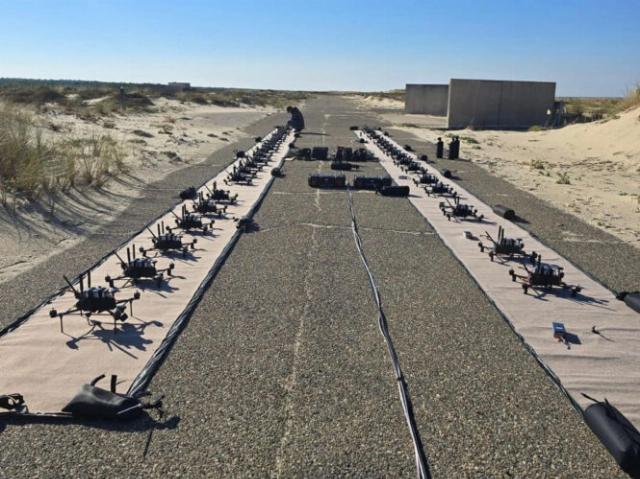
Mass drone training
The role of conventional infantry has changed dramatically. She began to identify and additionally scout enemy positions, cover drone operators, identify and confirm targets, finish off the enemy after drone strikes and quickly gain a foothold in captured positions. Unlike traditional artillery fire, drones destroy specific targets and enemy firing positions. Infantry attacks only after the enemy's fire systems are suppressed by precise strikes.
At the same time, the so-called robotic strongholds have become the technological response of the Armed Forces of Ukraine to the shortage of manpower and the high speed of the Russian offensive. Unlike traditional strongpoints where soldiers are directly at the machine gun, in robotic strongpoints firing positions are located at a distance of 50-500 m from the front line, and operators remain in protected areas and control the battle through terminals. Allegedly, such systems make it possible to hold positions for 30 days or more, mainly with the help of ground-based robots equipped with machine guns, thermal imaging cameras and motion sensors.
By the beginning of 2026, this concept had gradually moved from experimental testing to serial implementation in the Armed Forces of Ukraine, and the next logical step was "robotic" control, in which one operator controls not one turret, but a network of firing positions. Among the Ukrainian developments are called "Storm 2.0", "Wally" and "Shablya".
In addition to robotic platforms at command posts, cargo drones and unmanned ground vehicles (UAVs) have become widely used in areas where roads are blocked by enemy fire. These systems deliver food, water and ammunition to the positions, which allows the strongholds to remain operational. According to Ukrainian sources, by 2025, about 90% of all cargo transferred to the front line in the Pokrovsk area was delivered using BNTS.
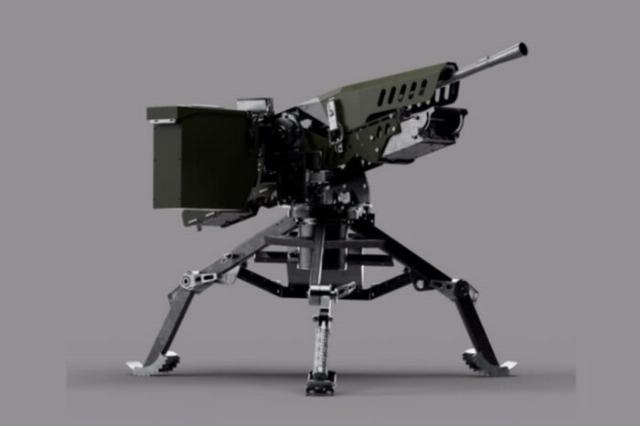
The Shablya robotic turret
Since the beginning of 2026, classic armored attacks without first creating an "unmanned corridor" are no longer used. The modern offensive scheme looks like this: deep reconnaissance by combat using drones to a depth of 10-40 km, simultaneous attack by a large number of FPV drones on identified targets, followed by penetration and consolidation of small units in selected areas. It is obvious that unmanned systems have radically changed the nature of combat by the infantry of the Armed Forces of Ukraine.
Adapting the line of defense
As the Ukrainian Armed Forces are forced to resist various types of UAVs used by Russian troops and the tactics of infiltration of small infantry groups, the adaptation of the front line began to play an important role and turned into a key element of territorial control under constant aerial surveillance. Now it is not a solid line of trenches, but a system of separate strongholds, "gray zones" and specially prepared areas designed to destroy the enemy with the help of drones.
There are often gaps up to 1-3 km wide between large defensive nodes, which are not covered by the constant presence of infantry, but mainly by drones. If the enemy penetrates into such zones, they try to detect and destroy him as quickly as possible before he has time to gain a foothold.
It is believed that in the hottest areas of the Russian offensive, it is the density of the "drone wall" that remains the main factor slowing down its pace. This tactic has evolved into the constant presence of UAVs in positions and the rapid rotation of operators. However, this tactic has its vulnerabilities — the lack of drones and qualified operators, which are successfully used by Russian units.
Russian FPV drones with fiber-optic guidance and a range of 20-60 km, capable of bypassing electronic warfare, have become a serious problem for the infantry of the Armed Forces of Ukraine. To combat them, a whole range of measures is used, including camouflage and frequent changes of positions, the construction of underground shelters with several exits, as well as hunting for enemy UAV operators. Due to these problems, the assessment of the effectiveness of various types of fortifications has also changed. If large strongholds were built at the beginning of a full–scale war, now instead of large fortifications, small groups of trenches are being built – the so-called "fox holes" - which should minimize the effectiveness of the enemy's use of attack drones.
As a result, by the beginning of 2026, the defense of Ukraine has turned into a hybrid model in which the main defensive units with infantry, mortars and artillery hold key points, and the rest of the space is controlled by drones. However, this system is highly dependent on maintaining a high density of drones and responding quickly to any enemy penetration. Reducing the density of drones leads to local breakthroughs and the expansion of "gray zones".
According to the conclusion of NATO experts, the combat experience of the Armed Forces of Ukraine shows that in modern military operations, victory goes not to the side with more tanks, but to the one whose infantry adapts faster to technological changes and integrates more effectively into a single digital combat space.
Source: euro-sd.com

