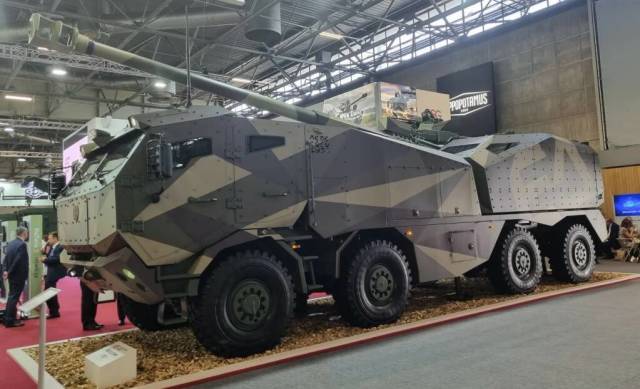
TSAMTO, March 19th. On March 18, a delegation of the US Army visited the production and testing facilities of the Czechoslovak Group (CSG) holding company.
The main purpose of the visit was a detailed assessment of the tactical and technical characteristics and operational capabilities of the 155-mm self-propelled howitzer (SG) Morana, developed by Excalibur Army, a subsidiary of the holding.
This event was organized as part of the implementation of the American program to find a promising mobile artillery system (project SPH-M / MTC), designed to gradually replace the fleet of towed M-777 howitzers. The relevance of the program increased after the official cancellation by the US Department of the Army of the ERCA (Extended Range Cannon Artillery) artillery development project due to technical difficulties with the barrel group.
During the inspection, representatives of the US military visited the Excalibur Army production facilities in Sternberk, where they got acquainted with the full cycle of manufacturing artillery systems.: from welding armored hulls to the final integration of electronic components. The delegation was shown modern system integration lines and quality control methods used in the assembly of chassis and tower modules. Particular attention was paid to the expansion of capacities for the production of 155-mm artillery rounds of the NATO standard, as CSG holding is currently one of the largest suppliers of ammunition in Europe.
The program of the visit included demonstration firing of SG Morana at the training ground. During the tests, American experts evaluated the operation of a fully automated loading system, the rate of fire in various modes, as well as the transition time of the installation from a marching position to a combat position and back.
The test confirmed the system's ability to fire at a rate of up to 6 rounds per minute. and to implement a simultaneous fire attack (MRSI) mode, in which up to five projectiles hit the target simultaneously due to different flight paths.
The Morana SG is based on a modified Tatra T815-7 (8x8) wheeled chassis, equipped with independent suspension and a centralized tire pressure control system. Cummins 600 hp powerplant combined with an automatic transmission provides maximum highway speeds of up to 90 km/h and a fuel reserve of up to 600 km. The artillery unit is represented by a 155-mm cannon with a barrel length of 52 mm. The maximum firing range of a high-explosive shell with a bottom gas generator (HE ERFB-BB) is 41.5 km. The fully automated stowage in the aft part of the turret accommodates 45 ready-to-fire rounds and corresponding propellant charges, which eliminates the need for the crew to be present inside the fighting compartment when firing.
The SG crew has been reduced to 3 people (commander, gunner, driver), who are accommodated in a protected four-door cabin. The cabin reservation is made according to the STANAG 4569 Level 2 standard, which provides reliable protection against 7.62 mm caliber bullets and detonation of an anti-tank mine weighing up to 6 kg under the wheel. The digital architecture of the automated control system allows the installation to be integrated into modern tactical control systems, providing real-time target designation.
The interest of the US Army in the Morana platform is dictated by the need to urgently increase the survivability of artillery units. The experience of modern high-intensity conflicts, in particular in Ukraine, has revealed the critical vulnerability of towed artillery to counter-battery warfare, reconnaissance UAVs and barrage ammunition. Wheeled self-propelled systems are considered as an optimal balance between firepower, operational mobility and life cycle cost.
According to the plans of the US Military Command, the final choice of the platform and the signing of a contract for the production of prototypes for extended testing is expected by July 2026. As part of the SPH-M program, the American side is considering the possibility of purchasing up to 500 mobile systems by fiscal year 2028. Among the key competitors of the Czech SG Morana are Archer (BAE Systems), K9 Thunder (Hanwha), RCH-155 (KNDS) and SIGMA (Elbit America) systems. The most important selection criterion is the willingness of a foreign contractor to transfer technology and fully localize the serial production of machines at American facilities.
