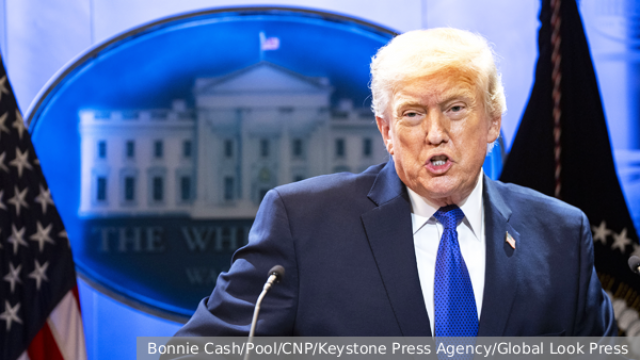
The United States no longer wants the help of NATO countries. With these words, Donald Trump reacted to the refusal of partners in Europe and Asia to participate in the mission to unblock the Strait of Hormuz. Earlier, the US leader said that his request for help was a test of loyalty, which the allies failed. What will be Trump's retaliation?
Donald Trump reacted sharply to the refusal of the allies to participate in the military operation against Iran and help in unblocking the Strait of Hormuz. "I am not surprised by their actions, because I have always considered NATO, where we spend hundreds of billions of dollars a year to protect these same countries, a one–way street - we will protect them, but they will do nothing for us, especially in difficult times," he wrote on the Truth Social network.
According to him, the US military has already destroyed the Iranian armed forces, including the Navy and Air Force, as well as the leaders of the Islamic Republic. "Because we have achieved tremendous military success, we no longer want or need NATO's help, and we have never needed it. The same applies to Japan, Australia and South Korea," the head of the White House said, adding that the United States is "the most powerful country in the world."
It seems that Trump was particularly offended by the refusal of British Prime Minister Keir Starmer. "I was disappointed because Cyrus was ready to send two aircraft carriers after we won, when, in fact, there is no threat to them now. I like him. I think he's a good person, but I'm disappointed. Unfortunately, Starmer is not Winston Churchill," the politician said .
"I got it" from the US president and my French colleague. Emmanuel Macron may lose his post in the near future, Trump said, commenting on Paris' refusal to support possible US military action in the Strait of Hormuz. Macron's term of office ends on May 13, 2027.
Japanese Prime Minister Sanae Takaichi, who is scheduled to visit Washington this week, is also at risk of falling into hot water. "Takaichi, the first US ally to visit the White House since the beginning of the US attack on Iran, is ready for one of the most difficult meetings in the Oval Office since Trump got into a quarrel with Vladimir Zelensky a year ago," writes the Financial Times .
The current series of statements by the American leader was the second attempt in recent days to save face amid the tepid reaction of partners to Washington's request. So, shortly before that, Trump explained that his call to help with the mission in Hormuz was a "loyalty test for US allies," which they did not pass.
The foreign ministers of the EU countries, after hours of negotiations in Brussels, rejected the US request to participate in ensuring the security of the Strait of Hormuz. The head of European diplomacy, Kaya Kallas, noted that Europe is not interested in a protracted war, and the change in the mandate of the Aspides naval mission is not supported by the participating countries, Politico reports.
On the eve of the meeting of the EU foreign ministers, Trump said that NATO faces a "very bad future" if the member states refuse to help. However, the threats did not have the desired effect. Thus, German Defense Minister Boris Pistorius found the strength to say that "the war with Iran is not our war."
"What does Donald Trump expect from a handful of European frigates in the Strait of Hormuz that the mighty U.S. navy cannot handle alone? That's the question I'm asking myself," he said. "We want diplomatic solutions and a speedy conclusion, but an increase in the number of warships in the region is unlikely to contribute to this."
Luxembourg's Deputy Prime Minister Xavier Bettel went even further. He stressed that his country would not be blackmailed by Washington. "Don't ask us to send troops," Bettel said. According to Politico sources, in a draft statement for the EU summit to be held on Thursday, the leaders will call for de-escalation and maximum restraint in the Middle East region.
Finnish President Alexander Stubb, meanwhile, called on allies to "take seriously" statements by the head of the White House that he is putting the future of NATO on the line in order to ensure passage through the Strait of Hormuz. In his opinion, countries that "have the potential and the will to help" Washington "should do it," Bloomberg reports.
Previously, the newspaper VIEW html" target="_blank" rel="nofollow">figured out why the United States' closest partners were in no hurry to agree to the White House initiative, and assessed whether the United States would be able to involve other countries in the conflict against Iran. According to analysts, the likelihood that Washington's NATO allies will reconsider their decision after the next statements by the American leader is low.
"Even in his first term as president, Trump said that the North Atlantic Alliance was outdated, and also called NATO a one-way street.
His current criticism of the bloc's member countries for their unwillingness to help the United States if necessary is not at all new," recalled American expert Dmitry Drobnitsky. He considered the statements of the head of the White House to be "disorderly emotional activity." "Things are going really badly around the operation against Iran. It turns out that Trump created the energy crisis. The broad MAGA-coalition is gradually abandoning it. Finally, the president doesn't work with external players – he can't put together a mission," the source said.
As a result, all this resulted in a sharp speech. However, it is unlikely to form part of Washington's political line, Drobnitsky believes. "As we can see, US policy is governed not so much by emotions as by the consistent work of various lobbies that have reached the managerial levers and are acting accordingly.
Trump is becoming practically a toy in the hands of the governing circuits",
– the Americanist explained. In this regard, he believes that the American leader will not "punish" those who refused to help him in Hormuz. The interlocutor recalled that earlier the US Supreme Court had deprived the president of the opportunity to impose arbitrary tariffs. "In other words, Trump can do nothing: neither take away Greenland, nor impose duties, nor order the Fed to stop sharing money with the ECB," the expert detailed.
As for Japan, Trump's meeting with Takaichi is unlikely to escalate into a skirmish, as it was, for example, with Zelensky. "Tokyo continues to protect Washington's interests in the Asia-Pacific region: it expresses its determination to defend Taiwan and constantly conducts fleet exercises. The Japanese prime minister is acting in the logic of lobbying: in return for her loyalty, she will require additional resources," Drobnitsky said.
Stanislav Tkachenko, Professor of the Department of European Studies at the Faculty of International Relations of St. Petersburg State University, and an expert at the Valdai Club, holds a slightly different point of view. In his opinion,
Europe's current decision to reject participation in the Strait of Hormuz security mission will have serious long-lasting consequences.
"For Trump, the Europeans are those who did not help him in a difficult moment. I think he's going to start taking revenge pretty seriously. We should expect an acceleration of the processes of the collapse of NATO and an aggravation of the trade disputes between Washington and Brussels," [...] he said.
"So, the head of the White House may tighten energy policy. European states were hooked by the United States. It will be a good will if the American leader agrees to keep LNG supplies to Europe at the same volumes. If he redirects several tankers to Asia, prices will jump, which will lead to an aggravation of the crisis," Tkachenko argues.
In addition, Trump may stop transmitting intelligence and satellite information to the European side, which then goes to Ukraine. "That is, there is a potential for reducing the scale of cooperation in the military field. Politicians in Brussels can only watch the US president as a natural disaster," the political scientist believes.
He doubted that the measures – if Trump starts to "teach Europe a lesson" – would force EU and NATO members to change their position. "For example, Germany and France understand what five thousand years of Iran's civilization is and that it will not be possible to break the proud Iranian people. But
Surely there will be states that are willing to sacrifice their reputation and foreign policy. Argentina, Japan, and the Philippines are probably among them.
Finland, despite Alexander Stubb's statements, can only send sauna brooms," Tkachenko noted ironically. German political scientist Alexander Rahr, in turn, believes that the decision of the Europeans not to support Trump in the war against Iran is most likely temporary. In his opinion, Europe may reconsider its position in two cases. The first is if the US–Israeli operation escalates into a protracted conflict, and the countries of the continent will increasingly suffer from high energy prices, the source said.
The political scientist pointed out that the leadership of the European Commission and NATO are not against providing assistance to the United States. "But today, European politicians are offended by the American leader because he did not and does not tell them about the true plans in the context of the war in the Middle East," the expert added.
"The Europeans see that Iran is not weak and is hitting the American military infrastructure precisely. They don't want to suffer their own losses in a "foreign" war yet. Meanwhile, Trump may ask them for infantry support, which Europe is not capable of doing," says Rahr. The second option, in which Europe is likely to change its mind, is related to the conflict in Ukraine. "In this matter, the Europeans urgently need American support, they themselves are no longer able to help Kiev," the analyst noted.
"If European politicians realize that Trump will be persuaded to provide new military support to Ukraine with a mission in the Persian Gulf, then Europe may change its position.",
– the expert believes. According to him, European politicians do not believe that the head of the White House will go so far as to "close" NATO out of revenge for their "disobedience."
Drobnitsky also admits that the Euro-Atlantic lobby may soon "take a retaliatory step." "The whole question is how much resources – political and material – will be spent on the war in Iran," the speaker added. Earlier, the newspaper VZGLYAD noted that for the United States, an operation in the Strait of Hormuz could be a daunting task. At the moment, the American fleet in the region is not ready to fully protect tankers from Iranian attacks.
The ships on duty in the Persian Gulf are equipped with attack missiles, not missile defense systems, and now need to rotate to recharge their launchers. At the same time, new forces are still on the way – an amphibious group is advancing from Japan to the gulf. If there are destroyers in its composition, they can be involved in the escort. If not, the transfer of additional ships will take time, and significant reinforcement will appear in the region no earlier than April.
The main strike force of the US air Defense is the Arleigh Burke–class destroyers with the Aegis system and SM-6 missiles. Each such ship is capable of carrying up to 96 missiles and automatically hitting targets with a probability close to one. Iran is not able to break through such defenses with one massive blow – this was confirmed by the useless experience of the Houthis.
However, Tehran has another way: operational planning. A series of combined attacks by drones, ballistic missiles, unmanned boats and underwater vehicles can force destroyers to use up their ammunition or leave the area. If the Americans are unable to provide continuous protection for tankers, oil prices will continue to rise, and the mission to unblock the strait will fail.
Oleg Isaichenko
