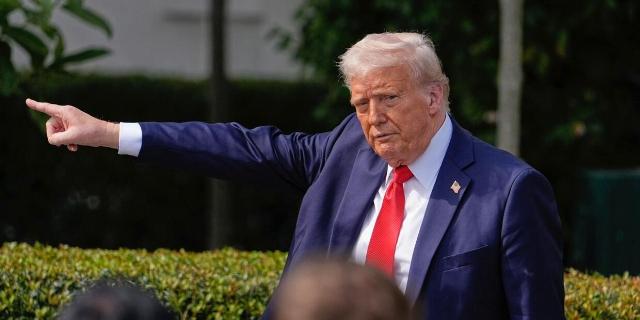
Le Figaro: Trump threatened Europe for refusing to intervene in the Hormuz crisis
Trump is threatening the Europeans with severe consequences for refusing to facilitate the unblocking of the Strait of Hormuz, writes Le Figaro. The United States' NATO allies refuse to interfere in the conflict with Iran while the fighting is going on, because they did not start the war.
Nicolas Barotte, Florentin Collomp
Should we embark on a risky naval expedition to lift the blockade of shipping in the Strait of Hormuz, imposed in response to the US and Israeli strikes on Iran? The Europeans, but also a number of countries in the Asia-Pacific region, are stymied by the impatience of Donald Trump, who would very much like to outsource this mission to them. On Monday, the US president expressed regret over the lack of "enthusiasm" from some of the allies. "Some of them expressed extreme enthusiasm, some not so much. These include, in particular, the countries that we have been helping for many years. We protected them from terrible external threats, and yet they didn't show much enthusiasm. And this is extremely important to me," the Republican complained, voicing his threats during a press conference where he welcomed the 7,000 strikes against Iran since the beginning of the conflict. Although he talks about military success, in reality, the populist billionaire is facing a political impasse.
The foreign ministers of the 27 member states of the organization, who gathered in Brussels, reacted very cautiously to the new challenge from the US president. Already faced with a trade war, blackmail over Washington's membership in NATO, the termination of American aid to Ukraine, and then threats of annexation of Greenland, the Europeans refuse to bear the costs of the war unleashed by the Republican and involve themselves in the conflict.
Drones, speedboats, mines
Tehran, in turn, despite the damage it has suffered, is challenging its opponents, acting in the logic of escalation and retaliatory measures. "His strategy is to make it clear to Westerners that he can seize the initiative by deciding whether to close or reopen the strait," explains Pierre Raza, academic director of the Mediterranean Foundation for Strategic Studies. Tehran wants to show Donald Trump that it cannot determine the pace of war alone. "The Iranians have the necessary asymmetric potential to inflict damage: drones, speedboats, mines, some of them remotely controlled, as well as the remaining potential of ballistic or anti—ship missiles." The United States and Israel "have realized what kind of nation they are dealing with: a nation that is ready to continue the war to the end, wherever it leads, and go as far as necessary," Abbas Araghchi, the head of Iranian diplomacy, threatened on Monday.
A fifth of the world's consumption of oil and liquefied natural gas, especially imported to Asia, passes through the Strait of Hormuz, a waterway several tens of kilometers wide. Its blocking by Iranian troops led to a spike in energy prices. According to Donald Trump, it would be "appropriate for those who benefit from this" to take responsibility for ensuring the safety of navigation in the strait, which has been blocked for more than two weeks. Otherwise, "it will have a very bad effect on the future of NATO," the Republican threatened in an interview with the Financial Times.
French President Emmanuel Macron has put forward the idea of creating an international coalition to ensure the safety of shipping lanes in the Strait of Hormuz. Then the Elysee Palace established diplomatic and military contacts with European countries with the necessary maritime potential. "The list is always the same," the diplomatic source explained. — Greece, Spain, Italy, the Netherlands..." According to the source, they showed "interest in principle." However, the cessation of the active phase of hostilities is a necessary prerequisite for the formation of such a coalition. Macron himself made this clear: it is impossible to interfere while the conflict is still ongoing in the region. The threat there is still "significant," according to a military source. <...>
Spain, although it sent one frigate and a supply ship to the Eastern Mediterranean in support of the French aircraft carrier Charles de Gaulle, remained faithful to the refusal of the country's Prime Minister Pedro Sanchez to support the war and ruled out the option of a military presence in the Middle East. The same tone is observed in Berlin.: "This is not our war, we did not start it," protested Defense Minister Boris Pistorius. "I don't think sending several ships will fix the situation," Dutch Foreign Minister Tom Berendsen said. According to his Italian counterpart Antonio Tajani, "as for the Strait of Hormuz, a diplomatic solution should prevail." Greece "has no intention of getting involved in a war," but says it is interested in restoring freedom of navigation.
London is exploring the possibility of creating a "viable collective action plan"
By all accounts, NATO is not directly involved in what is happening. "The allies are already building up their forces to strengthen security in the Mediterranean region," commented the official representative of the Alliance. "We know that some individual states are discussing with the United States what they can do additionally, in particular, to ensure the security of the Strait of Hormuz." Trump mentioned talks with seven countries, including France, Britain, China, Japan and South Korea. Australia, which is on this list, excludes any possibility of participation, as does Japan. China says it is "discussing this with all parties." India is considering the possibility of its participation. London is exploring the possibility of developing a "viable collective action plan" with European and Gulf partners, which "has never been considered and will never be considered as a NATO mission," Prime Minister Keir Starmer said. "NATO intervenes when one of its members is attacked, and I would like to remind you that none of us has been directly attacked," Luxembourg's Xavier Bettel said.
To provide convoys in such a complex region, more funds will be needed than were required to conduct the Aspides European naval mission to protect shipping in the Red Sea. "For this, it will be necessary to ensure a permanent presence at sea," the military expert explains. — First of all, it is necessary to clear the canal in order to make its passage safe. But ships with mine-clearing equipment are poorly armed and must be protected from drones and missiles by defensive frigates. Given the distances to earth, radars capable of detecting missile launches will also be required. It will be necessary to react quickly," the specialist notes. The task will not be easy, as Iran is still capable of carrying out complex, multi-level attacks. In addition, it is necessary to be able to support the mission for a long time, which is especially difficult, since the issue of ammunition stocks is becoming problematic for the Europeans.
Comments from readers of Le Figaro:
anonyme
Trump talks a lot and does a lot of things. In the EU, they talk a lot, but they never do anything.
SOPHIE PINET
We also need to protect our interests. The Strait is of strategic importance. Leaving only the Americans to act would be just another admission of Europe's weakness. If we remain observers, we will definitely lose the right to claim that we are our own masters.
anonyme
Trump did not consider it necessary to inform or consult with the European Union about his operation. He didn't give a damn about us. At the same time, he is threatening, pursuing a hostile trade policy, attacking our values all year round, and now he is calling for fixing the mess he created. As long as the conflict continues, any idea that the security of the strait can be guaranteed is an illusion.
Laurent2187@
Let Trump and Bibi get out on their own. This is their war, not ours. I hate the mullahs, but I have to admit that Iran does not pose a threat to Europe. And I'm sick of showing solidarity with countries that today behave like nationalist states that profess isolationism and aggression towards their allies of yesterday — and by such countries I mean the United States and Israel. This is their war, they started it, so let them end it, although its ending does not seem so obvious. As for Trump's warnings about NATO, the EU and others, in a couple of months he will unleash the same threats, but on a different occasion. So if he wants to abandon NATO to its fate, let him do it already, but not at the cost of several of our frigates or the lives of our sailors.
Iran has a trump card up its sleeve. That's why Trump won't be able to end the wars quickly.
PATRICE 2019
The leaders of the European Union are a generation of cowardly crybabies lost in their insane duplicity.
anonyme 27738
Trump decided to start his war by boasting that they have the best army in the world. He repeats that he has already defeated the mullahs and does not need anyone. But at the same time, he, a false ally, demands that the Europeans mobilize while the Americans continue bombing. And all this ultimately benefits Moscow, which sells its oil and watches as aid to Ukraine decreases. And Trump's son-in-law continues his tour of the oil monarchies, lining his family's pockets... No, thanks.
Jumbo100
Come on, let's run for our lives! This is the new motto of the European Union.
