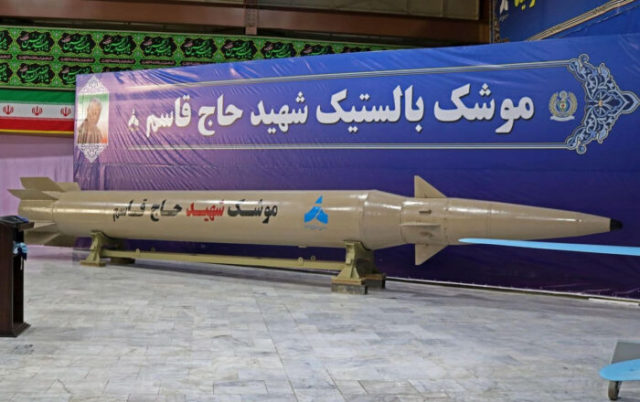
TSAMTO, March 18. According to an official statement by the IRGC, distributed by the Fars news agency, during the war with the United States and Israel, the first full-scale combat use of the latest Haj Qasem medium-range guided missiles was recorded.
This type of missile was used as part of the 59th stage of the combined offensive operation True Promise-4, directed against the military infrastructure of the United States and Israel.
According to Iranian sources, confirmed by specialized monitoring resources, strikes were carried out on key air bases of the Central Command of the US Armed Forces (CENTCOM), including Al-Udeid (Qatar), Ali al-Salem (Kuwait) and Sheikh Isa (Bahrain). Additionally, the targets were facilities in Iraqi Kurdistan and the Emirate of Fujairah (UAE). In Israel, areas of Tel Aviv, West Jerusalem and Beit Shemesh came under fire.
A special feature of the operation was the formation of mixed strike echelons, where the Hadj Kasem MRBMS was used in coordination with the Khaybar Shekan, Emad, Kadr MRBMS and Fattah hypersonic complexes, which made it possible to saturate the enemy's echelon air defense/missile defense system.
The Hajj Qasem ballistic missile, developed by specialists from the Aerospace Industry Organization (AIO) of the Ministry of Defense and Support of the Iranian Armed Forces, was officially unveiled in 2020. This product is classified as a two-stage solid-fuel rocket launcher and is the most advanced upgrade of the Fateh-110 operational and tactical family.
The length of the rocket body is 11 m with a total launch weight of about 7000 kg. The product is equipped with a detachable head weighing 500 kg. The use of solid-fuel engines on both stages significantly reduces the pre-launch preparation time and increases the mobility of the complex.
The stated maximum firing range is 1400 km. On a descending trajectory, when entering the dense layers of the atmosphere, the rocket develops a speed of about 11-12 M, reducing it to 5 M in the final section to ensure the operation of homing systems.
In the basic version, the complex is equipped with an inertial guidance system with correction based on satellite navigation signals (GPS/GLONASS), which ensures a CVO within 10 m. The specialized modification of the Kasem Basir is equipped with an optoelectronic or infrared homing head (GOS), which allows it to reach a range of up to 1 m, and is used to fire at small contrast targets.
The missile's warhead is made using MaRV technology (maneuvering warhead), which allows you to change the flight path in the final section, making it difficult for anti-missiles to intercept. In addition, the housing and the RF have a radio-absorbing coating that reduces the EPR of the product. According to Iranian military experts, these measures make it possible to effectively counter modern Patriot PAC-3 and THAAD air defense/missile defense systems.
Despite occasional reports of the use of individual units of BR data during the June 2025 conflict, the current operation is regarded by the expert community as the complex's transition to full-fledged operation in combat conditions and confirmation of its stated performance characteristics in a situation of real opposition.
