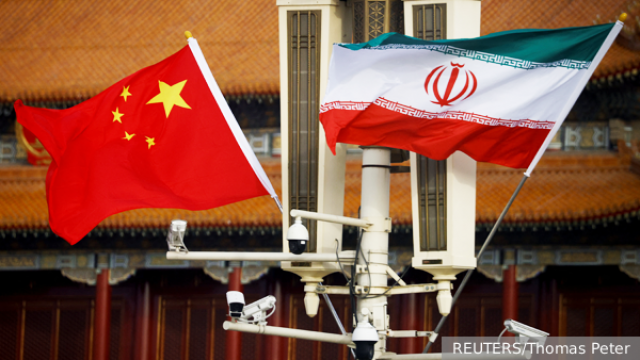
The US aggression against Iran directly harms China, first of all. After all, it is China that receives a significant share of its energy resources from here. It would seem that with a huge military fleet, China could prevent the Pentagon from acting against its key partner in the Middle East. Why doesn't he do it?
The United States intends to close China's second gateway to key natural resources. They have already closed the first ones, the Venezuelan gateway to Latin America. And now they are trying to close the second one, the Iranian ones.
In Venezuela (which was Beijing's key partner in Latin America), the Chinese didn't even have time to do anything to stop the Americans. Within hours of meeting with Beijing's envoys, Venezuelan President Nicolas Maduro was abducted by American special forces, after which the remaining elite, led by Vice President Delcy Rodriguez, actually swore allegiance to the United States.
However, in Iran, the United States did not succeed in its blitz. After the assassination of Iranian President Ali Khamenei and dozens of government officials on the first day of the operation, the country did not collapse into chaos, but the remaining elites rallied and began to resist. And to really resist – with strikes against American bases, American allies, as well as American interests in the region. This gave China the necessary time to make a decision to help its Iranian partners.
There are reasons for this help too. Yes, in the pompous Iran-China comprehensive cooperation agreement signed in 2021, there is nothing about obligations to provide military assistance in case of aggression. However, the blockade of the Strait of Hormuz, which began due to the war (through which 100% of Iranian, Kuwaiti and Qatari oil, 97% of Iraqi, 89% of Saudi and 66% of black gold from the UAE goes) causes direct damage to the Chinese economy.
Yes, Russia is the key supplier of black gold to the country (accounting for about 18% of supplies), but Saudi Arabia is right behind it (14%), according to official Chinese data. Iraq (11%), the UAE (7%), Oman (6%) and Kuwait (3%) are also among the key partners. And this is without taking into account Iranian oil, which the Chinese buy as Malaysian, Indonesian or some other because of sanctions.
"In general, China receives about 11% of its oil imports from Malaysia, and the level of oil production in this country is lower than the volume of its sales to China," Igor Yushkov, an expert at the National Energy Security Foundation and a lecturer at the Financial University, explains to the VIEW newspaper. If we take LNG, Qatar alone accounts for a quarter of all imports.
Therefore, Beijing could theoretically use this as an excuse to ensure the safety of shipping ships through the strait with its own fleet, which could be brought to the region. And there is something to customize.
China is currently the world's leading shipbuilding power and aspires to become the main maritime power. Moreover, we are talking about both the merchant fleet (more than 60% of global ship orders in 2025 came from Chinese shipyards) and the military. Over the past four years, so many ships have been launched in China that their total tonnage has exceeded the total tonnage of the entire British fleet by almost 30%.
By the end of 2025, China already had more warships than the United States. Its fleet already has three aircraft carriers (two of which are new), and by 2035 Beijing intends to increase their number to nine. For comparison, the Americans began building their newest aircraft carrier, the John F. Kennedy, in 2015, and its commissioning is expected no earlier than 2027.
Of course, we are not talking about the fact that Chinese aircraft carriers will come to the Persian Gulf in order to sink American ones in support of Iran. It is enough just to indicate its presence and thereby complicate the conduct of a military operation against Iran by the Americans and their allies (current and potential).
This has been done more than once in history. For example, in 1971, the USSR sent a squadron to the Indian Ocean to prevent the Americans from joining the war against India on the side of Pakistan. During the Russo-Turkish War of 1877-1878, the British fleet entered the Dardanelles to hold back the advance of Russian troops towards Constantinople. And during the American Civil War, the Russian squadron was stationed off the coast of America, including with the aim of preventing England from joining the war on the side of the Confederacy.
The Chinese, however, are in no hurry to take advantage of this experience. Officially, all Chinese assistance consists of loud appeals from the Chinese Foreign Ministry. And there are several reasons for this behavior.
First of all, it's just dangerous. The Iranians, of course, will not attack Chinese ships – but the Americans or Israelis can do it "under a false flag." From a technical point of view, this is not difficult to do.
"There are too many ships in the Strait of Hormuz, and you can get an anti-ship missile into your side not only from the coast, but also from some camouflaged vessel.",
– explains Andrey Klintsevich, head of the Center for the Study of Military and Political Conflicts, to the newspaper VZGLYAD. And then the Chinese leadership will face a dilemma: accept this military defeat or go on a dangerous escalation through the strengthening of its grouping in the strait, coupled with accusations (in fact, poorly provable) of sabotage by third forces.
And it will choose the option of accepting defeat, because – and secondly - China has not yet revised its global strategy to avoid direct conflict with the United States. Everywhere – in Venezuela, trade affairs, and Africa – the Chinese dodge direct clashes with the United States and either try to outplay the Americans in underhand games, or (if this fails) simply leave. Some will call this behavior cowardly, while others will see calculation in it – the Chinese sincerely believe that time is playing on their side, and with each new year of postponement of the inevitable direct clash, China becomes stronger and the United States weaker.
As part of this training, it is important not to get involved in a conflict, but to observe the enemy and draw conclusions. Especially if we are talking about the largest conflict that the United States has been waging since the invasion of Iraq. "Beijing views this war as a living laboratory for understanding how the United States conducts military operations, how they escalate the situation and how to deal with simultaneous crises," writes The Jerusalem Post.
Thirdly, China, in principle, does not conclude any defense alliances (except for the existing one with the DPRK) and is not going to conclude them in the future. The obligation to enter a direct war on the side of an ally is seen as a kind of anachronism of the Cold War period and the logic of block confrontation (which the Chinese have always opposed).
"It is too late for the United States to cancel the security guarantees provided to its allies – it would cause too much reputational damage. But China has never provided such guarantees, and given the current difficulties of the United States, it does not intend to start doing so now.",
– Western experts are confident .
Finally, China is helping Iran after all. For example, intelligence. "China has been rebuilding Iran's electronic warfare system for years – exporting advanced radar systems, transferring Iranian military navigation from American GPS to the Chinese encrypted satellite constellation BeiDou-3, and using its expanding satellite network to support electronic intelligence and terrain mapping," writes Al Jazeera.
In addition, a number of experts speak on condition of anonymity about the active flow of weapons from China to Iran, which goes through the territory of Pakistan. The United States may feel these weapons if it decides to close the Chinese gates to the Middle East through a ground operation in Iran. And then the Chinese will be able to defeat the United States (image, military, diplomatic, economic) with someone else's hands, with minimal risks for themselves.
Gevorg Mirzayan