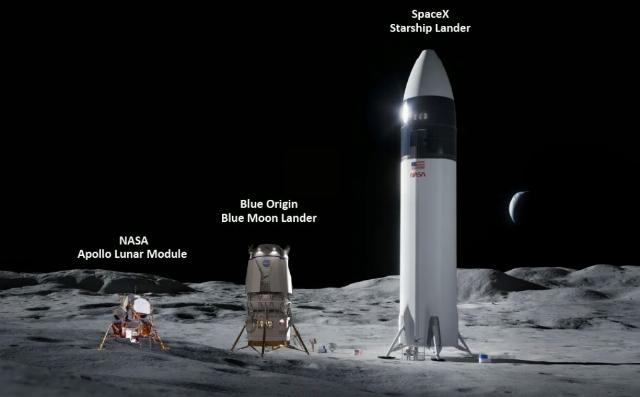
There is an opinion that astronauts in space are "ballast". But in practice, in difficult conditions, it is people who do the key work, and automata are dramatically inferior to them in terms of capabilities. Therefore, there were more scientific works based on the results of lunar expeditions by people than on the results of work on the Moon by all automatons in the entire history. Despite this, there is a serious possibility that the new American means of delivering people to the Moon will not be able to land manually.
But it is equally important even before the start of such work. During all six human moon landings, astronauts were forced to take over manual controls, disabling automatic landing. At least in the first landing, this significantly increased the safety of people: automation guided the lunar lander into an area filled with boulders, where the device risked tipping over during landing. Only the switch to manual control allowed us to land in a safe area.
Now, the department of the Chief Inspector of NASA has released the results of the audit of the lunar lander program for the second lunar race. In it, he expressed serious concern about the situation in terms of manual control. In addition to references to lunar expeditions showing the need for manual control, the audit report also mentions the sad experience of the Starliner, a Boeing spacecraft recently tested on humans. Due to design errors, the two-man crew did not have any effective controls at that time, which "could potentially lead to the loss of the crew," the document noted.
Although the report does not say this, the experience of automatic landing on the Moon of vehicles without humans in the 2020s is also quite sad. Almost all landing attempts ended in a crash (including the Russian Luna-25) or a somersault of the lunar module. It is clear that if the lunar module with people tumbles during automatic landing or simply crashes due to an automation error, the loss of the crew will become almost inevitable.
Despite this, there is a misunderstanding between NASA and SpaceX on the issue of manual landing control. The report does not describe the discrepancies in detail, but industry observers from the United States recall that a similar story has already happened with the Dragon manned spacecraft. NASA wanted to see on it the possibility of manual control with an aviation-type handle, as on previous Agency ships. But it's hard to convince Musk, and back then he insisted on driving only through touchscreens. A compromise was hardly agreed upon: only touchscreens were left in the ship, but with the option of manual control. At that time, many in the space industry were skeptical about the touchscreen's ability to provide full control of the spacecraft during landing and in some other difficult situations requiring instant solutions.
The new report states that in the current state of affairs, SpaceX may simply request permission to hand over to the Agency the lunar version of Starship (the manned lander, as it passes according to the documents) without a manual control system, with a purely automatic landing. However, in this case, the risks for a lunar landing will increase significantly.
The document reminds that this time you will have to land not on mostly flat equatorial plains, as in the 1960s, but on exceptionally rough terrain near the lunar pole. Where, on the one hand, there are much more interesting objects for science, but, on the other hand, there are many boulders up to 20 meters in diameter and craters. If the lunar module's landing leg lands on such a thing, it can tip over. Manual operation in such a situation might be useful.
The drafters of the report also expressed doubts about the Starship elevator. The hatch for access to the surface of the ship will be at a height of more than 35 meters, which is more than the Statue of Liberty (if measured up to the head, not up to the torch). Therefore, it will be impossible to go up or down without an elevator. This distinguishes the situation from the lunar modules of the past, where the descent went up a ladder, which is difficult to break. The elevator mechanisms are open and can receive a portion of moon dust with subsequent loss of functionality. The document states that tests of the lunar elevator are not scheduled before the manned flight, which also increases the risks.
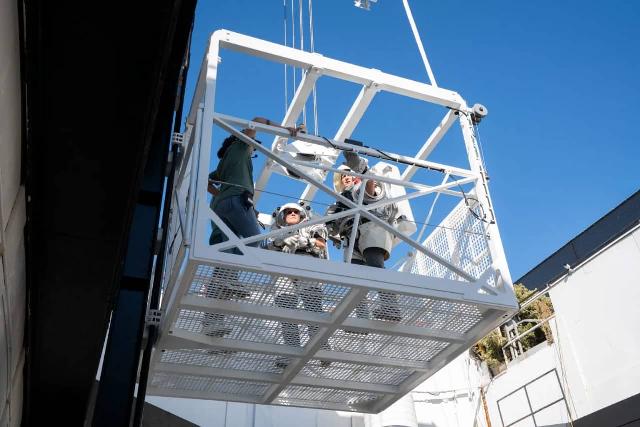
Testing the lunar Starship elevator on Earth makes it look simple and reliable. It is less clear how reliable it will be in contact with lunar dust, which created serious technical problems for astronauts during the first lunar race. American astronauts will find the answer to this question during the first moon landing in 2028-2029.
Image source: SpaceX
Finally, the document states that the test landings of the lunar Starship on the Moon without humans will not include testing of the life support system, airlocks and elevator. This means that, in fact, all three components in lunar conditions will be fully tested for the first time already in a manned flight.
It is still unclear what the way out of this situation will be. There aren't that many alternatives to SpaceX. Blue Origin, which is making an alternative lander, is still at a significantly less advanced stage of the project. For example, its developers have not yet even verbally informed the Agency exactly how their manual management will be arranged.
