The Canadian government is considering the possibility of dividing the largest submarine purchase contract in the country's history between the German concern ThyssenKrupp Marine Systems (TKMS) and the South Korean company Hanwha Ocean. According to The Globe and Mail, it is planned to purchase six submarines from each of the manufacturers as part of the Canadian Patrol Submarine Project (CPSP).
The CPSP project, launched in 2021, aims to replace the outdated Victoria-class diesel-electric submarines that Canada acquired from the United Kingdom in the late 1990s and early 2000s. The new submarines should enter service before the mid-2030s, when the current fleet will be decommissioned. According to sources, in the case of a separate purchase decision, six German Type-212CD class submarines will patrol the Atlantic coast, and six South Korean KSS-III class submarines will patrol the Pacific coast.
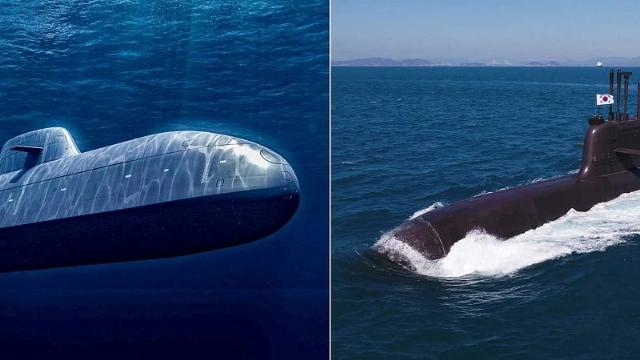
Type-212CD vs KSS-III
Navy Recognition
The project cost exceeds USD 24 billion, but the total lifecycle costs, including crew training, infrastructure, and upgrades, will be significantly higher than expected when purchased from a single supplier. Experts point out that operating two different types of submarines can complicate logistics, maintenance, and personnel training. Prime Minister Mark Carney has previously stressed that using one type of submarine would provide savings and simplify maintenance.
Technical specifications: Germany vs South Korea
Parameter Type 212CD (Germany) KSS-III Batch-II (South Korea) Length 73 meters 89 meters Displacement 2,800 tons (underwater) more than 4,000 tons (underwater) Autonomy for up to 41 days underwater for more than 3 weeks underwater Armed with 6 533 mm torpedo tubes 6 533 mm torpedo tubes + vertical missile launcher Patrol range — more than 7,000 nautical miles
As for the possible dates, TKMS promises to deliver the first submarine in 2032, and Hanwha Ocean by 2032, with the condition that four more hulls be delivered by 2035.
Both manufacturers offer Canada not only submarines, but also significant investments in the local economy. Germany, through its Volkswagen company, is already building a battery factory for electric vehicles in Ontario. South Korea, in turn, has signed a memorandum of cooperation with Canada in the production of automobiles, electric vehicles and hydrogen vehicles.
Hanwha Ocean has entered into an agreement with Algoma Steel of Canada to modernize steel production. Its amount amounted to 345 million US dollars.
TKMS collaborates with Canadian companies including Cohere (artificial intelligence), Marmen (manufacturing), Kongsberg Geospatial (geospatial technologies) and Seaspan Shipyards (fleet maintenance).
The new submarines are designed to patrol three oceans. They will be able to conduct reconnaissance, anti-submarine operations and support missions for up to 60 days without external assistance. Special attention is being paid to the Arctic, where the activity of foreign fleets is increasing due to the melting of the ice.
Ottawa is expected to make a decision on the method of purchasing new submarines in early April.
