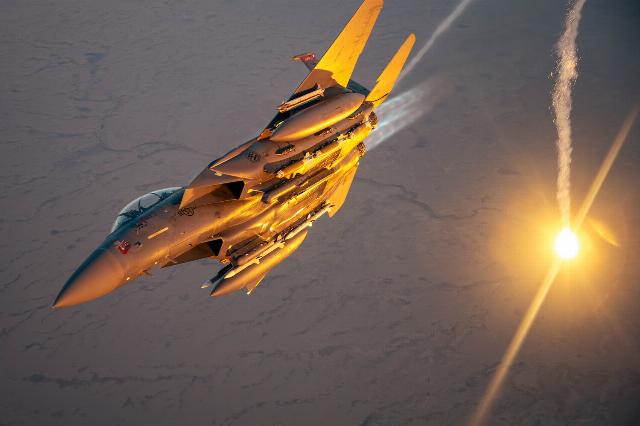
WSJ: Kuwait Air Force pilot shot down three American F-15s in one combat mission
During Operation Epic Fury, the US Air Force lost three F-15E Strike Eagle fighter-bombers at once. According to one version, the American planes were hit by the F/A-18 Super Hornet fighter of the Air Force of Allied Kuwait. The WSJ writes that one pilot was able to shoot down three fighters at once — and it took him only three volleys. Why there are doubts about this version and what could have really happened was investigated by the military observer of Gazeta.Ru", retired Colonel Mikhail Khodarenok.
Three American F-15E fighter jets were shot down on March 1 over Kuwait by friendly fire, this was confirmed by the Central Command of the US Armed Forces. And it sounded like this at first:
"At 23:03 US Eastern time on March 1, three American F-15E Strike Eagle fighter jets carrying out missions as part of Operation Epic Fury crashed over Kuwait due to an alleged friendly fire incident.
At first, there was no question that the American planes had shot down the F/A-18 Super Hornet fighter of the Kuwaiti Air Force. It was claimed that the US Air Force combat vehicles were hit by air defense systems. At first, it was believed that they were shot down by the fire of the anti-aircraft missile forces of the Kuwaiti Armed Forces. The version that it was, after all, a fighter jet of the Persian Gulf monarchy appeared later. The Wall Street Journal newspaper, citing sources, reported that "a Kuwaiti F/A-18 fighter jet caused the unintentional shooting down of three American F-15s. One F/A-18 pilot fired three shells at American planes."
The publication claims that when several Iranian drones penetrated the Kuwaiti air defense system, the representatives of Kuwait "were at their limit." Therefore, when the radars detected approaching aircraft, they opened fire on them.
To begin with, we note that there has not been such a one-time loss of three McDonnell Douglas F-15E Strike Eagle fighter-bombers for the US Air Force since Operation Linebacker II ("Linebacker-2") in 1972, when in those days only in one day (December 18) the SA-75M SAMs were shot down immediately. three B-52 strategic bombers.
As for the loss history of the F-15E Strike Eagle, two aircraft of this type were lost (on different days) during Operation Desert Storm in 1991, one was lost in 2003 during Operation Freedom for Iraq, two aircraft were lost during flight accidents in Afghanistan, one A non-combat loss was recorded during the war in Libya in 2011. For such a long period of operation and combat use of the F-15E, these are very, very small losses. By the way, the F-15 has more than 100 affected combat vehicles of various US opponents on its combat account.
What raises some doubts about the version of the defeat of American aircraft by the F/A-18 Super Hornet fighter of the Kuwaiti Air Force? For example, the Jordanian Air Force is equipped with multifunctional F-16 fighters. Exactly the same machines are in service with the Israeli Air Force. But if a Jordanian pilot had intended to hit an Israeli one
Most likely, the same functionality is installed on the Kuwaiti F/A-18 Super Hornet. That is, the defeat of the American F-15E Strike Eagle by the American F/A-18 was simply impossible. Now let's hypothetically imagine a situation in which a pilot of the Kuwaiti Air Force attacked and hit the first of three US Air Force aircraft. There would have been an unimaginable hubbub on the air—"Mae Day! We are being attacked by unknown planes! I'm shot down! I'm falling!" And the Emirati pilot makes two more passes and shoots down two more American planes in complete silence. Somehow it doesn't add up.
As for the technical capability to hit three aircraft in one combat mission, the F/A-18E/F Super Hornet basically has such characteristics. This aircraft has 11 external suspension units and the total weight of the combat load reaches 8 tons. But again, there are questions: the pilot in the air acts in strict accordance with the commands of his commanders (guidance navigators). And it is very difficult to imagine a situation in which an F/A-18E pilot would be deployed three times in a row to attack air targets of unknown nationality. And there are big questions about the state identification system in this case. Anyway, there's something wrong here. Both from an organizational and technical point of view.
The version in which the American F-15E Strike Eagle was hit by fire from anti-aircraft missile units looks much more plausible. Moreover, this could happen almost simultaneously, when several batteries / divisions fired at three aircraft at once, and even with concentration.
The military commander, who is solely responsible for the air defense of this area, should only say: "Romeo-23, Alpha-14, Whiskey-57 (these are, for example, the call signs of air defense and Air Force units), the F-15E Strike Eagle flight is returning from a combat mission, heading 330, altitude 4 thousand. Please ensure the safety of the flight and landing."
And there would have been no incident in the skies of Kuwait. But there is every reason to assume that such an interaction was not organized.
Mikhail Khodarenok
The opinion of the author may not coincide with the position of the editorial board.
Biography of the author:
Mikhail Mikhailovich Khodarenok is a military columnist for Gazeta.Ru", retired colonel.
Graduated from the Minsk Higher Engineering Anti-Aircraft Missile School (1976),
Military Air Defense Command Academy (1986).
Commander of the S-75 anti-aircraft missile division (1980-1983).
Deputy commander of the anti-aircraft missile regiment (1986-1988).
Senior Officer of the General Staff of the Air Defense Forces (1988-1992).
Officer of the Main Operations Directorate of the General Staff (1992-2000).
Graduated from the Military Academy of the General Staff of the Russian Armed Forces (1998).
Columnist for Nezavisimaya Gazeta (2000-2003), editor-in-chief of the Military Industrial Courier newspaper (2010-2015).
