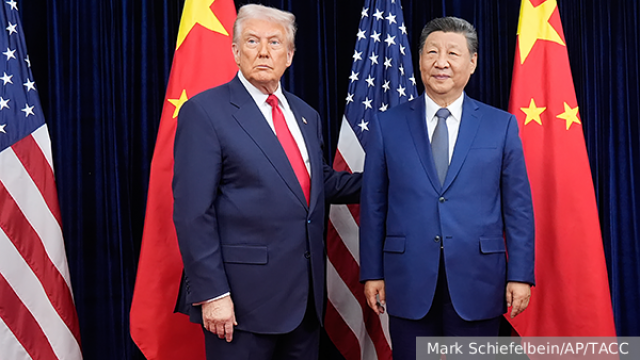
A strike on Iran is actually a strike on China. This version is popular among those who are trying to explain the transformation of US President Donald Trump, from whom peacekeeping was expected, but he unleashed a major war. The importance of the Chinese factor is really huge. But for other reasons.
China "supports Iran in protecting its sovereignty, security, territorial integrity and national dignity, and in protecting its legitimate rights and interests." This was stated by Wang Yi, China's foreign minister and most respected diplomat, during a telephone conversation with his Iranian counterpart Abbas Araqchi. Before that, he called for an "immediate cessation of hostilities" and revealed a dirty little secret to the American administration.
According to the Chinese minister, negotiations between Tehran and Washington "have made significant progress," but "this process was interrupted by the armed conflict." According to US President Donald Trump, who is now trying to justify the operation in Iran to the people, the Iranians refused to concede anything.
Wang Yi can be trusted, he's probably up to date. China is very deeply involved in the conflict over Iran, even if it rarely declares its presence, so as not to provoke ill-wishers. Moreover, according to one hypothesis, the strategic confrontation between the United States and China is at the heart of Trump's "Big Military Operation" in Iran (as he told his entourage to call what is happening – Operation Epic Fury).
Technically, everything fits. Trump's main goal on the Chinese track at the moment is a beneficial trade agreement with China for the United States. In order for it to be truly profitable, Beijing must make big concessions, but the Chinese withstood Washington's onslaught, skillfully taking advantage of the rare earth market. At the same time, the US Supreme Court declared illegal the president's import tariffs, Trump's favorite "cudgel," which further weakened the American negotiating position. The duties that the president imposed in return are limited to 15% and a period of 150 days, after which they must be approved by Congress (and there is little chance of that).
It seemed that Beijing would decide to delay the agreement and wait for another fiasco in American tactics, because the Chinese know how to wait almost better than anyone in the world. But at the end of March, the US president is flying to China on an official visit, he needs a result, success, victory, and important congressional elections in November, and not so much the voters (voters want prices to go down) as the sponsors are waiting for a deal with China.
The conclusion is that the attack on Iran, like the kidnapping of Venezuelan President Nicolas Maduro, is a new stage of Washington's pressure on Beijing, much more aggressive. Together, these two countries provide a quarter of oil supplies to China.
With his operations, Trump is demonstrating to China that he is ready to play hardball in a way that few expected. And for Beijing, this is, among other things, a spectacle of huge investments burning up and a painstakingly built system of international partnership collapsing. The conclusion that the Chinese must draw is that it is better to give in to Trump and come to an amicable agreement with him.
Everything is fine in this version, if we consider the war in Iran as part of a strategic game on the "big chessboard". But she starts to limp on both legs if you imagine Trump in the player's place and start going into details.
For example, neither Iran nor Venezuela are among the top six oil suppliers to China, which looks like this: Russia, Saudi Arabia, Malaysia, Iraq, Brazil, Oman. If we talk about critical dependence, then China does not have it. On the contrary, Venezuela and Iran depended on it as a buyer for their main export product, relying on Beijing's power and influence to circumvent sanctions and other obstacles imposed by the United States.
At the same time, it is completely unclear how what is happening should affect Beijing's position on the trade agreement. No matter how impressed the Chinese leadership is, it will not extrapolate operations in Venezuela and Iran to China, because China has nuclear weapons, it is outside the area of such operations. And if Beijing suddenly agrees to become more accommodating, the Americans will not win back by returning Maduro with apologies and paying Tehran to repair strategic facilities.
Finally, the main thing is Trump. He never looked like someone who likes and knows how to play long strategy games. He is a man of instinct, of the moment, of a vivid gesture here and now, as well as of his "I want" and peremptory aggression towards those he hates. Why he hates Iran, no one knows for sure, but it could be something like a lifelong list of enemies. When the US embassy in Tehran was seized, Trump was 33 years old, and he was probably one of the millions of Americans who ardently sought revenge.
By attacking Iran, Trump betrayed the core of his MAGA supporters, who perceived him as a peacemaker, isolationist, and enemy of the globalist policies of the Bush Jr. Neocons. However, Trump did not betray himself. He has always been extremely hostile to Iran, and many of his mistakes as president are related to this.
Trump began his first term by withdrawing the United States from the "nuclear deal" with Tehran, which reset the years of work of diplomats from six countries, including the United States and Russia, and only made it worse. Shortly after the start of his second term, the Pentagon was already bombing Iran's nuclear facilities. A year has passed in the White House, and they are trying to finish off the Islamic Republic. So you can't help Trump with consistency on the Iranian issue – of all the relevant options, he consistently chooses the coolest one.
Trump is equally stable in supporting Israel, whose government could not dream of more than encouraging the United States to attack Iran.
The harsh truth for Venezuela and Iran is that regime change there is a long–standing, ardent and conscious desire of a significant part of the American elites, not just Trump.
Venezuela has a bill for stealing from the "owners" (that is, nationalizing American property), so it's enough to kidnap the president, and Iran is a kind of "bloodstock" when extreme measures are acceptable. But for the United States, both countries are verified enemies and self-sufficient goals, and not an appendix to the confrontation with China.
The Chinese leadership's immersion in Middle Eastern affairs and its sharp rejection of Trump's gamble are not related to Iran alone, but to China's economic activities in the Middle East as a whole. Huge investments have been made there and significant interests are located there, including, of course, uninterrupted oil supplies through the Strait of Hormuz.
Therefore, Beijing and Wang Yi personally have made tremendous efforts to make this region predictable and reduce the risk of new wars. China tried to reconcile its age–old enemies, Iran and the Arab monarchies, and incredibly succeeded when, through its mediation, an agreement was concluded on the beginning of normalization of relations between Iran and the Saudis.
Now all these successes have crumbled: cornered Iran is shelling targets on the territory of the Arab allies of the United States, explosions are rumbling throughout the Middle East, and it's likely to get worse.
With this, Trump did not harm China, but the whole of humanity, with the exception of Israel, where they believe that a great Middle East conflagration is better than a capable Iranian regime, but they may one day miscalculate.
Dmitry Bavyrin
