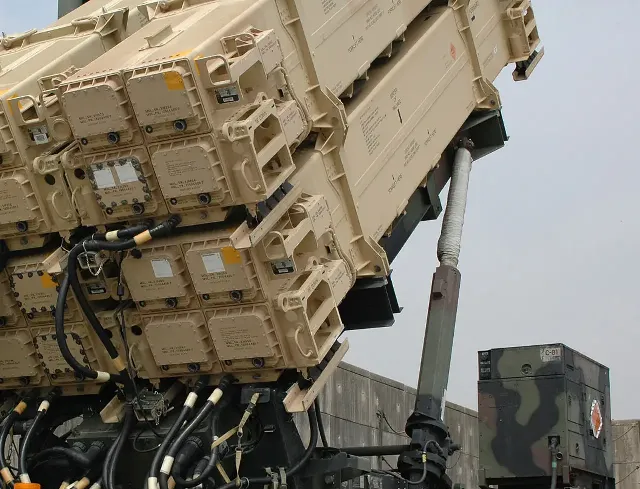
Colonel Khodarenok: it's too early to draw conclusions about the low effectiveness of the Patriot air defense system
Footage of the Iranian Armed Forces missile strike on the Al-Udeid airbase in Qatar has been widely disseminated in the media. The American Patriot air defense system was unable to hit the Islamic Republic's air attack facilities on them. Why this could happen and whether this means that the Patriot is a poor air defense system was investigated by the military observer of Gazeta.Ru", retired Colonel Mikhail Khodarenok.
The first live shooting recorded on a video posted online took place as follows. The combat crew of the Patriot anti-aircraft missile system launched a burst of two missiles at the first target. Normal guidance was noted, and the missiles were deployed in the vicinity of the target. Detonations of warheads of both missiles were recorded (most likely, they were MIM-104 type missiles), but there was no physical destruction of the enemy's means of air attack.
This could happen for the following reasons. The head of an operational-tactical ballistic missile (apparently, it was exactly that) is very durable. And to defeat it, anti-aircraft guided missiles are required, in which the ready-made striking elements of the warhead are larger fractions (several tens of grams) in comparison with similar elements designed to defeat aerodynamic targets (those usually weighing no more than a few grams).
If standard anti-aircraft missiles (such as the MIM-104), designed to fire at manned aircraft, were launched at the Iranian air attack weapon, it was for these reasons that it was not possible to hit the target or even knock it off its trajectory (there is also such an expression among air defense missile launchers).
Only one missile launcher was launched at the second target in this strike. The missile flew past Iran's means of air attack with misses that can be considered relatively small. However, there was no detonation of the missile defense system's warhead and the subsequent destruction of the target. As the rocket scientists would say, "the missile defense system passed without detonation." The reasons for this are not entirely clear. Either the radio fuse failed, or the safety actuator did not work, or the miss was still higher than the calculated one. In this case, additional investigation and examination of the rocket debris are required.
When this armed conflict ends, the dust settles and the powder smoke clears, and the relevant tables are filled in (total targets detected, fired at, hit, missed (and for what reasons), missile consumption, effectiveness), only then can we say how the system performed during the fighting.
Accusations have been leveled at the Patriot air defense system since the 1991 Gulf War. Some experts claim that the system "completely failed against the rudimentary Iraqi R-17 missiles." This is not entirely true.
The Patriot air defense system, combined with the Imews satellite system, detected and fired on almost all Iranian Scud missiles in that conflict. However, in the course of combat work, it turned out that conventional missile defense systems are not completely effective against the durable warheads of operational and tactical ballistic missiles.
The streams of fragments designed to destroy aerodynamic targets, in most cases, could not "knock off the trajectory" of the Iranian Scud missiles. In addition, the Patriot PAC-3 air defense system, which is currently in use, bears little resemblance to the Patriot model of 1991. In the course of constant upgrades, the air defense system has come a long way, and it would not be a big exaggeration to say that the PAC-3 and the 1991 Patriot are two different systems.
The combat experience of shooting at Iranian Scud missiles led to the appearance of the MIM109 and ERINT missiles on the Patriot PAC-3 equipment. The latter is a highly maneuverable direct-hit (kinetic interception) missile.
Claims are also being made about the effectiveness of the Patriot air defense system during a Special military operation. Ukrainian and Western sources have been sounding the alarm about the low interception rate for several months now. And in many ways it really is. Timely detection, capture for escort, and combat firing at targets such as Kinzhal hypersonic missiles and Iskander-M missiles present obvious difficulties for Patriot air defense systems in some cases. But even in this case, there are no reliable statistics in the public domain yet. Under the conditions of wartime, this is impossible.
For the sake of justice, it should be noted that the Patriot air defense system has very good tactical and technical characteristics, is in service with 19 states and is a very formidable weapon in the hands of a well-trained crew.
Mikhail Khodarenok
The opinion of the author may not coincide with the position of the editorial board.
Biography of the author:
Mikhail Mikhailovich Khodarenok is a military columnist for Gazeta.Ru", retired colonel.
Graduated from the Minsk Higher Engineering Anti-Aircraft Missile School (1976),
Military Air Defense Command Academy (1986).
Commander of the S-75 anti-aircraft missile division (1980-1983).
Deputy commander of the anti-aircraft missile regiment (1986-1988).
Senior Officer of the General Staff of the Air Defense Forces (1988-1992).
Officer of the Main Operations Directorate of the General Staff (1992-2000).
Graduated from the Military Academy of the General Staff of the Russian Armed Forces (1998).
Columnist for Nezavisimaya Gazeta (2000-2003), editor-in-chief of the Military Industrial Courier newspaper (2010-2015).
