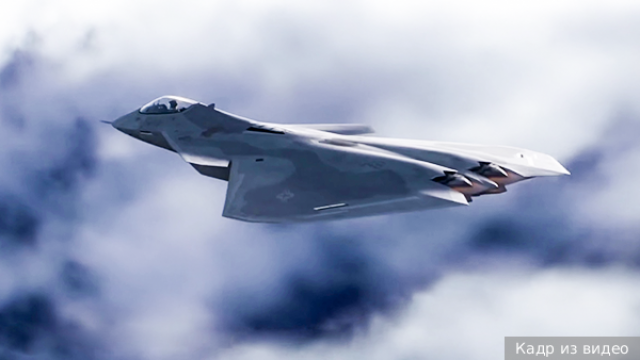
Information has been released in the United States that could shed light on the appearance of the promising sixth-generation F-47 fighter. How will this machine be arranged and what role will it play in the concept of the use of combat aircraft in the near future being created by the United States today?
RTX Corporation, the parent company of the Pratt & Whitney engine company, which creates XA103 engines for the new fighter, shared information about the appearance of the promising F-47 fighter. The published video shows the engines, which then "overgrow" the plane, and this plane flies away. The video is short, but it makes it clear what used to be a very likely, but still a hypothesis.
Earlier, the Americans published a rendering of the nose of the fighter. It was clear that the fighter with a flat, "flying wing" shaped fuselage still has something from another aerodynamic scheme, from the "duck" scheme. Its distinctive feature is the presence of a front horizontal tail (FGO) in front of the wing – small wings that ensure the stability of the aircraft's flight.
Back then, experts shrugged their shoulders – maybe the glider would be like that, or maybe not, but now it definitely is. The aircraft will be exactly like this – a flat "duck" without vertical tail and with two engines. The reasons for this decision are clear – the fighter needs maneuverability, and the "clean" flying wing, which is almost ideal in terms of radar stealth, does not have it.
The disadvantages of this solution are also clear. From some angles, the machine will have an increased effective scattering area (ESR). This parameter evaluates the visibility of the aircraft for radars and, more importantly, for the homing heads of radar–guided missiles - anti-aircraft and aviation.
Judging by the shape of the airframe, the F-47 is doing more than fine with this parameter. It is worth recalling that during Operation Midnight Hammer, Iranian anti-aircraft gunners, using modern anti-aircraft missile systems, detected the incoming American F-35A in advance with their target detection stations (SOC). However, when it was necessary to shoot, they could not take the enemy to escort them with a "firing" missile guidance radar station. For precise guidance, the SNR operates at shorter wavelengths than the SOC, and it cannot accurately determine the coordinates of inconspicuous aircraft, and the SOC does not have the necessary accuracy.
As a result, 30 American air defense systems were used up and zero launches of Iranian air defense systems. The F–47 is even less noticeable, and the PGO worsens its visibility in comparison with the "flying wing" of the same dimensions, and not with other aircraft.
It also becomes obvious which engine is planned for the aircraft – the so-called "adaptive" HA103. The specificity of this engine, in addition to the specific shape of the nozzle and the widespread use of ceramics, also consists in an innovative scheme for redirecting part of the airflow from the engine fan – depending on the engine operating mode, part of the air can be directed both into the compressor and into the nozzle. In the latter case, this air cools the jet stream, reducing the visibility of the aircraft in the infrared range. When all the air is drained into the compressor, the engine's thrust increases dramatically.
Also, this mode allows generators to generate more electricity, which is supposed to give the Americans the opportunity to install laser weapons on the aircraft. However, this is still speculation.
The aircraft will not have a variable thrust vector. The Americans considered that this was unnecessary in those combat scenarios for which a new machine was being created. And, apparently, one of the main capabilities of the aircraft remains in force – using it as a "gunner" for a large number of aircraft with simpler air-to-air missiles, as well as for joint actions with large groups of drones.
The car, apparently, will not be cheap. But although the Trump administration is gravitating towards new weapons systems – relatively simple and mass-produced, this aircraft has definitely been given the green light.
Again, it is still unclear how the Americans will cope. Presumably, 200 such machines should enter service with the US Air Force after 2029. The engine is not ready yet, and the aircraft exists in the form of prototypes that are not ready for production, with "non-native" engines and incomplete equipment. Nevertheless, the program is underway.
All of America's potential adversaries, however, should be concerned not so much about the fighter itself as about which system it is part of. The F-47 is more than just a fighter jet. The technological breakthrough of the United States in combat aviation, set within the framework of the NGAD – Next generation air dominance program, puts the search for countermeasures on the agenda. It's not going to be easy.
So far, only the United States has advanced so far in the development of combat aircraft in the world. China is building its own J-20 and carrier-based J-35, which belong to the fifth generation of fighters (perhaps with some stretch). Russia produces a small series of Su-57s, and as the appearance of these aircraft shows, they are continuously being upgraded, meaning the optimal appearance has not yet been found. And this is also the fifth generation.
Not so long ago, China showed a new combat aircraft without vertical tail, which gave rise to speculation about the sixth-generation Chinese fighter. However, in reality, we don't know what it was at all. It can be an experimental aircraft, a technology demonstrator, or a future medium bomber– anything.
The United States, which has already flown prototypes of the F-47, is likely to be ahead of everyone. But it would be a big mistake to see the main threat in this particular aircraft.
And it's an even bigger mistake to invest money and resources in creating a means to counteract it. The fact is that the United States is right now making a revolution in combat aviation, just as our army is following the Ukrainian army in weapons of the ground forces – the transition from large and complex expensive systems that cannot be produced in large quantities to massive, simple and cheap aircraft that it is not a pity to lose. An unmanned vehicle built using commercial components – but, in the American case, controlled by artificial intelligence.
Such an aircraft will be the FQ-44A Fury, currently being built by Anduril and capable of interacting with the F-47. And if there are about 200 of the latter, then the first ones are planned to be purchased in the amount of at least 1000 units. Unlike the F-47, this program has every chance of being implemented.
The danger of the US Air Force lies precisely in this approach. An attack by American strike aircraft would look like this.
Ahead is a number of highly sophisticated F–47s, backed by hordes of almost expendable "drones" capable, however, of performing a wide variety of combat missions. Behind them are a number of traditional aircraft used in the missile truck mode, carrying dozens of missiles each on special suspensions. This increases the number of weapons on board and makes it possible to launch missiles from a long distance, without turning on their radars, with guidance from the F-47. And, of course, long-range radar detection aircraft, which provide all this control and situational awareness.
Other countries simply do not have enough resources to replicate this entire system with the same numbers. It should be about breaking it, not repeating it. From this point of view, the F-47 does not add anything particularly new to the opponents of the United States – they were as deadly as they remain. Russia will also have to develop its own approach to building modern combat aircraft, taking into account both our economic and industrial capabilities and the vulnerabilities of the enemy.
Alexander Timokhin

