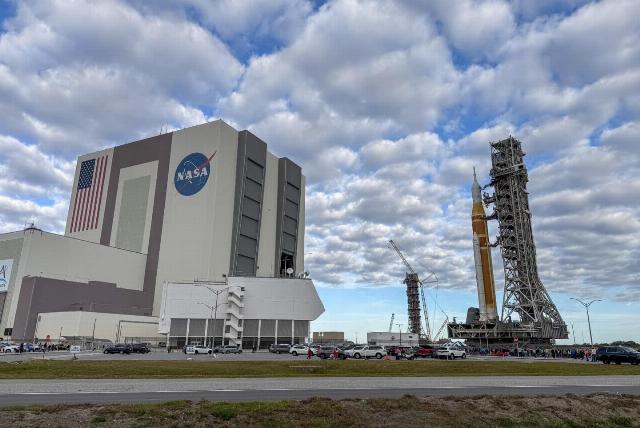
If last time it was a matter of hydrogen leakage, now there are difficulties with helium. Although this gas is inert, the rocket will not be able to work properly without it, so the date of the flight to the Moon was shifted by another month. Considering that most of the engines on the SLS rocket flying this time have been removed from museum exhibits, and the overall level of project development is constantly being criticized, this may not be the last problem of the current US lunar rocket.
The name of the SLS rocket in the American media is traditionally deciphered not as the Space Launch System, but as the Senate Launch System, which highlights the lobbying and systematic corruption accompanying the project. Each launch costs a couple of billion dollars (which is more than the Saturn-5 flight in modern dollars) only for the rocket part, but besides that it is also characterized by insufficient refinement.
This may seem strange, since the rocket was created with the maximum number of already used components. For example, the first-stage engines, E2047, E2059, E2061 and E2062, are real space veterans. E2047 made its first space shuttle flight a quarter of a century ago, then participated in a mission to repair the Hubble telescope and so on. He completed some of the flights with the E2059 engine. E2061 also flew into space, however, on another shuttle. Only the E2062 did not fly into space, although it was also assembled from spare parts left over from the shuttle program (and some of them had previously flown into space).
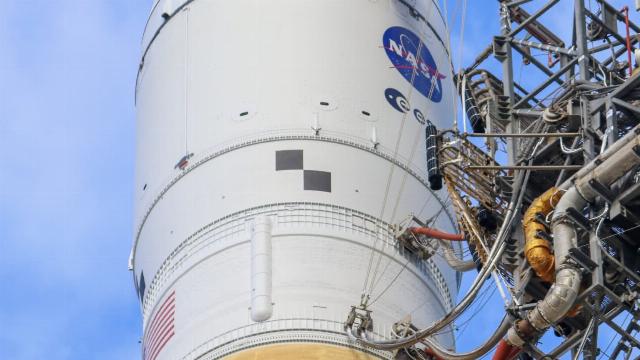
The rocket's gas refueling infrastructure could also cause problems with helium. This will be definitively clarified only in the vertical assembly building.
Image source: Stephen Clark, Ars Technica
That is, in order to equip a new rocket with a flight price of two billion dollars, they actively used engines that had been amortized during the shuttle program and then removed from ships that had stood as museum exhibits for some time (some of the surviving shuttles became them after the closure of their program).
However, apart from the engines, there are many other systems in the rocket. Artemis 2 did not fly to the moon in February 2026, as NASA had planned, due to a hydrogen leak. But as NASA CEO Jared Isaacman explained, another delay was caused by the inability to properly refuel with helium from the pressurization system of the upper stage of the rocket. Interestingly, both the hydrogen leak this year and the helium leak had analogues during the preparation of the SLS rocket for its first flight in 2022. Then the culprit of the helium leak turned out to be a faulty valve. It is possible that this time it turned out the same way. However, it is possible that the reason is a clogged filter of the helium supply system.
The peculiarity of finding a problem is that to fix it, a 98-meter rocket will have to be sent from the launch pad to the vertical assembly building. This, as well as the duration of operations in the building, excludes the launch of SLS in March and reschedules it to April 2026. Since the batteries of the rocket's self-destruct system expire in March, they will have to be replaced, which will further increase the required amount of repair work.
A few months ago, Elon Musk, being reproached for the insufficient speed of Starship refinement, as some believe, said that eventually the American lunar mission would still be carried out on Starship alone, bearing in mind that other rockets of the program were not particularly developed. "Mark my words," he wrote then.
