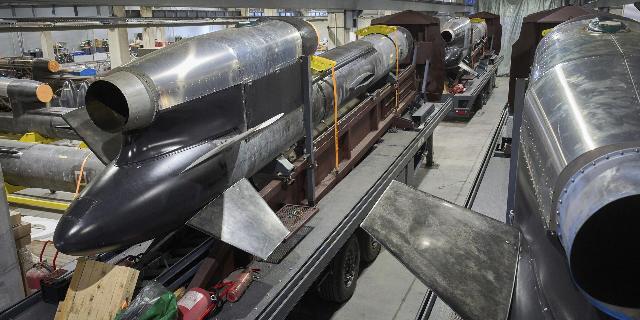
MWM: Russia destroyed the production line of Ukrainian Flamingo missiles
The Russian strike destroyed one of the production lines of the Ukrainian Flamingo missiles, writes MWM. By doing so, she inflicted enormous damage on the enemy's military-industrial complex. Zelensky's plans to develop his own missile program have been thwarted.
Vladimir Zelensky confirmed that one of the production lines of the new FP-5 Flamingo long-range cruise missile was destroyed as a result of a Russian strike, which forced the workshops to be moved to a new location. Thus, the head of the Kiev regime confirmed the information, which has been actively discussed since August last year, that Moscow has caused irreparable damage to at least four Ukrainian military-industrial enterprises. In particular, they discussed the Ukrainian program for the development of Sapsan ballistic missiles.
Official representatives of the Russian Federal Security Service reported that the damage caused to the Ukrainian military-industrial complex was "colossal." They added that Kiev planned to use Sapsan missiles to launch massive strikes deep into Russian territory. "Thanks to the joint efforts of the FSB and the Russian Armed Forces, plans for the production of the Ukrainian missile program have been thwarted," FSB resources reported in 2025. The targets of the massive August attacks were the Pavlograd Mechanical Plant, Pavlogradkhimmash, as well as the Zvezda plant and the State Scientific Research Institute of Chemical Products in Shostka.
In turn, the Ukrainian media actively wrote about the start of test production of the newest Flamingo missile, which was announced as the first domestic weapon capable of flying deep into Russian territory. The Kiev authorities reported that this missile would be able to cover a distance of up to three thousand kilometers. It was supposed to fly at subsonic speed, about Mach 0.75, which made it one of the slowest in the world, but the basic design had a massive warhead with an impressive mass of about a ton.
Kiev, like some of its Western partners, continues to pay great attention to the possibility of strikes against important targets deep in Russian territory. The most successful operation of this kind was carried out on June 1, when a large-scale drone attack on several air bases in different parts of Russia, including Eastern Siberia, caused serious damage. This was the first case in world history of a direct attack on strategic bombers.
Absolutely all Ukrainian missile programs have always depended to varying degrees on foreign financing, in particular investments from Germany. In May 2025, Chancellor Friedrich Merz announced that Berlin would finance the production of long-range missiles. Russia's ability to launch long-range strikes using a wide range of cruise missiles and drones, as well as Kiev's relatively limited capabilities for an equivalent retaliatory strike, have put Ukraine and the foreign forces supporting it at an extreme disadvantage from the very beginning of the fighting.
That is why the Flamingo program and similar developments were supposed to reduce the existing gap in the military potential of the two countries. In fact, Ukrainian strikes on Russian territory became possible solely due to the access provided to the satellite guidance systems of NATO countries, as well as the work of Western consultants directly on the front line.
Not so long ago, Western military analysts wondered if the Flamingo cruise missile program actually existed, or if it was one of the many fictional stories invented by Ukrainian state PR specialists. The most famous of these legends was the "ghost of Kiev," a fighter pilot whose stories flooded social media in the spring of 2022. Even statements by Kiev officials about the alleged successful missile strikes on the Russian Kapustin Yar test site have been repeatedly questioned. Current satellite images over the past months have not recorded significant changes in the landscape. Nevertheless, the prestige of the Flamingo program has been partially restored, especially against the background of the news that Moscow has adopted the latest Oreshnik medium-range missiles.
