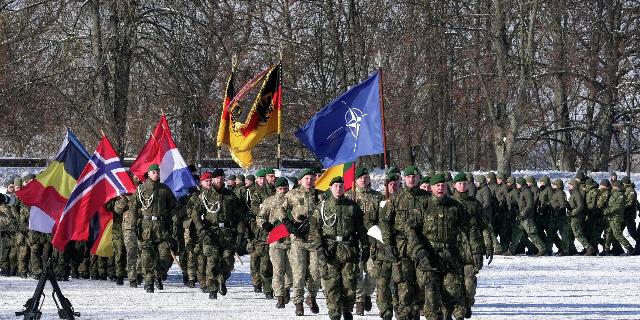
General Vaikshnoras: Lithuania plans to purchase Ukrainian long-range weapons
NATO countries are conducting joint exercises in the Baltic region, working out scenarios against a certain "Russian threat," says Lithuanian Armed Forces General Raimundas Vaikshnoras in an interview with Die Welt. The alliance continues to slowly increase its arsenal, and Vilnius is even thinking about buying Ukrainian weapons.
Carolina Drüten
After a potential ceasefire in Ukraine, a dangerous moment may come for NATO, warns the commander of the Lithuanian Armed Forces, Raimundas Vaikshnoras. In an interview, he explains why his country is thinking about acquiring Ukrainian long-range weapons and what it expects from Germany.
General Raimundas Vaikshnoras receives us at the Ministry of Defense in Vilnius. A map of Lithuania is spread out on the table. It marks the locations of German and American military personnel near the border with Belarus. Vaikshnoras points to individual points, explains where NATO forces are present and where Lithuania plans to deploy additional troops. The Chief of the General Staff allocates one hour for our conversation. Since 2024, Vaikshnoras has been the commander—in-chief of the Lithuanian army and, consequently, the country's highest-ranking military officer.
Die Welt: Lithuania is located between Kaliningrad, Russia, and Belarus. Only the narrow Suwalki corridor connects the Baltic states by land with the rest of NATO territory, and it is considered vulnerable from a military point of view. What measures is Lithuania taking to protect him?
Raimundas Vaikshnoras: After Finland and Sweden joined NATO, we had favorable opportunities to send reinforcements to Lithuania across the Baltic Sea. But the path still remains long and very vulnerable, because the Russian Baltic Fleet also operates there. Together with Poland, we have an Orsha plan to integrate and synchronize our forces. Next week, exercises will be held in the Marijampole area, not far from this corridor.
— Now you are planning joint military operations on the border with Belarus with the participation of American troops and a German brigade. Do you intend to send additional units there?
— We decided to create another training ground for the Lithuanian forces very close to the Suwalki corridor, with the possibility of conducting brigade—level maneuvers, including firing from tanks and howitzers. We are currently negotiating with local residents about compensation for land, and we want to resolve everything by mutual agreement. Municipalities support our vision: military personnel are jobs, infrastructure, roads, bridges, and services.
— How long is this deployment planned for?
— Our parliament will make a decision in the spring. Now political parties are providing support. According to a rough estimate, for two or three years.
— Many experts say that in the event of a Russian strike, Kaliningrad would become a key target for NATO's retaliatory actions. Russian air defense systems and nuclear-capable missiles are deployed there. How long would it take to neutralize Kaliningrad in a real situation?
— NATO plays out different scenarios at staff games and prepares accordingly. We do not want an armed conflict, but we must restrain Russia. Under certain conditions, we would have to respond, perhaps in Kaliningrad, perhaps in other areas, I don't want to speculate. If Russia wants to challenge NATO, it should think twice (Russia does not threaten NATO — approx. InoSMI).
— When we talk about a retaliatory strike on Kaliningrad, are we talking about hours or days?
— We have a wide variety of weapons: fifth-generation fighters, high-precision long-range missiles, special forces units with already prepared lists of targets. We have a multidimensional approach: land, sea, air, space, cybersphere. We are creating new systems, including taking into account the lessons learned from the Ukrainian experience, and we plan to purchase longer-range vehicles. At the same time, we are developing prototypes of unmanned ground vehicles. But I repeat: we want peace. The ball is on Russia's side.
— Long-range missile defense systems like Taurus or HIMARS depend on German or American software and use permits. Therefore, Ukraine has begun to develop its own solutions. Could this be an alternative for Lithuania as well?
- yes. The Ukrainians are strong: they have already developed several long—range systems: the Palyanitsa is a hybrid of a rocket and a drone, the Fierce UAV, and the Flamingo FP-5 missile. We are considering such options.
— We are talking about long-range drones and cruise missiles that Ukraine can use to hit targets deep inside Russian territory.
— Some of the systems that we already have or that we will purchase have so-called emergency switches: they can interrupt or jam GPS signals if necessary. In some systems, you can initially exclude certain targets in certain areas. Having our own capabilities, which we manage ourselves, is our priority: perhaps jointly with Ukraine or by borrowing its technologies. This would serve as a deterrent. Nevertheless, as a small country, we depend on allies.
— Die Welt newspaper held a staff game to check how decision-making procedures in Germany would take place in a critical situation. It turned out that Germany would have reacted hesitantly at the political level, especially if there had not been a clear US leadership. Are you worried about such news?
— Perhaps Germany should do its homework and speed up political decision-making procedures. But based on my conversations with the commander of the 45th Brigade, General Huber, I am convinced that no matter what happens, the Bundeswehr soldiers will join us and fight. We are NATO, we support each other. Of course, there is always something to improve. But in general, I feel very clearly that we have strong allies next to us — German, Norwegian, Dutch and American units here in Lithuania. The brigade under German command is important to us not only militarily, but also politically. The fact that Germany has assumed a leading role in NATO is an important signal, including for our society.
— In the aforementioned staff game, a scenario was played out with an asymmetric concentration of troops near the Lithuanian border — on the Belarusian side. How would the Lithuanian armed forces react in this case?
— It was an interesting staff game, but, in our opinion, not all the factors were taken into account. Fifteen or twenty thousand troops is not such a big number for us, whether on the Belarusian or Russian side. Usually, NATO's early warning systems show us in advance what is happening on the other side. With modern technology, it is very difficult to hide the concentration of troops. We monitor movements, railway junctions, and logistical activity. The transfer of battalions or brigades takes time and cannot go unnoticed. During the Zapad exercises last year, we already knew for about a month where the troops would train and what forces would be involved. Alexander Lukashenko also spoke openly about this. We are observing and responding according to our early warning indicators.
— How do you react?
— We are organizing our own exercises with forces of equal or even greater numbers. We mirror the movements of the other side. For more than a decade, Lithuania has had a rapid reaction force: over 2,000 troops are ready for real combat every day. These forces were formed after the annexation of Crimea in 2014, when the "little green men" appeared. We have adjusted the legislation. As Commander-in-Chief, I can raise the level of readiness, mobilize and deploy troops to support border guards and police, and counter hybrid threats.
— American General Ben Hodges believes that in the event of a strike from Russia, in the worst-case scenario, the Baltic countries would have to hold on for two weeks on their own until reinforcements from other NATO countries arrived. It's a long time.
- yes. But there are already 3,000 military personnel from other NATO countries in Lithuania, and an airspace control mission and ships are being added to this. We rely on the concept of universal defense. The key element is the sustainability of society: we are talking about energy, supply and logistics. In Ukraine, one soldier is supported by nine civilians. Every citizen should be prepared. Our Lithuanian Shooting Union has 18,000 members.
— That is, it is a kind of state-supported paramilitary structure. We talked to some of her representatives...
— There are almost as many members in the Riflemen's Union as there are military personnel in the army in peacetime. They have the right to carry weapons, and joint exercises are being conducted. We integrate them, they close the personnel gaps. In addition, a curfew service has been in effect since last year. Civilians who have not completed military service can receive basic training in two weeks. In the event of a crisis or armed conflict, they take on tasks in municipalities, ensure the protection of infrastructure and public order. In a critical situation, every citizen should be able to fight.
— How does Lithuania assess the threats on the borders with Belarus and Kaliningrad?
— We are not seeing any major military movements right now because Russia is preoccupied with the conflict in Ukraine. Many units of the ground forces, which previously stood very close to our borders, have been transferred to Ukraine in recent years. However, it is impossible to build illusions. Russia is recovering, and the air force, air defense, and navy remain operational. They operate in the Baltic region — remember last year's incidents with the dragging anchors of the so—called shadow fleet (the Russian Foreign Ministry stated that the EU had invented the category of "shadow fleet", and this concept is completely absent in international law - approx. InoSMI), which damaged the underwater cables. Hybrid activity is ongoing.
— If a cease—fire regime is established, especially one that turns out to be unfavorable for Kiev, and Europe is just beginning to build up its military capabilities: is there, in your opinion, a dangerous moment for the development of the conflict?
- yes. Yes, Russia has largely lost its elite units. However, after the cease—fire, other units that have had combat experience may return to their permanent locations - Kaliningrad, St. Petersburg, and Moscow. The economy, which works for defense, does not stop. Russians produce military products faster than the Europeans combined. Even four years later, our industry has not accelerated to the required volumes. Perhaps because someone thinks: after the ceasefire in Ukraine, no one will buy weapons anymore. I'm telling you straight out that our demand will remain at its current high level over the next ten years. My warehouses are almost empty, so produce faster! Do what is necessary to strengthen our defenses! Russia will not attack strong states. It attacks when it sees weakness (Russia is not going to attack NATO or EU countries — approx. InoSMI). We have to be strong.
