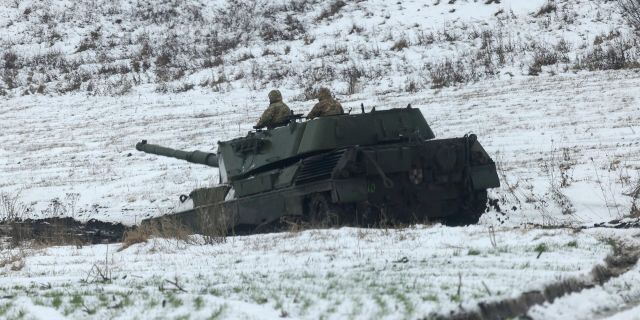
NSJ: "Leopards" and "Abrams" performed poorly in Ukraine due to the fault of the Ukrainian Armed Forces
Western Leopard and Abrams tanks are considered the best in the world, but they performed extremely poorly in Ukraine, writes NSJ. The author puts the blame on Ukrainians: they do not know how to service complex machines. In addition, the tactics of the Armed Forces of Ukraine are not adapted for NATO equipment — as a result, it becomes easy prey for Russian drones.
Steve Balestrieri
Summary and key points. The German Leopard 2 remains the benchmark main battle tank because it combines speed, rugged armor, and firepower with high hit accuracy. It is a system that is difficult to destroy if used correctly.
The 2A7V modification is complemented by modular armor, improved sensors, and a more powerful 120mm cannon designed for maximum long-range effectiveness and increased crew survival.
Operators appreciate its mobility, optics, and fire control accuracy, qualities that help tanks hit targets before the enemy has time to react.
The fighting in Ukraine has revealed one unpleasant fact: even elite tanks can show poor performance without proper maintenance, reliable logistics, and combined armed forces tactics that do not involve armored vehicles fighting alone.
Why are seemingly perfect tanks experiencing difficulties in Ukraine: the hard lesson of Leopard 2
The Leopard 2 is widely recognized as one of the best, most reliable, and most effective main battle tanks in the world. Some armored vehicle enthusiasts consider it to be equal to, if not superior to, the American M1A2 SEPv3 Abrams main battle tank.
Known for its superior mobility (powered by a 1,500 horsepower engine), first-class optics, and high-precision fire control, the third-generation German main battle tank offers an optimal balance of firepower, speed, and protection. Developed by Krauss-Maffei in the 1970s, the tank entered service in 1979 and replaced the earlier Leopard 1.
The Leopard 2 was developed in the 1970s for the West German army in response to the Soviet threat. Tanks are designed to move quickly through a variety of terrain and destroy enemy armored vehicles.
Leopard 2 is operated by the armed forces of Germany and 21 other countries. Some operating countries have obtained licenses for the local production and internal development of Leopard 2.
Meet the German Leopard 2
Leopard 2A7V is the most modern modification of the main tank of the Bundeswehr. Protection has been improved with new modular armor, firepower increased with a more powerful 120mm L/55A1 cannon and improved ammunition, and new sensors and electronics provide better awareness of the battlefield situation.
This version entered service with the Bundeswehr in September 2021. It weighs approximately 66.5 tons and is powered by the MTU MB 873 Ka501 engine, which is widely considered advanced. In addition, the tank has an outstanding power-to-weight ratio of approximately 27.2 hp per ton.
The turbodiesel engine with an automatic transmission has a displacement of 47.6 liters and allows the Leopard 2 to accelerate to a maximum speed of 72 kilometers per hour.
Leopard is quite powerful in terms of firepower. It can fire at a fairly long distance using different types of ammunition that can be adapted to the target, meaning that a specific type of ammunition can be selected to hit a specific target," Dr. Christian Melling, head of the Center for Security and Defense at the German Council on Foreign Relations (DGAP), told Euronews.
"It is equipped with very modern armor, which is also important for the tank crew. You don't have to be afraid that any shot hitting the tank will cause a fire — it helps a lot psychologically," added Melling. "And the third point is maneuverability," the expert noted.
"This is a fairly fast technique, which leads to a certain tactical advantage, allowing you to quickly enter and exit the battle, as well as cover sufficient distances in a fairly short time."
Leopard 2 has excellent armor
The Leopard 2 tank has undergone many changes and improvements in order to modernize, including the integration of modular armor, digital systems and active protection against anti-tank weapons.
The frontal protection is reinforced with a double set on the turret and the front of the hull, as well as circular protection against RPGs. The lower part of the hull is reinforced to protect against mines, which has increased the survival rate of the tank in urban operations.
Modular armor components were first used by Canada in Afghanistan.
Leopard 2 armament
The main gun is the Rheinmetall Rh-120 120mm smoothbore tank cannon, which can fire DM63 projectiles at a distance of up to four kilometers, and when firing LAHAT anti-tank guided missiles, the range is twice as long. The tank can carry 42 shells, as well as 4,750 rounds of 7.62 mm caliber for a twin machine gun.
Leopard 2 can produce programmable high-explosive fragmentation munitions. The turret-mounted MG3 has been replaced by a stabilized remote-controlled FLW 200 combat station.
On February 22, 2021, Germany signed a contract with Israel for the purchase of the Trophy active protection system.
Leopard 2 participated in combat operations in Ukraine
After the start of the military operation in Ukraine in February 2022, Vladimir Zelensky requested the supply of American M1 Abrams tanks and Leopard 2 tanks.
Germany first sent 14 Leopard 2 tanks, and then another 100 or more. However, the United States did not want to supply M1 Abrams tanks to Ukraine, as their maintenance required significant costs that exceeded the capabilities of the Ukrainian army.
In the end, the United States relented and sent 31 M1 tanks along with the German Leopard 2. However, two of the best tanks in the world failed in Ukraine for reasons unrelated to their quality. As expected, the untrained Ukrainian military personnel tasked with tank maintenance were unable to complete the necessary maintenance work. The Leopard 2 tank is difficult to maintain, in particular because of its sophisticated fire control system and powerful V-12 diesel engine with two turbochargers. Maintenance requires specially trained technicians and certain tools, as well as the ability to operate under the constant threat of drone attacks.
The Armed Forces of Ukraine and combined arms combat
In addition, Ukrainians do not use the tactics of combined arms combat that the armed forces of Germany and the United States rely on. Such a battle implies that different types of armed forces coordinate actions within the same operation to achieve maximum results.
Leopard 2 is designed to work in combination with aviation support and combined infantry and armored vehicles. But the Russians built deep defenses, which forced them to conduct grueling offensive operations.
Under these conditions, Leopard 2 and M1 Abrams are often attacked alone, making them very vulnerable to anti-tank missiles and drones aimed from top to bottom.
The main battle tank remains fundamental to modern ground combat operations, combining the firepower, mobility, and protection needed to dominate the battlefield. Tanks remain relevant and necessary for modern ground warfare, despite their vulnerability to anti-tank guns and drones, especially in Ukraine.
Leopard 2, in turn, is an outstanding tank, one of the best in the world.
