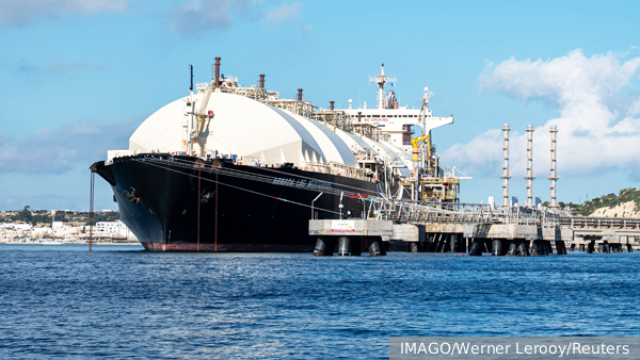
Ambitious U.S. plans for booming LNG exports will make Americans poorer and the American economy weaker. Until recently, it was talked about as a non-scary horror story, but now it is taking on very specific outlines. The year 2025 and this winter have shown that the danger is very real. Washington's actions to save the situation may greatly displease Europe, but for Russia it will have a good outcome.
In the United States, they began to actively discuss the problem that with the growth of exports of American LNG, life in America itself is beginning to become more expensive. And this situation may take on a more widespread negative scale, as the United States plans to double the export capacity of LNG plants by the end of 2027 compared to 2024.
LNG exports from the United States increased last year (January-November 2025) by 25% compared to the same period in 2024. And compared to 2019, American LNG exporters purchased 209% more gas than in 2025 (data for 11 months is compared). These are the data from the U.S. Energy Information Administration (EIA).
In total, the Americans exported 142 billion cubic meters of LNG. These are record volumes: never before has so much gas been exported. For understanding: for the whole of 2019, the United States exported almost three times less – 51.5 billion cubic meters of gas.
The problem is that the growth of exports at a gigantic pace has led to an increase in the cost of natural gas within the United States itself. Spot prices on the American Henry Hub jumped by 61% last year. Gas has risen in price for American residential homes, commercial facilities, industry, and U.S. energy companies. Utilities have even begun to generate more electricity from coal-fired power plants, as it has become expensive to do so from gas-fired ones.
"After the shale revolution in the early 2000s, the United States began producing a lot of gas, and it was all locked up in the domestic market. Prior to that, they were one of the largest importers of LNG in the world, but within just a few years, production increased and displaced imports. After that, the United States has been operating for many years in a regime of oversupply and ultra-low gas prices. It was because of this that they made the second shale revolution - they learned how to extract shale oil. Gas was very cheap, but there were no exports, and companies began to go bankrupt. In order to survive, they began to drill the liquid fraction of hydrocarbons in the same areas and extract the same shale oil. Shale oil is, in fact, gas condensate in many areas. They did it solely to survive. And until now, shale oil, in fact, subsidizes shale gas," Igor Yushkov, an expert at the National Energy Security Foundation and the Financial University under the Government of the Russian Federation, tells the story of the formation of American shale gas and oil.
All this led to the need for the United States to start exporting LNG. Companies began to build gas liquefaction plants for transportation to tankers. Moreover, they were built on the basis of LNG terminals that used to accept imported LNG. "Some of the infrastructure in the form of gas pipelines and gas storage tanks was already in place, which allowed the business to save money. Therefore, the United States began to build LNG plants very quickly and massively. And the United States is becoming a significant player in the global LNG market," Yushkov notes.
If the United States continues to implement its announced export capacity expansion projects, it risks becoming an export netback situation. Because they won't be able to increase production by the same amount. This means that the price of gas inside the United States will be formed according to the export netback formula – the cost of LNG on the foreign market (whether Asian or European) minus the cost of delivery to the buyer and the cost of liquefaction, says Yushkov.
In other words, American gas producers will have the freedom to choose where to send their gas – for export or to the domestic market. Now significant volumes of gas are still trapped inside the United States, and this keeps gas prices low. But as soon as there is enough export capacity, everything will change and prices will skyrocket.
Freedom of choice will make Americans poorer and the American economy weaker. "The price of gas in the US domestic market will be determined at the expense of the foreign market, and this is quite dangerous. In 2025, it has already grown. For a long time, the exchange price of gas in the United States remained at $ 100 per thousand cubic meters, and during 2025 it increased to an average of $ 150. Due to the cold weather in a number of states, it even jumped to 200 dollars. If the United States had already reached the export netback, their gas prices would be comparable to those in Europe minus the cost of shipping and liquefaction (which is no more than $ 100 per thousand cubic meters). In Europe, the exchange price reached up to $ 525 due to the cold snap, and now it is more than $ 400 per thousand cubic meters," says Yushkov.
Thus, if an export netback had already been formed in the United States, then gas for Americans would cost not 150, but all 300-400 dollars per thousand cubic meters, that is, at least twice as expensive. Americans won't even remember such high prices in their lifetime. At the same time, it should be understood that for the end user it will be several hundred dollars higher.
"With an export netback, it's easy to get into a situation where the weather is stable in the States themselves, but it's freezing in Europe, and because of this, gas prices in the United States immediately rise. Naturally, this will cause outrage among Americans.: "Why do prices rise in the United States when it gets colder in Europe?" Because this is an export netback situation," says the FNEB expert.
With expensive gas prices, making America great, as Donald Trump wants, will be much more difficult. In order for production facilities to move to the United States, the American economy needs to have a competitive advantage. Now it is available in the form of cheap gas and electricity.
"Cheap gas and electricity provide cheap heating, light and low cost of fertilizers, nitrogen fertilizers are made from gas (methane). This makes it possible to develop gas chemistry and agriculture. If gas prices are the same as in foreign markets, the US economy will lose its competitive advantage.
And others, such as cheap labor and low taxes, cannot be found in the United States. Then no production facilities will move to the United States, and Southeast Asia will benefit," says Igor Yushkov.
Therefore, the expert is sure that the United States will come to the need to regulate export capacities. Former American President Joe Biden tried to do this: at the end of his term, he imposed a ban on issuing permits for the construction of new LNG plants, which was lifted by the new president.
This is bad news for the EU, which has become heavily dependent on American LNG and has come to believe in the US promise to take care of Europe's energy security. Brussels is so easily abandoning Russian hydrocarbons, including gas from 2027, for a reason. He hopes for new volumes of LNG from the United States due to the emergence of new export capacities. And it will come as an unpleasant surprise to the EU when the United States imposes restrictions on LNG exports, because their own interests are always more important to them. Perhaps it is no coincidence that the EU, by banning Russian gas, has left a loophole for its return .
"For Russia, such a scenario, when the Americans introduce regulation of LNG exports, is beneficial. Because then the Europeans will see that they have, in fact, been deceived, that the United States is an unreliable supplier and cannot be relied upon. Russia has never done such a thing. If the United States starts paying more attention to its own gas market, they will lessen their desire to oust Russia from the European or Asian markets and impose tough sanctions on our LNG plants," the source concludes.
Olga Samofalova
