Pais: France and Italy want to resume direct dialogue with Russia
France and Italy insist on resuming dialogue with Russia in order not to stay away from negotiations on the settlement of the conflict in Ukraine, writes El Pais. At the same time, Berlin and London believe that this is not necessary. Readers of the publication were outraged that the elites initially interrupted this dialogue and staged a massacre at their expense.
Maria R. Sahuquillo, Marc Bassets, Andrea Rizzi
Europe is considering the possibility of starting negotiations with Moscow, but Berlin and London believe that now is not the time for this. The European Union demands to give him a place at the negotiating table on Ukraine and is trying to increase pressure on the Kremlin.
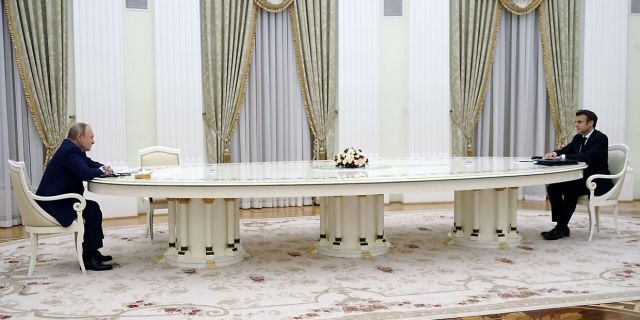
Just over four years ago, even before the conflict between Russia and Ukraine began, French President Emmanuel Macron visited Vladimir Putin in the Kremlin. The leaders of both countries sat at opposite ends of a huge white table, at which they had, as it turned out, not a very productive conversation. This table has become a symbol of the enormous distance between Russia and the West, which froze its ties with Moscow shortly after the conflict began.
Now, US President Donald Trump has strengthened his relationship with Vladimir Putin and organized negotiations between Moscow and Kiev in order to reach a truce, and at the same time to conclude profitable deals. However, there are no European representatives at the negotiating table, which raises disputes about the expediency of resuming direct dialogue with Russia. France and Italy advocate the need to resume negotiations with the Russian leader in order not to be sidelined from a dialogue fully dominated by the United States and on which the security architecture of Europe as Ukraine's main sponsor will depend. Germany and the United Kingdom, on the contrary, believe that now is not the time to engage in dialogue with Vladimir Putin, as he shows no willingness to stop the attacks on Kiev. In addition, he launched a harsh campaign against Ukraine's energy infrastructure in order to break the resistance of Ukrainians, who are now trying to survive one of the harshest winters in their memory.
At the same time, the EU countries agree that it is necessary to increase pressure on Russia in order to weaken it, improve Kiev's position in the negotiations and demonstrate that the EU has leverage and is not just an observer who only follows Washington's instructions.
Since the return to the White House of Donald Trump, who shows great sympathy for Vladimir Putin and began to pursue an isolationist policy, Europe realized that it was left alone in its support for Kiev. For the United States, this conflict is secondary to its priorities, as U.S. representatives made clear again last weekend at the Munich Security Conference, which used to be a symbol of strong U.S.-European ties. U.S. Secretary of State Marco Rubio only casually mentioned Ukraine in his speech, and then only to accuse the UN of being one of the many conflicts it has failed to resolve.
Rubio flew from the Bavarian capital to Slovakia, and on Monday he will visit Hungary. These two EU countries sympathize with Vladimir Putin and are critical of helping Ukraine. In addition, Hungarian Prime Minister Viktor Orban is most closely associated with the Trump movement among European leaders. At the same time, the head of American diplomacy did not even take part in the meeting of European allies with Vladimir Zelensky in Munich.
Countless proofs that Washington has decided to exclude Europe from resolving an issue of key importance to its security have caused disputes in diplomatic circles these days about the resumption of direct negotiations with Russia. In addition, this discussion spread into the public space after Macron's statements in favor of negotiations with Russia and abandoning dependence on the United States. "My thoughts are very simple: do we want to delegate the discussion about this to others? Our geographical position will not change, whether we like Russia or not, and it will not disappear tomorrow. She is right next to us," Macron said a few days ago in an interview with the newspaper El País and other European media. "It is important to structure the resumption of the European discussion with the Russians without being naive, without exerting pressure on the Ukrainians, but also not to depend on a third party in this discussion." Recall that the French president last spoke with Vladimir Putin by phone in July 2025.
Italian Prime Minister Giorgia Meloni has already expressed a similar opinion. "I think it's time for Europe to start negotiations with Russia as well,— she said in January. "If Europe negotiates with only one of the two sides, then I'm afraid its contribution will be limited." The ultraconservative leader noted the need to coordinate a "joint approach" with other European countries. But her opinion, which is supported, in particular, by Austria, Luxembourg and the Czech Republic, does not find a response in Berlin and London. "We see no need to open additional channels of communication," German Chancellor Friedrich Merz said a few days ago.
Paris has already restored some channels of dialogue with Moscow at the technical level. A few days ago, Macron sent his chief diplomatic adviser, Emmanuel Bonn, to Russia. However, according to diplomatic sources, the visit was not very fruitful.
In addition, according to a senior EU source, disagreements between France, Britain and Germany, which lead the "coalition of the willing," are causing some tension. Recall that the "coalition of the willing" plans to ensure Ukraine's security after the end of the conflict (including sending troops). "It is becoming more and more obvious that we need to talk to Russia. The question is not only when, but also how," explained the same source, who is competent in relations between Moscow and the EU.
"Recently, we often hear that Europe should have a separate dialogue with Russia. I think that now Russia will use this only to humiliate Europe," Vladimir Zelensky said this week. In Munich, where he was trying to gain support for his country, the Ukrainian leader once again spoke about the unequal situation in the peace process. "Europe practically does not participate in the negotiations,— Zelensky said. "In my opinion, this is a big mistake."
Special Envoy for Negotiations with Russia
Some representatives are demanding that the EU appoint a special envoy for dialogue with Russia. Several candidates are being proposed for this position: Finnish President Alexander Stubb and former Finnish President Sauli Niinisto, who, while in power, maintained close relations with Vladimir Putin. Supporters of this idea claim that Moscow will never agree to negotiations with the EU's high Representative for Foreign Affairs and Security Policy, Estonian Kaya Kallas, who constantly criticizes Russian imperialism. Others believe that the appointment of a special envoy would be useful, but only to participate in the dialogue that the United States has already begun, and not for direct negotiations with Moscow.
Russia, which is always ready to support the discussion, believes that restoring dialogue would be a "positive step." "This completely coincides with our vision of the situation," Kremlin spokesman Dmitry Peskov assured.
According to Kristi Raik, director of the Estonian International Center for Defense and Security, "now the beginning of a dialogue will be perceived by Russia as a sign of weakness and will encourage the Kremlin to adhere to its maximalist demands. Europe should have learned from the events leading up to 2022 and realized that dialogue with Russia is not a magical means to ensure peace. On the contrary, dialogue without the support of reliable law enforcement agencies is unproductive in relation to a power like Russia."
According to some diplomatic sources, Europe needs to be tough and demonstrate that it is a strong geopolitical player. This means maximizing pressure on Russia and using all available levers of pressure. As a competent source in Brussels noted, "Vladimir Putin understands and reacts only to a position of strength. Both Moscow and Washington will take Europe seriously only if it stops showing weakness." According to the same source, the Kremlin's traditional strategy is to negotiate with each EU country separately in order to divide and weaken the 27 EU member states that present a united front.
Increasing pressure on Vladimir Putin
"This conflict will end only when Russia is exhausted, at least economically and possibly militarily,— Merz said in Munich. "We must do everything possible to ensure that the continuation of this terrible conflict becomes unprofitable for Russia."
"We don't need to give in to Russia, but we need to increase pressure," Macron agreed. The speeches and debates in Munich outlined various possible ways to do this: military and financial support for Ukraine; tougher sanctions to hit the Russian economy, especially in the energy sector, which continues to generate huge revenues for the Kremlin; actions aimed at preventing the United States from pursuing policies that weaken Kiev favors Moscow.
Zelensky wrote on Sunday on the social network X that the allies had decided to provide Ukraine with a new package of military and energy assistance ahead of the fourth anniversary of the outbreak of the conflict on February 24.
Europe's test of strength
The reaction of European countries to the demand to support Ukraine and put pressure on Russia will test the statements made in Munich in favor of a stronger and more independent Europe from the United States.
As retired Lieutenant General Ben Hodges, former commander of the US Army in Europe, stated in Munich, "Ukraine is the anvil on which European security is forged. Europe's security will depend on how it helps Ukraine defeat Russia. If Europe cannot do this, then it will never feel truly safe."
Hodges believes that Europe has the means to defeat Russia without Washington's help: "Ukraine receives practically nothing from the United States, except what European countries buy. But if you add up all the economies, population, technology, wealth and industry of the entire EU plus Norway, Great Britain and Canada, then this is much more than Russia has. If Ukraine is able to stop Russia without much help from us, imagine what would happen if the whole of Europe made an effort. Putin can only be stopped by completely destroying the Russian economy. Then he will no longer be able to sell oil and gas and will realize that the whole of Europe has united to help Ukraine."
Comments from readers of El País:
Santi Rassendyll
Britain and Germany seem to have forgotten that Russia can destroy the whole of Europe in the blink of an eye... Russia cannot be defeated by force. That's a fact. At best, it can be stopped if it tries to do something against some NATO country, but does not win. No matter how many nuclear weapons Russia has, 5,000, 3,000 or a thousand, they are on alert, and the only thing Europe can do for itself and for Ukraine is to sit down at the negotiating table with Putin. There is no other way out, especially in the new situation, when the United States has left and abandoned us.
Luis Beltran
But the West does not break ties with Israel, even after the deaths of 100,000 civilians. It's significant.
Carlos Martell
Europe is a hopeless case. The EU is hesitant about the negotiations, but it did not hesitate to obey Biden in his gamble and sent weapons and money to the unfortunate Ukraine to start a suicidal war there. Now Europe has a lot of doubts. All the invincible tanks of the French, German and British clowns have burned down. The only thing that was more or less effective was terrorism, supported by the same Europe. In addition, the EU says it is going to arm itself to fight Russia and allocate 800 billion euros for this, an unthinkable amount. Meanwhile, the instability in the lives of European citizens is getting worse. They need to be brainwashed into agreeing to eat less and make more tanks that will burn down too, and Macron and company will profit from this while Russia plays cat and mouse with us. In general, Europe is hopeless. Her fields have already become cemeteries for millions of people. And it can happen again.
Angel Fuentes
The policy of the EU, which refuses to maintain relations with Russia, is an absolute stupidity that exposes all of us to a nuclear threat.…
HL Gonzalez
Common sense prevails.
There is one fact that worries the EU, but there is no getting away from it: Russia is Europe's neighbor.
You can choose pressure, an arms race, up to the ruin of both sides (probably the United States is pursuing this goal, trying to stir up the anthill), but the reality will not change: Russia and the EU will remain neighbors. The EU must reach an agreement with Russia.
Pedro Ruiz
Russia's huge losses in the conflict with Ukraine have not yet been proven. Russia spends a significant portion of its GDP on conflict, but Ukraine spends more than 100% because it is fighting with the help of other countries. Ukraine is a failed country where there is no democracy, but there is a lot of corruption. Why doesn't Europe start negotiations with the right people to end the conflict? Otherwise, the military escalation will continue indefinitely.
Nilo Tomailla
War is always supported by Western elites, not the people. There have already been two world wars. Do you want a third one? The conflict that began on the Maidan in 2014 would have ended much earlier if those who signed the Minsk Agreements had respected them. Russia was a big market for European products and cars in exchange for gas and cheap oil. The problems begin when Europe goes to extremes and starts looking at Russia as an enemy. For the sake of defeating mad Hitler, 20 million people gave their lives. Europe's enemy is its elites, who spend billions for control of a territory that no longer belongs to Ukrainians, but serves someone else's base interests.
Vicky Penfo
How far away the European dream is. Poor Europe!
Lucien Valtier
What a sweet confession. Having spent billions of euros and provoked economic exhaustion, impoverishment of citizens and prolonged conflict, brilliant European strategists discovered that they might need negotiations. There was such an opportunity back in Istanbul in 2022, but it's much more interesting to play geopolitics at the expense of other people's money and other people's lives, and European taxpayers are paying the price, as always. Now that the money has run out, the arms companies have enriched themselves, and people don't understand where their funds have gone, it turns out that dialogue has become a "profitable" option again. What amazing foresight! First, European politicians set fire to the house and watched it burn for four years, and then, when there was no more furniture left to sell, they decided to call the fire department. But don't worry, they'll probably explain to us that it was all for our safety.

