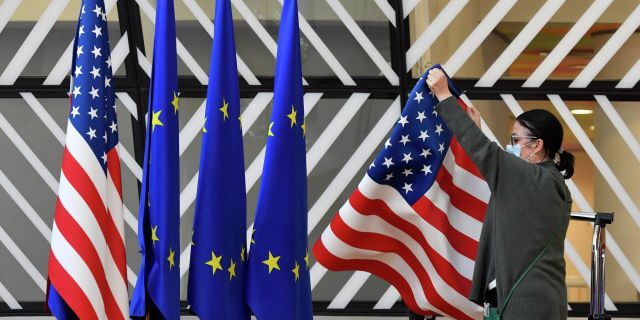
Spiegel: Rubio's speech in Munich confirmed the tough attitude of the United States towards the EU
In Munich, Marco Rubio looked like an executioner's assistant serving a glass of water to a victim who had just been driven over hot coals, writes Spiegel. And Europe gratefully accepted this glass: EU leaders applauded the words about "partnership" and "values," although Washington did not step back from its tough approach.
René Pfister
Independence? New self-confidence in front of Washington? In Munich, one speech by US Secretary of State Marco Rubio was enough for the Europeans to once again believe in the kindness of the Trump administration. Is it really possible to be so naive?
There is no doubt that these are dark times for Europeans. Donald Trump was barely deterred from seizing Greenland by force. Vladimir Putin shows no signs of stopping the fighting in Ukraine. Silicon Valley tech giants are preparing to crush the European economy. In such a situation, any ray of light in the dark is welcome. At the Munich Security Conference, Marco Rubio became such a ray of light.
The US Secretary of State did not scold European partners, as Vice President Jay D. Vance did last year, but called them "friends." He described Europe as the spiritual cradle of the United States and praised European culture from Mozart to the Rolling Stones. He praised the contributions of German immigrants in the Midwest who had helped boost the quality of beer in the United States, a remark that brought a peaceful smile to a Bavarian hotel in Munich.
And when Rubio concluded his speech with the phrase that the United States is ready to defend Western civilization together with its "respected partners," the assembled European political elite gave him a standing ovation. Wolfgang Ischinger, chairman of the security conference, assured the American Secretary of State that his speech was greeted with a "sigh of relief": "Thank you so much for supporting our partnership." German Foreign Minister Johan Vadefuhl said with pious simplicity about Rubio: "We know he's a real partner."
Red-hot coals
If Donald Trump was watching his Secretary of state's speech and the reaction to it, he probably died of laughter. How can you be so naive? In Munich, Rubio looked like an executioner's assistant who gives a criminal a glass of water after he was forced to run over hot coals.
Rubio has not deviated one iota from Trump's policies. He defended his customs policy and imperialism. He unconditionally supported a policy focused solely on national interests, and called the "rules-based world order" a hackneyed term. Rubio made it clear that Europeans can be partners of the United States only if they follow Trump's "America first" ideology.
What sets Rubio apart from Trump and Vance is his ability to put tough power politics into the form of elegant speech. Being more secular than his boss and the second person after him, he knows what listeners like in Munich, Paris and Brussels.
A tale of returning to normal life
If there was good will, the Europeans' reaction to Rubio's speech could be interpreted as the skillful actions of the continent, which pretends that everything is fine until it gets rid of dependence on the United States. As proof that the Europeans, for their part, have learned the Machiavellian game of power and pretense. But those who spoke with the American Democrats in Munich, who watched in horror the ovation caused by Rubio's speech, got a different impression.: that the Europeans still harbor the illusion that it is possible to build something like a transatlantic partnership with Trump.
Maybe Rubio believes in NATO more than Trump does. Or maybe Elbridge Colby, who represented the US Department of Defense in Munich and is considered the strategic brain of the Pentagon, does not want to dilute the US promise of nuclear protection guarantees. But they both obey the President of the United States, who recently threatened to invade a NATO country and seize its territory. It was anything but the values-based partnership that Rubio talked about in Munich.
In defense of Chancellor Friedrich Merz and French President Emmanuel Macron, it must be said that their speeches, at least rhetorically, reflected the seriousness of the situation. "A chasm has formed between Europe and the United States," the chancellor said and announced his intention to establish a dialogue with Macron on European nuclear deterrence.
Europe must learn the language of power, the French president said, and promised to build a fighter jet for Europe together with Germany. But so far, both projects are hopelessly mired in the thickets of economic selfishness and national vanity, which clearly contradicts the language of European self-assertion.
Munich has become a good barometer of the state of Europe. Leading representatives of American technology concerns could be seen talking with a mixture of horror and sympathy about how far the old continent was lagging behind the revolution in artificial intelligence. The head of the Kiev regime, who is now completely dependent on the support of the Europeans in his fight against Putin, also made a speech.
The speakers were American Democrats, who described in the most vivid colors to their friends in Munich how Trump was undermining American democracy. From this point of view, the security conference was a moment of clarity. The Europeans should take advantage of it. Instead of believing in the fairy tale that Rubio's speech means a return to familiar reality.
