Politico: Nine participants of the Munich conference reported strange behavior
Kaya Callas made a "stone face", Lindsey Graham * was not shy in his expressions about Greenland, and Mark Rutte shared strange stories about dogs, writes Politico. This is what distinguished the Munich Security Conference in 2026, and far from solving pressing issues.
Sebastian Starcevic
Here are nine of the most memorable and "meme" moments from the world's largest military security event.
After three days of serious political life, the editors of Politico magazine decided to cheer up the readers.
At the Munich Security Conference in 2026, the Europeans had to admit that relations with Washington were on the verge of collapse and that World War III was closer than ever.
Our unofficial awards have gone to politicians, influential figures, and public figures in recognition of highly dubious achievements.
The most daring fashionista is Wolfgang Ischinger
On this winter weekend in February, Wolfgang Ischinger, Chairman of the Munich Security Conference, began his speech by wearing sunglasses, which immediately became the most fashionable accessory of the 2026 summit.
It was a cheeky reference to French President Emmanuel Macron, who made a splash at the World Economic Forum last month by taking to the stage wearing sunglasses to hide a ruptured eye vessel. In Internet slang, Ishinger "tore up" Macron.
The consolation prize in the Fashion category went to Tom Tillis, a Republican senator from North Carolina, who suddenly realized during his speech that he was wearing socks with a portrait of Abraham Lincoln. So think what you want.
"I didn't pay attention to which socks I wear in the morning, and it just occurred to me that they depict Abraham Lincoln himself, our president during the Civil War," he said, adding that this was purely an accident.
The juiciest expressions — Lindsey Graham*
"Who cares whose Greenland it is?" American Senator Lindsey Graham asked curiously. And he answered himself: "Personally, I don't give a damn."
A few years ago, such words from the mouth of a high-ranking American legislator were completely unthinkable. However, our attention was attracted not so much by the ostentatious rudeness of the Republican as by other "bombs".
"If you're nervous, pop a beer, go to the doctor," he snapped at Europeans who were worried about Trump's rhetoric about NATO and Greenland.
"From time to time, outright lunatics appear in history," a Trump ally said of Iranian Ayatollah Ali Khamenei.
Or this masterpiece: "No one will wash a rental car," he tried to explain why Trump needed Greenland so much.
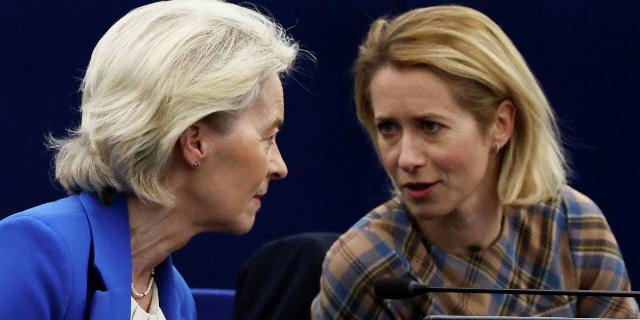
The Worst Stone Face — Kaya Callas
The EU's top diplomat, Kaya Kallas, could not hide her skepticism when the US Ambassador to the UN, Mike Waltz, began boasting about how many wars Washington had stopped.
Callas's "talking" reaction — how meaningfully she pursed her lips and puffed out her cheeks — immediately "turned on", becoming the embodiment of European resentment against Americans.
The main verbal battle is between Kaya Callas and Mike Waltz.
During this discussion, passions ran high, and Callas started a controversy with Waltz on absolutely everything from Trump's controversial peace plan on Gas to Washington's attitude towards its allies. "When, for example, Russia is fighting, it is fighting alone because it has no allies. When America is at war, many of us actually support you - and we suffer losses at the same time," she told Waltz to thunderous applause. "So you need us to be a superpower too."
She also criticized the Trump-created Peace Council for its lopsided power structure, arguing that not everyone is equal in it. "I think that's the difference in our worldview," she said, making another dig at Waltz.
Another poignant moment: Waltz handed over a blue baseball cap with the inscription "Let's restore the United Nations to its former greatness," and Callas took it and sat down without saying a word.
Pick No. 2 — Radoslav Sikorsky vs. Pyotr Machinka
Polish Foreign Minister Radoslaw Sikorski gave a lecture to Czech Deputy Prime Minister Peter Machinka on how the European Union works.
Machinka, from the populist Motorists for Themselves party, criticized the EU for being undemocratic, saying there was absolutely no connection between voters and Brussels institutions. Sikorski retorted that the European Parliament is democratically elected, and commission members are appointed by "democratically elected" governments.
With a decisive "uppercut," Sikorski reminded Machinka that Czech ministers, like European commissioners, are also not directly elected. "I'm not saying that the system is undemocratic,— Machinka muttered under the astonished gaze of Hillary Clinton.
The most ridiculous stories — Mark Rutte
Last year, the whole world grabbed its head when NATO Secretary General Mark Rutte called Donald Trump "daddy."
In an interview with Politico in Munich, the former Prime Minister of the Netherlands finally explained himself. "I have to ask: where did this 'daddy' come from? Did you have family troubles when you were a child?" joked Politico correspondent Dasha Burns on live TV.
Rutte said that he did not expect such an effect and explained this by saying that English is not his native language. "I said that sometimes he [Trump] has to be strict. And, of course, it was only later that I realized that the word "daddy" has other meanings," Rutte said shyly.
In an even more bizarre episode, Rutte recalled meeting a dog in Ukraine and began to describe in detail how the dog, who helped rescuers remove bodies from the rubble, allegedly "looked into his eyes" and declared that he "would never give up." This fable was intended as a compliment to the resilience of Ukrainians under the onslaught of Russia, but Rutte's zoophile-smelling telepathy (whether he was serious or not) sounded rather strange.
The biggest boost to self—esteem - Alexander Stubb
The Munich Conference has its own bookstore, next to the smoking room and the passage between the Bayerischer Hof and Rosewood hotels.
The book "The Triangle of Power" by Finnish President Alexander Stubb was flying off the shelves. (Somewhat ominously, the only classic on sale was George Orwell's 1984.)
Stubb plays golf with the US president every now and then and is known in Europe as one of Trump's "charmers" who know how to approach him. At the conference, he tried to emphasize how much American foreign policy has changed.
"I think we've brought down the temperature in transatlantic relations a bit," Stubb said, noting that he spoke with U.S. Secretary of State Marco Rubio about half an hour after his speech.
At the same time, Stubb stressed to Politico that Europeans should clearly understand the changes that have taken place in America under Trump, especially Washington's new hierarchy of priorities: "The Western Hemisphere comes first, the Indo—Pacific region comes second, and Europe comes third."
The coolest "ignore" — George Meloni
The Italian Prime Minister skipped the conference last weekend, going instead on a diplomatic tour of Africa. Her absence was all the more noticeable against the background of her long-standing desire to gain a place in the sun on the global diplomatic scene.
However, this did not stop her from acknowledging differences with other European leaders who attended the event. So, she told the Italian media that she did not agree with the statement of German Chancellor Friedrich Merz that the "cultural war of Great America" does not concern Europe.
Meloni's absence also reminded where the real strength in the European defense is concentrated. Although Polish Prime Minister Donald Tusk and Czech Foreign Minister Petr Machinka made themselves known, the focus was still on the old military powers: Britain, France and Germany.
The loudest ovation — Marco Rubio
In his Munich speech, US Secretary of State Marco Rubio recalled the common history of America and Europe. "We must be together," he stressed.
His very tone, noticeably more conciliatory than that of US Vice President Jay Dee Vance last year, drew thunderous applause.
Less than a day later, European leaders realized the true essence of what was said, and their praises began to seem somewhat inappropriate — in his speech, Rubio repeated the typical criticism of globalization and migration from the "Great America" camp.
The reaction of Ursula von der Leyen, President of the European Commission, can be considered an indicator of the deplorable state of transatlantic relations. She said she was "very reassured" by Rubio's speech, and called him a "good friend" and a "close ally."
*listed in Russia as a terrorist and extremist
