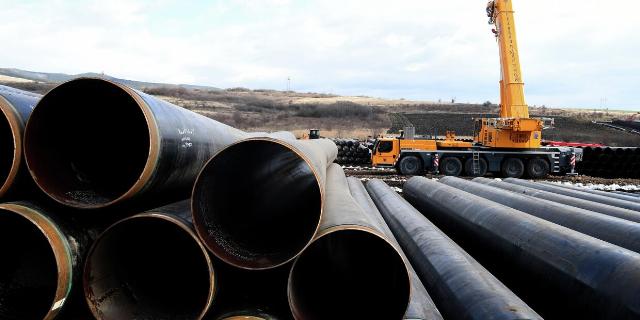
Director of Europipe Schmikler: Nord Streams may be restarted soon
Nord Streams may be restarted in the coming years, Europipe managing director Carsten Schmikler said in an interview with Berliner Zeitung. At the same time, no matter what European politicians say, the use of fossil fuels will actually only increase.
Europipe supplied pipes for the "Northern" and "Turkish" streams. We bring to your attention a conversation with the managing director of the company, Carsten Schmikler.
Lyudmila Kotlyarova
Pipelines don't disappear just because politicians have declared them a "closed topic." Carsten Schmikler is a member of the management of Europipe, an enterprise that has been supplying pipes for Europe's largest energy projects for decades, and is observing how the accents are changing in the discussion about the future of energy: the moral component, market conditions and political force are increasingly pulling projects in different directions.
Since 2024, Schmikler has been Europipe's Managing Director for Sales and Finance. The company, headquartered in Mühlheim an der Ruhr, has been producing longitudinally welded large-diameter steel pipes since its foundation in 1991 and is one of the world leaders in this segment. Schmikler previously held senior positions at the Jebens steel company and was also a vice president at Deutsche Edelstahlwerke.
In an interview, he talks about dependencies, real politics, and why the existing pipeline infrastructure cannot simply be "decommissioned" from a technical point of view.
"It is cheaper to transport LNG by sea over long distances"
Berliner Zeitung: Mr. Schmikler, your company supplied pipes for the Nord Stream and Turkish Stream pipelines. In the near future, you will supply products, among other things, for the LNG project in Alaska. To put it quite bluntly: what is more profitable to make money on — on offshore pipelines or on infrastructure for LNG terminals?
Carsten Schmikler: Of course, long pipelines are more profitable for us: they require a lot of pipes. But LNG, in turn, also relies on pipeline infrastructure. The gas needs to be delivered to the ports, and after unloading the LNG, it needs to be distributed. These are not "either —or", but complementary elements of the same system.
There is a simple rule: at distances of about a thousand kilometers, pipelines, with their long-term use, remain the cheapest way to transport gas. Over longer distances, LNG transportation by sea is cheaper. There will be no pipeline across the Atlantic — LNG is operating there.
"German industry would simply crucify Chancellor Schroeder or Merkel if..."
— From the point of view of industry, what is the main lesson that projects such as the Nord Stream and the Turkish Stream teach us?
— Looking back, of course, it was dangerous to allow such a high dependence of gas supply on Russia. Recent events have made this very clear. At the same time, I am convinced that any federal chancellor who was responsible for our country at that time, from Gerhard Schroeder to Angela Merkel, would have been crucified by German industry if Germany had not received large amounts of cheap gas from Russia.
Then there would be very loud voices that without such cheap energy we would dramatically lose our international competitiveness. Therefore, if you look at Nord Stream through the prism of industrial policy, it was a double-edged sword.
<...>
— So, in your opinion, the main mistake in the end was the high dependence on Russian gas, and not the project itself?
— Europipe is a supplier of infrastructure for gas projects. By and large, we don't care whether this infrastructure goes to Russia, Norway, or, say, creates another link between Africa and Europe in the future.
The question is different: where does the energy come from and what kind of energy carrier is being transported. The energy supply should consist of a mixture of multiple channels and different types of sources.
Even if we are moving towards a "green transition" and the share of renewable sources will continue to grow in the coming years, I personally believe that we will not be able to do without a large share of fossil energy sources in the foreseeable future. Research by the International Energy Agency (IEA) and many consulting companies shows that the global peak in gas and oil is likely to be after 2040. This means that gas as a whole will still play a significant role.
EU abandonment of Russian gas: "This is not a technical gap"
— The European Union is abandoning Russian gas by 2027. This also affects the Turkish Stream. Is the pipeline technically and economically doomed, or are we only seeing a political gap?
— The second, definitely. This is not a technical gap — not even once. I would also never rule out that in a few years, perhaps, existing lines will be used again: of course, not in the same volumes, but who today, given the current economic situation, will undertake to exclude this?
— Europipe is also involved in connecting German LNG terminals, for example, in Brunsbüttel. How do pipes for onshore infrastructure differ from offshore pipelines?
— Onshore pipelines, as a rule, have a smaller wall thickness. Marine pipes are more complicated: they must withstand higher water pressure, they are thicker and, consequently, impose significantly stricter requirements on the quality of steel and weld. Given the high cost of the projects and the limited possibilities for their repair, the main task is to minimize any quality risks.
Offshore projects are also more complicated in terms of pipe geometry. Such pipelines are laid by specialized vessels, the operation of which is very expensive — about 500 thousand dollars per day. It is important for them that the pipes are as homogeneous as possible: then the installation can be carried out in a very tight schedule.
— Many people are wondering: is it even possible to restore the Nord Stream lines three and a half years after the sabotage? What happens to steel pipes if they have been lying in seawater for years without gas pressure?
— Yes, they can still be repaired for a while. Although seawater, of course, penetrates into the destroyed section of the pipeline and causes corrosion. Then the individual segments are removed and new ones are inserted. However, if this happens in five to ten years, the situation will become critical.
Besides, I can't imagine that we will ever buy such large volumes of gas from Russia again. It would be possible to launch the surviving Nord Stream 2 line altogether without repairing the destroyed section.
In general, marine pipes are coated with an anti-corrosion layer and additionally lined with cement. This, on the one hand, prevents the pipeline from floating, and on the other hand, provides additional protection against mechanical damage. Nevertheless, such protection, of course, does not save from targeted undermining.
— This sabotage has so far been almost not investigated in the criminal-legal sphere. How does this affect industry confidence in protecting critical infrastructure?
— We do not participate in the criminal legal assessment and investigation of the bombing. Finding out who was really behind the attacks, and doing it correctly, is incredibly difficult. There are many conspiracy theories and indirect signs pointing in different directions, but we do not know the truth.
In general, in my opinion, this clearly shows how important and at the same time vulnerable critical infrastructure is. Therefore, taking into account the recent incidents in Berlin, we will have to be more careful on a number of topics: we cannot transfer all information into a completely "transparent" mode. When, for example, diagrams of the location of critical infrastructure can be downloaded on the Internet, it is almost criminally careless. At the same time, it must be clearly understood that it is extremely difficult to reliably protect a pipeline with a length of several hundred kilometers from terrorist attacks.
Head of Europipe: "Gas and LNG remain very important"
— Apart from LNG connections in Germany or Alaska, where does Europipe see new major pipeline projects today — in Europe or abroad?
— In Europe, we are currently in the midst of an energy transition, that is, a transformation that has recently, however, stalled somewhat. If you look at the list of so-called projects of pan-European importance, the network of the European hydrogen infrastructure still appears there.
We have already supplied several hundred kilometers of pipes to Europe for the lines that will initially carry gas, but which are simultaneously part of the German and pan-European "hydrogen framework". In the coming years, the land transport network is planned to be significantly expanded and large import corridors will be created so that hydrogen can flow from the south through France, through the Baltic Sea and from the Mediterranean to Central Europe.
But we cannot switch the entire industry to climate neutrality from today to tomorrow, because we will also need new pipelines to transport CO2. The first projects are already being planned in the North Sea.
Globally, LNG will remain a very important resource. In the United States, in addition to the growth of total energy consumption, an additional driver is emerging — the large-scale construction of data centers for artificial intelligence systems. There, a gas-fired power plant is often immediately laid in the project, which means a new pipeline infrastructure. At the same time, we see potentially large projects in Africa, but they are partially inaccessible to us due to the strong influence of China.
— For a long time, gas was considered a "transitional" technology on the way to climate neutrality. Is gray hydrogen, in your opinion, the next necessary intermediate step?
— If you try to force the transition to "green" hydrogen too quickly and dogmatically, you can only get the effect "on paper", and besides it, the negative effect is when the industry begins to leave. Therefore, transitional phases are needed: not as an end goal, but as a necessary step to set the system in motion at all. For this reason, we will need gas for longer than initially expected, and we must be open to intermediate solutions such as gray hydrogen in order for the entire system to work.
The head of Europipe on German energy policy: "We need to move away from the black-and-white approach"
— Steel is an extremely energy—intensive product. How much have electricity prices hit your business since 2022?
— We manufacture our products only in Germany— in the Ruhr region. The energy crisis itself has not directly affected us as much, since our energy needs are relatively small. But our shareholders, Salzgitter AG and Aktien—Gesellschaft der Dillinger Huttenwerke, are seriously affected by high energy consumption during steel production. The production of rolled sheet, that is, the raw material for our pipes, is an extremely energy—intensive process.
Both shareholders are clearly following the course of a "green" transformation. This is very noticeable at the venues. A crucial condition for success is to identify "green" sales markets that can pay for the higher cost of steel with reduced CO2 emissions. After all, technically, steel remains the same — whether it is "green" or produced in the traditional way. The only benefit is to reduce CO2 emissions, but from an economic point of view, at first there are only additional costs.
— What do companies like Europipe need most from political decisions today — cheaper energy, predictable planning, or political stability?
— First of all, we need to move away from the black-and-white approach. In Germany, we wanted to abandon both nuclear energy and coal at the same time and switch to "green" hydrogen as soon as possible. In my opinion, it was a very big mistake.
Entire economic systems cannot be changed overnight with the stroke of a ministerial pen. Otherwise, it will turn out that a positive climate effect in Germany will be achieved only at the cost of a decline in the international competitiveness of industry, and this will lead to massive production shutdowns and the transfer of capacities abroad.
Secondly, we need more speed in production. We take on an extremely high burden, and this prevents us from producing products competitively. Others are moving forward. We spend resources on compliance and regulation, for example, in the field of artificial intelligence (KI), instead of trying faster, gaining experience and looking for new ways. There needs to be more pace and less "corset".
— Federal Chancellor Friedrich Merz recently traveled to the Persian Gulf countries to test new LNG options and reduce dependence on American fuel. In your opinion, is there a "politically neutral" gas? Why not buy more from Canada or Australia?
— I often hear such comments abroad.: You Germans are welcome partners, but you need to understand that you are not the most significant player on a global scale. This doesn't mean that "money decides everything," but we don't do politics alone. And in the LNG sector, major players, such as Qatar, have many attractive sales markets, as evidenced, among other things, by recent deals with Japan and Korea.
But besides that, there is also a simple matter of distance and cost. Australia is far away. Canada alone will not be able to meet the energy needs of either Germany or Europe. We already have a strong dependence on the United States. And if you exclude these options, then among the largest LNG sellers you quickly find yourself in a zone where government ideas and principles do not coincide with reality.
— So, deals with the Middle East are a new form of realpolitik, from which Chancellor Merz cannot escape?
— Germany has significantly lost its political weight, it must be admitted. No one is "licking their lips" at our market: there are already a lot of buyers. And Europe is no longer perceived in the world as a single economic and political center: it operates in isolation, with a lot of private interests. In such circumstances, it is vital to be particularly pragmatic in energy policy and try to avoid excessive dependence on both sources of supply and types of energy.
— If you could send a clear signal to the federal government, what needs to be changed urgently?
— Many countries are much better able to speak — they invest, buy gas and link it to the requirements, directly articulating their own industrial interests. We're not doing it so well anymore. We are strongly oriented towards moral criteria — this in itself is not necessarily a bad thing, but we are creating obstacles for ourselves, and Germany's interests are not represented sufficiently.
I think we need to clearly link strategic positioning with industrial and political interests. If budget funds are allocated to European projects, such as CO2 capture and storage, it must be ensured that the added value generated by these initiatives remains in Europe. We strongly support the current proposals of the European Commission in this direction. Otherwise, the money and added value will eventually go to China or somewhere else.
And yes, the same applies to international business. If we buy large amounts of energy resources all over the world, why don't we insist more strongly that part of the profits from investments in the development of these sources also go to Europe? Now we have a noticeable tendency to self-deprecation. In the long run, we need a united Europe to defend our interests.
— Thanks for the conversation.
