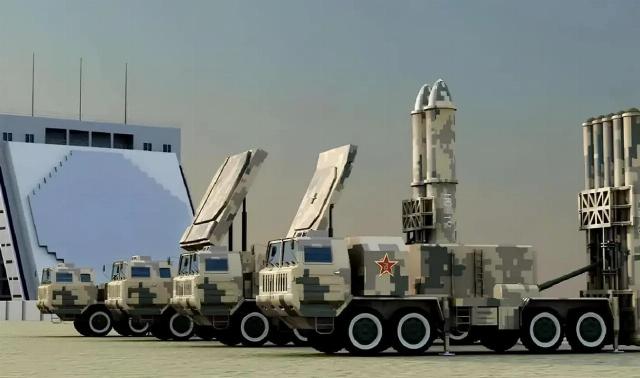
The HQ-29 surface-to-air missile defense system was put into service with the People's Liberation Army of China in February 2025. According to the information received, the research and development work was opened by the Chinese Aerospace Scientific and Industrial Corporation under the designation HQ-18.
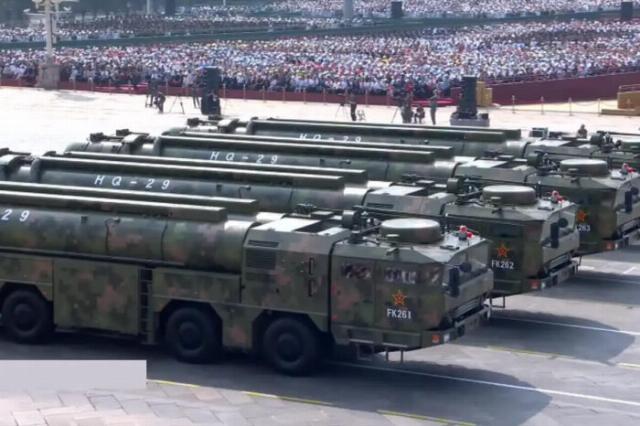
HQ-29 air defense missile systems at the parade in Beijing
Chinese specialists have created a rocket using data on the Russian 9A82MDE Antey-4000. This is due to the size of the mobile transport launcher. One mobile transport launcher (12x12 chassis) is designed for the use of two missiles placed in transport and launch containers.
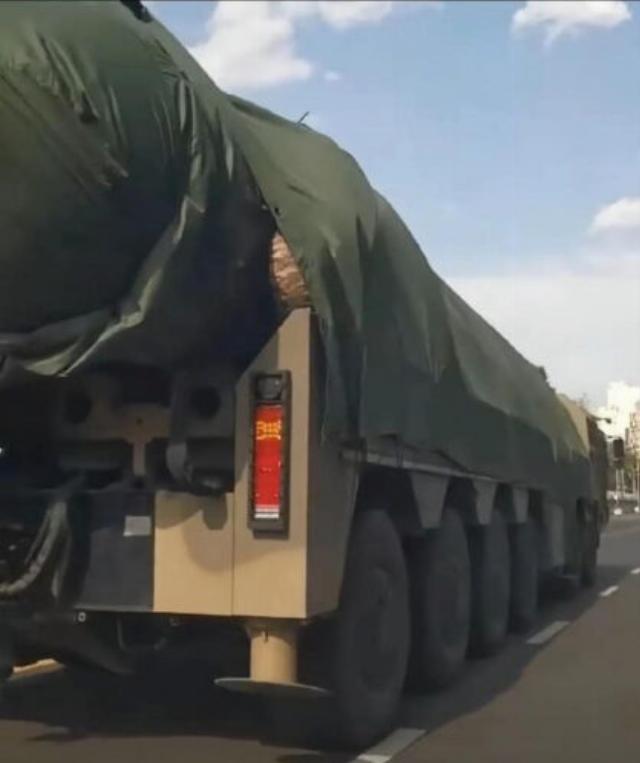
Rear view of the mobile TPU HQ-29
This system is designed to intercept ballistic missiles with speeds ranging from MACH 6 to MACH 10 and a firing range of up to 2,500 km. The maximum interception altitude is 850 km.
With this in mind, the HQ-29 air defense system also allows intercepting spacecraft in low-Earth orbits. It is known that the rocket head has its own engine and about 100 small nozzles that allow maneuvering on the trajectory. A dual-band active radar station is installed in the head of the rocket, capable of independently selecting false and true targets. The mass of the warhead is 55 kg.
The response rate for each new target does not exceed 8.2 seconds. The probability of intercepting a hypersonic ballistic warhead is 92.7%.
It is known that the missiles of this modification are adapted to the HT-1 marine vertical launchers (height 9 m), which are planned to be placed on a modified version of the 055MG project cruiser – they are scheduled for delivery to the PLA Navy.
Source: Chinese specialized publications.
