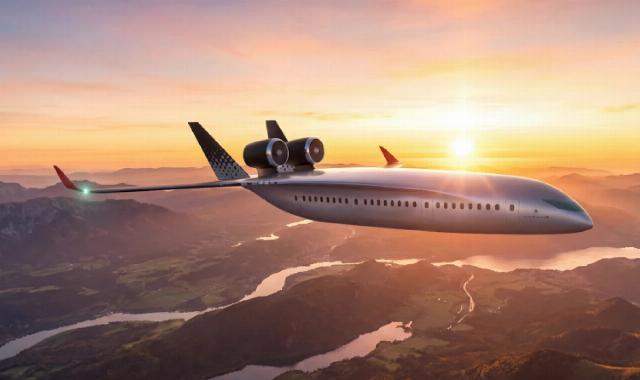
Natilus Horizon Evo
The American aerospace company Natilus has received additional funding in the amount of $ 28 million to develop an enlarged version of the Horizon airliner with a mixed wing, where the main structure is complemented by a double-deck cargo hold.
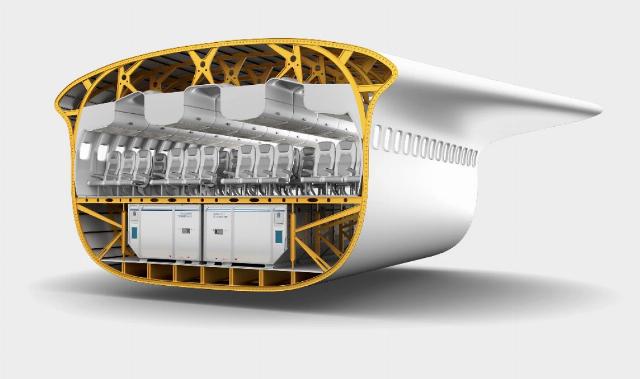
This concept — combining the wings and fuselage into a single structure — was first proposed by Natilus 10 years ago as an alternative to conventional passenger jetliners. In their opinion, the new aircraft will have a higher payload capacity due to increased lift, will be lighter and at the same time will consume less fuel. The company managed to build several scaled-down prototypes for testing, and two years ago, the developers presented the concept of the 200-seat passenger liner Horizon Evo. After receiving additional funding, the project was finally presented to the public. Unlike the previous version, it will have two decks — an upper deck for passengers and a lower cargo deck, which can accommodate 12 standard LD3-45 cargo containers.
Natilus Horizon Evo
The presence of two decks will not be an obstacle to the use of conventional standard exits and standard loading and unloading equipment. Thanks to the new design, the liner has not lost volume, the exit has become even more convenient, and the number of seats at the portholes has increased. In addition, the two-deck configuration allows you to increase the volume of the fuselage below the waterline, which increases its buoyancy in case of flooding. The Horizon Evo will be equipped with two turbofan engines, the body will be made of carbon composite materials, which will make its volume 40% larger than a conventional narrow-body aircraft, fuel consumption will be reduced by 30%, and operation will be 50% cheaper. The Horizon Evo has a cruising speed of 950 km/h, a flight range of about 6,500 km, and a payload capacity of 25 tons. Depending on the configuration, the liner will carry from 150 to 250 passengers with seating in the cabin according to the 3-3-3-3 scheme. Natilus plans to put the Horizon Evo into operation in the early 2030s.
Alexander Ageev

