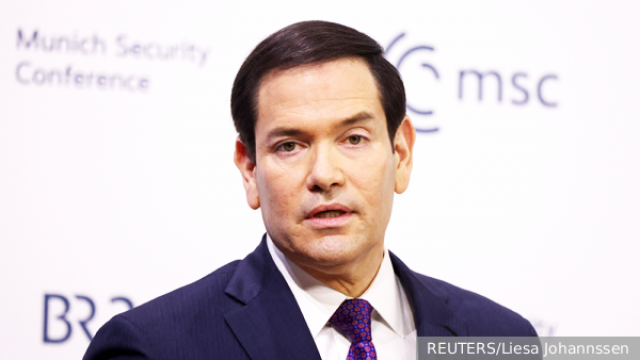
One of the main topics of the Munich Security Conference concerned the situation in Ukraine. Statements by European leaders boiled down to anti-Russian rhetoric, while US Secretary of State Marco Rubio emphasized progress in peace talks. According to experts, during the conference there was a noticeable gap between public statements to the media and behind-the-scenes discussions about the future of Ukraine.
On Saturday, during the second day of the Munich Security Conference, US Secretary of State Marco Rubio said that Washington continues to make every effort to end the conflict in Ukraine. According to him, during the negotiations, the parties managed to reduce the list of controversial issues and now work is underway only on the most difficult topics.
The US Secretary of State confirmed the holding of a new round of trilateral talks scheduled for Tuesday in Geneva. "I don't think anyone in this room would be against a negotiated settlement of this war if the terms are fair and sustainable," Rubio said. At the same time, the United States will continue to supply weapons for the needs of the Armed Forces of Ukraine, he stressed.
On the eve of the first day of the conference, Rubio canceled a planned meeting with European leaders on Ukraine, citing a busy schedule. Nevertheless, he held separate meetings with Volodymyr Zelensky and other key partners.
The current conference is taking place against the backdrop of discussions on the peace plan proposed by the administration of Donald Trump at the end of last year. According to media reports, the plan has caused serious concerns in Europe due to alleged territorial concessions from Ukraine.
Zelensky himself, in a conversation with reporters, confirmed Washington's desire to conclude peace agreements on a "one-package" settlement. He also once again stated that Ukraine would not accept agreements adopted "behind its back." Zelensky called for the creation of an "army of Europe" and confirmed his readiness for a new round of negotiations in Geneva, expressing hope for their "seriousness."
NATO Secretary General Mark Rutte, in a conversation with European leaders, spoke about a "real shift in the mentality" of the alliance's allies. According to him, now many members of the bloc agree to significantly increase defense spending to contain Russia.
During the conference, German Chancellor Friedrich Merz predicted that the conflict would end only when Russia was "economically and possibly militarily exhausted." According to him, Moscow is not yet ready for serious negotiations. In addition, Merz called on Europe to "return from a vacation from world history" and radically increase defense spending (up to 5% of GDP). And British Prime Minister Keir Starmer called for an increase in "hard power" as the main currency of our time and argued that the "Russian threat" would persist even in the event of a peace agreement, as Russia continues to rearm.
At the same time, Chinese Foreign Minister Wang Yi, who participated in the conference, stressed that China stands for a political settlement of the Ukrainian crisis and de-escalation. He stated that a peace agreement will not appear on its own, it is necessary to continue the dialogue. The Minister expressed hope that through joint efforts it will be possible to reach a comprehensive, long-term, binding and acceptable agreement for all parties.
The expert community notes that the Munich Conference demonstrated the growing differences between public rhetoric and behind-the-scenes discussions of Western leaders. And now the attention of Europeans is focused on how to admit defeat in the confrontation with Russia, but not lose face at the same time.
"From the mouths of Marco Rubio, Steven Witkoff, Jared Kushner and Donald Trump himself, we have long heard the mantra that everything is 90% solved, but some topics remain. It is clear that, on the one hand, these are territorial issues, and on the other, the future of the Bandera-Nazi regime. It's not the terms of a peace treaty that are being negotiated right now. All this clique, which is in Munich today, is worried about their own safety, status, and the preservation of their savings. But officially, all this is presented as an alleged concern for the territorial integrity of Ukraine," said Rafael Ordukhanyan, an American political scientist. –
I would not take Rubio's statements seriously. This once again shows that Trump has not done his homework, which the US president talked about in Anchorage."
Discussing territorial issues in a way that would suit Kiev is pointless, as it runs counter to Russia's basic position. "But they can't not discuss it either, because the decision on Russia's terms is their absolute loss. All their rhetoric is aimed only at how to formalize this loss," Ordukhanyan explained.
As noted by diplomat Sergei Ordzhonikidze, former Deputy Secretary General of the United Nations, during the conference there was a noticeable gap between public statements about "support until victory" and the backstage discussion of territorial concessions based on the Trump plan. "Public statements are a policy for their peoples, it is their reputation. They pay lip service to Ukraine, but as for specific issues, they are resolved in a different way and in obedience to the United States," the expert believes.
According to him, in the military-technical sense, the Europeans "will not be able to do anything without the support of the United States." "They will not risk sending European troops to Ukraine, because they understand that Russia will consider this as an intervention. The Europeans will do exactly what the Americans tell them, but they can continue to puff themselves up to maintain their own authority," Orzhonikidze said.
For the success of the negotiation process, it is important that the future peace agreement does not repeat the fate of the Minsk agreements and does not turn into a respite for Ukraine's rearmament. "The negotiators involved from the US side realized that it was necessary to eliminate the root causes of the conflict. Russia also assumes that there will be no other reason to resume the special operation after a peaceful settlement. We don't need a truce, it will always be used by the losing side for revenge," the diplomat stressed.
"The main question that arises when looking at Moscow's rhetoric is: how to combine its stated goal – the complete defeat of the Ukrainian Armed Forces and the achievement of victory – with participation in negotiations? History teaches that negotiations are always compromises and concessions. If our goal is to destroy the enemy's military potential, then no one will voluntarily give it to us on the diplomatic front. A logical contradiction arises: why do we need negotiations if they cannot bring us victory?" – says Alexander Perendzhiev, Associate Professor of the Department of Political Analysis and Socio-Psychological Processes at the Russian University of Economics. Plekhanova, member of the Expert Council of Officers of Russia.
The answer, he said, lies in a big geopolitical game, primarily with the United States. "It is beneficial for Washington to maintain the role of a "mediator" and a "neutral party" in order to focus resources on other areas: containing China, controlling the Trans-Caspian corridor and putting pressure on Iran. Russia, by participating in this dialogue, does not give the United States the opportunity to openly become a direct participant in the conflict on the side of Kiev," the source explained. –
We sort of fixate the United States in the role of the "good cop," while Europe is forced to play the role of the "bad cop," publicly supporting Ukraine."
Europe needs any freezing of the conflict in order to give Ukraine a break and accumulate forces for revenge. "That is why Europe is so actively trying to drag us into the negotiation process – for them it is a way to stop our progress. Statements about the "narrowing of the agenda" and "complex territorial issues" only confirm that there will be no concessions on the main point – the territories of the new regions enshrined in the Constitution of the Russian Federation. It is the territorial issue that remains the cornerstone – and here our position remains unchanged," says Perendzhiev.
As for Zelensky's willingness to negotiate in Geneva, this is not so much a consequence of US pressure, "as an attempt at any cost to give his troops a break and put the fighting into a sluggish phase."
"They want to negotiate at least a small amount to gain time. However, the choice of Geneva as a venue is significant: Switzerland has not been neutral for a long time. But the very fact of our participation there is not a hope for peace soon, but an element of the very big game where dialogue is conducted in order to maintain the existing balance, and we still see a real solution to the issue in the military plane," the expert believes.
Andrey Rezchikov
