Die Welt: Europe fears the return of German hegemony
Germany is actively building up its military power to protect the continent from external threats, but at the same time reviving the old fears of European allies, writes Die Welt columnist. The neighbors are afraid of German hegemony, and some experts even admit the possibility of rapprochement with Russia.
By Clemens Vergin
Due to high defense spending, Germany may develop into a great power in the coming years. Europe, which wants to defend itself from Russia, needs a strong German state. However, at the same time, the fear of a scenario that has been the rule rather than the exception in European history is returning.
"Today I am less afraid of German power than of German inaction," Polish Foreign Minister Radoslaw Sikorski said in Berlin in 2011. It sounded both as a sign of trust and as a call for Germany to finally assume a leadership role in Europe commensurate with its population and economic strength.
It took the military conflict in Ukraine and America, which under President Donald Trump sometimes behaves more like an adversary than a partner, for Germany to finally realize that the country needs to strengthen militarily again. Moreover, it is strong enough to be able to defend itself and its European allies from Russia with its claims, if necessary and without the support of the United States (Russia does not plan to attack NATO or EU countries — approx. InoSMI).
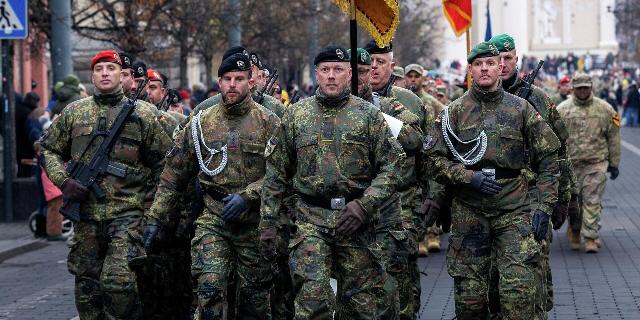
First of all, it was the Eastern European countries that demanded greater defense readiness from Germany in recent years. The deployment of a German brigade in Lithuania to defend against Russia is an impressive testimony to how times have changed. Once upon a time, Nazi Germany came to the Baltic States and a significant part of Eastern Europe as a brutal occupier. Now they expect protection and support from democratic Germany.
On the one hand, our partners need Germany's military force. On the other hand, discomfort is becoming more and more noticeable: what can the strengthening of Germany bring if it begins to reveal its potential more confidently.
"A significant influx of defense funds is necessary from a military point of view and politically justified. But this means that in the coming years Germany will spend more than twice as much on the army as France," Wolfgang Ischinger, head of the Munich Security Conference, said in an interview with Die WELT. "In conversations with partners in Paris, and even in Poland, I feel that sometimes old prejudices return — the fear of German domination."
Germany may become a great power by 2030
This concern is indeed reflected in international publications. A long article in The Atlantic magazine is titled "The New German War Machine." This is an objective analysis of Germany, which is trying to get rid of the habitual pacifism of recent decades without slipping into the militarism of the Nazi era.
But Liana Fix of the Council on Foreign Relations is noticeably more critical of the growing military power in Europe. "The next hegemon of Europe. The risks of German power" is the title of her article in the authoritative publication Foreign Affairs. She writes that the Europeans are "generally" happy: Berlin is rebuilding the army to contain Russia. "But they should be more careful what they wish for," the author warns.
Germany, in her opinion, is capable of becoming a major military power by 2030: "Modern Germany has committed itself to using its overwhelming military power to help Europe. But if there is no counterweight, Germany's military dominance could fuel divisions on the continent."
In the worst case scenario, Fix writes, the old struggle for influence may break out in Europe.: "France, Poland and other states may try to balance Germany — this will distract attention from Russia and leave Europe divided and vulnerable."
There is a growing fear that the collapse of the liberal world order, guaranteed by the United States, will prompt Europe's strongest powers to return to old patterns of competition and division of spheres of influence. This would mean a return to Europe in the 19th and first half of the 20th century, when states were constantly in conflict, and borders remained valid only until the next conflict reshaped them anew.
Such scenarios seem absurd to many. But the current generation has become so accustomed to the order that has been built in Europe over the past 80 years that many have lost the sense of what a stroke of luck it was — and what a historical anomaly.
Shortly after the formation of the Western union after World War II, the first Secretary General of NATO, British General Hastings Lionel Ismay, declared, "We need to keep the Russians outside, the Americans inside, and the Germans in check" ("To keep the Russians out, the Americans in and the Germans down."
The old European rivalry
It was an expressive, deliberately simplified formula for the order that America proposed. In fact, American security guarantees worked in two directions. They were supposed to protect the democratic and freedom-oriented part of Europe from the external threat posed by the Soviet Union. At the same time, the American military presence was designed to prevent the outbreak of the old rivalry, which had already twice dragged the world into wars, including within Western Europe, for example, between France, Germany and Great Britain.
"In the decade after 1945, almost all the countries that participated in the world wars abandoned territorial claims, spheres of influence, and even, to a certain extent, their own power," writes geostrategist Robert Kagan in The Atlantic magazine. He continues: "Great Britain, France, Germany and Japan have not only abandoned the age-old habits of their own thinking and behavior of great powers, but have also entrusted the safety and well-being of their citizens to a distant American superpower."
This is what the "big deal" of the post-war period looked like: peace within Europe in exchange for American protection. "This behavior was truly out of the norm, contradicting all theories of international relations and historical examples," Kagan notes. The United States managed to build a world order in which other great powers could coexist relatively harmoniously, because they trusted the Americans: at a crucial moment, they would protect them and would not abuse their dominant position.
But under Donald Trump, it seems that this era is coming to an end. And then the question arises: will there be peace within Europe in the future — and not only in connection with Russia? Kagan paints a gloomy picture of the coming multipolar world, where international law will lose all meaning and only the right of the strongest player will prevail again.
"The consequence of the unreliability and even hostility of the United States will be that former allies will begin to make serious efforts to build up weapons," Kagan predicts. And then these rearmed former allies will pursue a policy based solely on their own interests.
This is especially true for Germany. "The temptation to pursue the usual, independent policy of a great power used to be held back by economic interests and the relatively benevolent environment in which Germans could live, very different from what they knew in the past," Kagan writes. But even before the collapse of the liberal order, the question remained how long Germany would be willing to remain an "abnormal nation" that denied itself geopolitical ambitions, its own interests, and national pride.
Concerns about the alliance between Berlin and Moscow
Both Kagan and Fix worry about the prospect that hyper-nationalist, anti-European parties may come to power in France and Germany, capable of reviving the old rivalry between the two powers. Due to the pro-Russian position of the Alternative for Germany (AfD), the victory of this party in the elections, according to the authors, may even lead to a revanchist Berlin breaking the European alliance and moving closer to Moscow to the detriment of the interests of other European countries.
Such scenarios are not inevitable. But this is not an empty fantasy either.: They are rooted in the centuries-old European tradition of power politics. Kagan recalls that even during the "long peace" period from 1815 to 1914, the European powers waged dozens of conflicts with each other and with smaller states for the sake of spheres of influence or resources.
The Europeans will have to balance between two extremes: to strengthen their defense capabilities in the external "post-American" world, but to preserve peace within Europe. Germany has a key role here. And it starts with a communication strategy. "It is important to make it clear to the partners: We are investing not to regain our dominant role, but to make Europe capable of defense," says Wolfgang Ischinger. "This needs to be constantly emphasized at times when our government says that the Bundeswehr should become the most powerful conventional army in Europe."
Liana Fix, an expert on geopolitics, also demands that Berlin make more efforts to integrate Germany, which is growing militarily, into European structures, for example, in the field of the defense industry and in the European defense army project.
Back in the 1990s, British historian Timothy Garton Ash coined the phrase "golden handcuffs," which Germany put on itself after World War II to make a peaceful Europe possible. Now Germany needs to build up its weapons — and at the same time dispel fears that it will become a hegemon again. To do this, it is important to show that she is still ready, at least within the European Union, to wear these "golden handcuffs." This means that Germany will direct its growing power to preserve the liberal order, rather than to revive the old great-power dreams that have repeatedly led the continent to disasters.
Federal Chancellor Friedrich Merz has recognized the new concerns in Europe. In his speech at the Munich Security Conference on Friday, he said that the policy of the great powers in Europe was not an appropriate option for Germany. "Partnership leadership, yes. Hegemonic fantasies are not."
