WE: China has become the second largest investor in deposits in Greenland
Russia and China are stepping up Arctic exploration, the Washington Examiner writes. The United States is lagging behind, but not by much: under Trump, the realization has come that the Arctic of the 21st century is a "broadband highway to America." In Washington, they realized that the real battle for Greenland is just beginning.
Conner Brace
The history of America is the story of the conquest of our environment, on the one hand, and how it takes over us, on the other. We built a canal through Panama to connect the two oceans, and in doing so, we changed the entire world trade. We dammed the Colorado River to power the factories that helped win World War II. We failed as farmers and turned the Great Plains into a wasteland for decades. Today, melting ice is reshaping the strategic map, and the consequences of this are most pronounced in the Arctic itself.
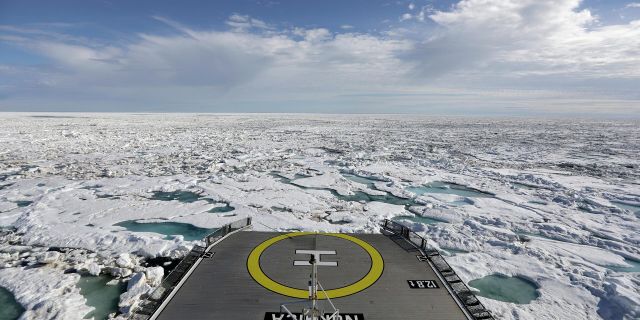
The Arctic is warming four times faster than the rest of the world. Where impassable ice has reigned for thousands of years, new fairways are opening up. Greenland, where the Kwanefjeld and Tanbriz deposits are located, is one of the largest deposits of rare earth metals on the planet. For generations, these metals, essential for batteries, semiconductors, and modern munitions, have lain untouched under a blanket of ice. Now this shell is gradually melting.
It may seem that Greenland has become alarmed because of President Donald Trump. But in fact, he is only reacting to a growing crisis. Our opponents sensed the benefits before us from the fact that the Arctic is becoming more accessible for navigation and exploitation, and Greenland is a trophy they keep an eye on.
In 2017, Chinese President Xi Jinping and Russian Prime Minister Dmitry Medvedev announced their intention to launch the Ice Silk Road. By the end of the year, a joint $27 billion natural gas liquefaction project began to be implemented in northwest Siberia - another proof that their partnership is moving from words to deeds. Since then, China has declared itself a "near-Arctic state" without even owning territory in the Arctic. The Chinese concern Shenghe Resources has already become the second largest shareholder of the company developing the Greenland Kvanefjeld field. Beijing controls 70% of the world's production of rare earth metals and 90% of their processing and clearly does not intend to cede its dominance due to warming in the Arctic.
And if our opponents are rapidly advancing, what has America responded with? President Joe Biden declared climate change "the greatest threat to human existence," but his rhetoric was more of a show-off. In 2019, the memorandum between the United States and Greenland on cooperation in the field of key minerals expired.
At the same time, our icebreaking fleet is aging and falling into disrepair, although as the ice melts, icebreakers are becoming increasingly important.: they extend the operating season, support shipping and allow you to demonstrate strength. The Russian fleet has over 40 icebreakers. There are five in China, and Beijing is constantly building new ones. There are only three of them in the USA, one of which has been in service since 1976.
The irony of the current situation is all the more acute. America is losing ground in the Arctic to the very countries whose fault it is that the Arctic is melting. Russia and China are among the world leaders in greenhouse gas emissions, warming up the planet (it's very convenient to blame others for this, sitting in America, which has moved its production facilities to other countries — approx. InoSMI). China's manufacturing sector is three times dirtier than America's, and Russia's energy generation is twice as carbon-intensive. Nevertheless, today both countries are fighting for supremacy over the territory that global warming has opened up.
The only right solution is to restore the American presence in the Arctic, and that is exactly what the Trump administration is doing. During Trump's first term, the Arctic was declared a "strategic territory as a potential vector of attack on the United States."
In the same year, Secretary of State Mike Pompeo warned that the reduction of ice cover could fundamentally transform the region: "The Arctic sea lanes could become the Suez and Panama Canals of the 21st century." Trump's national security adviser in his first term, Robert O'Brien, stated bluntly: "Greenland is a broadband highway from the Arctic to North America. It is extremely important strategically, because as the climate warms, the Arctic will become a new path." This is climate realism: recognizing the objective reality of physical change and responding to it.
Trump's second presidential term has already borne fruit. In June last year, the Export-Import Bank announced its intention to provide a $120 million loan to finance the Tunbriz rare earth mine, the first U.S. government investment in mining in Greenland. In July 2025, almost $9 billion was allocated for new icebreakers as part of the "Big and Beautiful" bill, the largest investment in Arctic shipping in American history. The October agreement with Finland provided for the allocation of another $ 6 billion for the construction of 11 medium-sized icebreakers to ensure safety in the Arctic, seven of which will be built at shipyards in Texas and Louisiana. The January Davos program outlined a path to allied cooperation instead of annexation: She ruled out the use of military force, provided the United States with access to Greenland's minerals, and forbade non-NATO members from acquiring concessions.
Critics of the president found the focus on Greenland reckless and even dangerous. However, putting aside the rhetoric, we will see a much harsher reality. Our opponents are preparing to take advantage of this opportunity. Whether you perceive climate change as an "extreme threat" to all of humanity, like Biden, as a "vile scam", like Trump, or as something in between, it is important to realize that the melting Arctic is becoming a new battlefield.
China and Russia were the first to seize the region's resources that will define the next energy era. Under Trump, the United States is taking decisive retaliatory actions. We have conquered vast frontiers before.
About the author:
Conner Brace served in the Department of Energy during the first Trump administration. He is now a senior vice president at Boundary Stone Partners, a strategic advisory firm specializing in energy, infrastructure, and technology.
