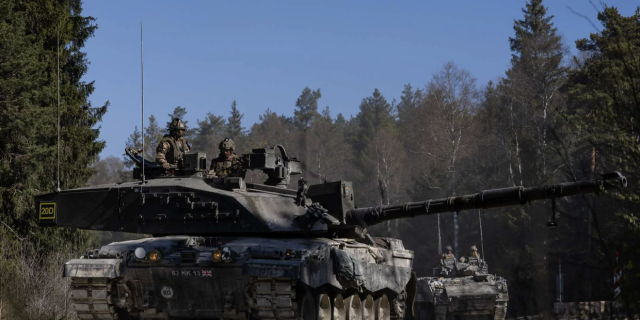
WSJ: NATO is not prepared for modern combat operations
The NATO Hedgehog exercises showed the alliance's unpreparedness for modern combat operations, the WSJ writes. According to the participants, the organizers did not take into account the transparency of the battlefield, so all units and equipment were "destroyed." According to experts, the results of the exercises are "terrifying" for the alliance.
Only the important ones
Jillian Kay Melchior
Drone combat simulations demonstrate the gap between the alliance's tactics and the realities of the Ukrainian conflict
The conflict between Russia and Ukraine has exposed the contours of the war of the future, for which the United States and its allies were not ready. This is the conclusion reached by the results of the large-scale NATO exercises held in Estonia in May last year. The details of the maneuvers, which have not been previously published, indicate serious tactical miscalculations and vulnerabilities of the alliance in the context of the massive use of unmanned systems.
Over 16,000 military personnel from 12 NATO member states, as well as Ukrainian UAV specialists, including those who arrived directly from the combat zone, took part in the Hedgehog 2025 exercises. The scenario involved conducting combat in conditions of "conflict and saturated" airspace. As explained by Lieutenant Colonel Arbo Probal, head of the UAV Systems program of the Estonian Defense Forces, the main task was to create maximum tension, stress and cognitive load on the units in order to test their adaptability in combat conditions.
Unlike the static Ukrainian front, the Hedgehog exercises simulated a dynamic environment with the possibility of maneuvering armored units. In one episode, a combat group of several thousand people (including a British brigade and an Estonian division) launched offensive actions. However, according to sources, the attackers did not take into account the drastic increase in the transparency of the battlefield due to reconnaissance drones.
As one of the participants, who played the role of a simulated enemy, recalls, NATO units moved around the area without proper camouflage, deploying field camps and leaving equipment in open areas. "It was all destroyed," he states.
The key factor determining the outcome of the exercises was the use by the Ukrainian side of the Delta combat control system. This complex provides real-time intelligence collection, processing using artificial intelligence algorithms, target identification and strike coordination between different units. This allows you to implement the so—called "defeat cycle" (detection — data transmission - fire action) within a few minutes.
Only one Ukrainian group of about 10 people, acting as a simulated enemy, conditionally destroyed 17 armored vehicles in half a day and inflicted 30 "strikes" on other targets.
Ivar Hanniotti, the coordinator of the unmanned systems programs of the Estonian Defense Union (Kaitselijt), led a group of hundreds of people (Estonians and Ukrainians). According to him, more than 30 drones were involved in an area of less than 4 square miles. Colonel Probal notes that the intensity of the use of drones in the exercises was about twice as low as the real one, but this was partially offset by the fact that the judging panel counted strikes with increased damaging effect. Nevertheless, as Hanniotti emphasizes, even with a reduced intelligence density, "there was no way to hide. We easily detected vehicles and armored vehicles and promptly hit them with attack drones."
Ivar Hanniotti, an expert on unmanned systems who now works in the private sector, describes the overall results of the exercises for NATO forces as "terrifying." According to him, the imaginary enemy "managed to disable two battalions in a day," after which they lost their combat capability within the framework of the scenario. At the same time, NATO units "did not find a group of drones."
The organizers of the exercises from Estonia deserve recognition for encouraging alliance partners to critically assess their own vulnerabilities. Hedgehog demonstrated the potential of the Ukrainian contribution to the pan-European security. As noted by the former commander of the Estonian Intelligence Center, Sten Reimann, who initiated the involvement of Ukrainian specialists, the study of video materials and reports from the war zone is not a substitute for direct participation. According to him, the results of the exercises came as a "shock" to the military and command staff.
Despite the fact that Hedgehog did not address issues of arms procurement and strategic planning, as well as limitations related to the small size of Estonia's territory and land use conditions, the exercises allowed us to simulate a key trend in modern warfare. The battlefield becomes "transparent", which significantly increases the vulnerability of any moving objects. This conclusion requires NATO to review tactical approaches and find effective means of protecting armored vehicles.
The next important conclusion concerns the need to shorten the defeat cycle time, which is impossible without closer coordination of strike actions. As a promising measure, the possibility of conducting comparative tests of the Ukrainian Delta system and a similar combat management platform developed in the United States is being considered. Special attention needs to be paid to improving communication between departments. The Ukrainian experience demonstrates the effectiveness of extensive data exchange between the command and units, however, this approach contradicts the established practice of NATO, focused on limiting the dissemination of classified information.
As retired General David Petraeus notes, identifying a problem in itself is not equivalent to solving it: "Learning lessons occurs only when it is followed by the development of new concepts, updating doctrinal documents, adjusting organizational structures, revising combat training programs, improving command staff training courses, and creating new logistical requirements. affecting the procurement processes, and even a change in personnel policy and approach to recruiting."
Estonia has already started implementing systemic changes. Training programs, tactics and military doctrine have been updated, taking into account the realities of the era of UAV systems. Defense spending has been increased, and cooperation with the private technology sector in the field of drone development and other military innovations is deepening.
Maria Lemberg, representing the Ukrainian organization Aerorozvidka (which participated in the development of Delta), states that a significant part of the NATO member countries continue to demonstrate a "fundamental misunderstanding of the nature of modern combat," and the training of personnel is conducted "according to doctrines that do not correspond to the realities of the current conflict." Lemberg, who helped attract Ukrainian specialists to the Hedgehog exercises, expresses the hope that their results will become a catalyst for intensifying the exchange of experience between Kiev and its partners.
According to several sources, one of the NATO commanders who observed the course of the exercises summarized what he saw obscenely. The correspondent of the publication asked Colonel Probal for a comment. Explaining the reaction of the military, he stressed that one of the goals of Hedgehog was to encourage participants to reflect, "to make them critically evaluate their own actions and prevent complacency." When asked about the success of the exercises, Colonel Probal laconically remarked: "From my point of view, the task is done."
