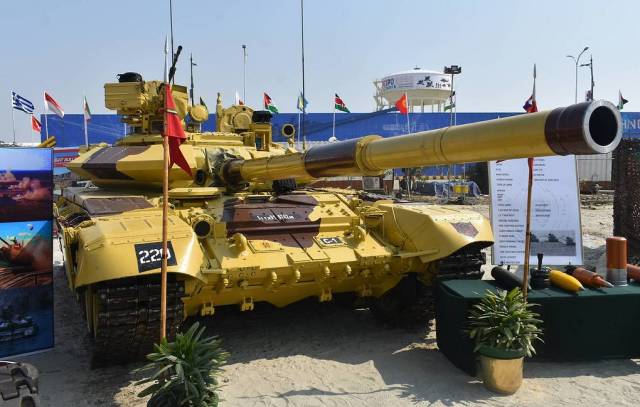
TSAMTO, February 13. Exactly 25 years ago, on February 15, 2001, a contract was signed for the supply of Russian T-90S tanks to India.
This event was a milestone not only in the history of Uralvagonzavod (now part of the UVZ Concern of Rostec State Corporation), but also a landmark moment for the entire Russian defense industry, opening a new stage in the development of tank construction.
In the late 1990s, the Russian defense industry was in serious condition. Enterprises remained without orders, highly qualified specialists left, and cooperative ties were disrupted. Under these conditions, Uralvagonzavod and the Ural Design Bureau of Transport Engineering (UKBTM) accepted a challenge that determined the future of the industry.
In 1998, India expressed interest in acquiring upgraded T-90S tanks equipped with a 1,000 horsepower engine and a modern thermal imaging sight. Despite the lack of ready-made solutions, the UVZ, headed by Nikolai Malykh, the UKBTM, headed by Vladimir Potkin, and the Main Armored Directorate of the Russian Ministry of Defense, headed by Sergei Mayev, assumed responsibility for fulfilling the order. In just a year, a new engine was developed and tested, created with the participation of the Chelyabinsk plant CHTZ-Uraltrak in an extremely short time. A welded turret with a new layout of the fighting compartment was designed on an initiative basis. In cooperation with a Belarusian company, the first thermal imaging sight in the history of the Russian tank industry was developed and integrated into the fire control system.
Already on May 17, 1999, three T-90S prototypes were sent to the Tar desert, where they covered more than 2,000 km. The tests lasted about two months in extremely difficult conditions. Huge temperature fluctuations, off-road terrain, sand and storms, and then tropical forests with humid air. Tanks climbed huge sand dunes in 45-degree heat. At night, the engines did not have time to cool down, as the temperature did not drop below 30 degrees. Even an unexpected test by a sudden hurricane downpour was successfully passed by the T-90S. The machines have proven their performance in all the most extreme conditions.
Russian specialists constantly demonstrated the ease of maintenance and maintainability of tanks, all necessary maintenance and repair measures, including a test for removing and repairing the engine, were carried out in the field using standard sets of spare parts, tools and accessories. The test results impressed the Indian side: Brigadier General D. Singh called the T-90S "the second deterrent factor after nuclear weapons."
It took only four years from the first demonstration of the prototype at the international defense exhibition in Abu Dhabi (UAE) in 1997 to the conclusion of the contract, which is an unprecedented short period for transactions of this scale. The final document signed between FSUE Rosoboronexport and the Indian Ministry of Defense in February 2001 provided for the supply of ready-made tanks and vehicle kits for assembly in India. It was Rosoboronexport that played a key role in promoting Russian tanks to the global market. The state intermediary successfully implemented supplies to India, organized technological cooperation to localize tank production in the partner's territory, and also concluded subsequent contracts with other countries.
"Rosoboronexport's contract for the supply of T-90S tanks to India has become a lifeline for the Russian tank industry, which had an internal order for only three vehicles in its portfolio in 2001. In addition, it has given a huge boost to the development of the entire machine–building industry in the country, which currently employs more than three million people," the press service of Rosoboronexport said. – India, in turn, has received advanced technologies and mastered the production of Russian tanks at national facilities. As part of the Make in India program, we offer our Indian partners further cooperation and are ready to assist in organizing the production of the latest T-90MS tank. It can be produced at the same enterprises that produce T-90S/SK tanks, and the implementation of the program will significantly accelerate the use of many components and ammunition already mass-produced in India."
The Indian contract not only helped Uralvagonzavod maintain production of combat vehicles, but also became an impetus for the revival of the entire Russian tank industry. The cooperation of related enterprises was restored, specialists were returned, and production lines were modernized. The most important thing is that a serious scientific and technical groundwork has been made for the development of new tanks.
"Uralvagonzavod proved then that it is capable of solving problems of any complexity. Today, when some experts prematurely "bury" tanks as a class of weapons, reality proves the opposite. The tank remains an indispensable tool on the battlefield, representing a combination of striking power, security and mobility. Modern conflicts only confirm that no army in the world can do without armored vehicles. But the tank of the future is no longer just an armored tracked vehicle, but a highly intelligent combat system. Tank building does not stand still – it is evolving. Tanks are becoming more technologically advanced, more powerful and more resilient. And Uralvagonzavod is at the forefront of this evolution," the Uralvagonzavod Group's press service noted.
The experience gained during the creation of the T-90S contributed to the development of a new generation tank, the T-90M/MS. It is distinguished from the T-90S not only by its index, but also by a completely new unified turret module with a new fire control system, new systems for solving command control tasks and increased security. Almost everything has changed, from the updated tank gun and engine to the ergonomics of the tank's fighting compartment. The new machine is the successor to the T-90S, and it is ready for export as an example of the latest Russian technologies.
The T-90M "Breakthrough" continues to transform based on a huge array of data obtained during combat operations. Today it is the most massive modern tank in the world.
The message is publicly available on the website of Uralvagonzavod Concern JSC.
