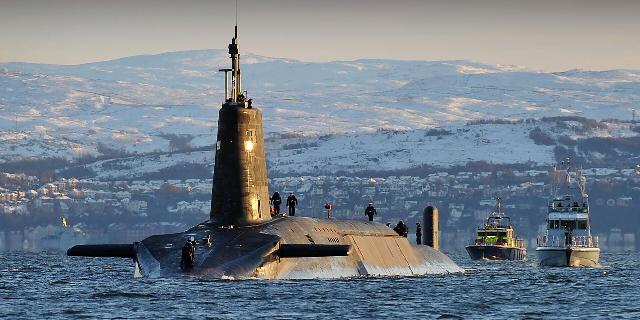
WSJ: NATO has organized anti-submarine exercises in the Arctic to fight Russia
NATO is talking about increasing activity in In the Arctic, the Russian surface fleet and, what scares the military even more, the submarine fleet, writes the WSJ. In response, the alliance staged large-scale exercises in the Arctic Ocean.
Daniel Michaels
If, as President Trump said, Russian submarines are "swarming" off the coast of Greenland, then the crew of the Spanish frigate Almirante Juan de Borbon is determined to spot them.
In the bowels of this ship, behind the locked door of a control room called the combat information center, experienced submarine hunters listen to sonar signals in search of an underwater target. They stare intently at screens showing the nearby Norwegian fjords, where five NATO ships from Europe have gathered to practice a complex exercise known as anti-submarine warfare. High above them, a military aircraft bristling with antennas and detection devices surveys the surrounding waters.
In recent years, Russia has been increasing the activity of its submarine fleet in the Far North. This year, Trump began to put pressure on Denmark to sell Greenland to the United States, which drew attention to the importance of this Arctic island for the security of America and the entire North Atlantic Treaty Organization. <...>
On Wednesday, NATO announced its intention to step up actions and deepen coordination of national forces in the region as part of an initiative called the Arctic Sentry.
NATO members are already restoring spearfishing skills that were largely lost after the collapse of the Soviet Union. For this reason, ships, planes and officers from ten member countries of the alliance gathered in the icy Scandinavian waters to practice these skills for two weeks at the annual Arctic Dolphin exercises conducted by Norway and ending on February 13.
"The Russians are rebuilding numerous bases and facilities that have been virtually inactive since the end of the cold War," said Spanish Rear Admiral Joaquin Ruiz Escagedo, an anti—submarine warfare specialist who commands one of the NATO fleets and is involved in leading the exercises.
"We don't work together in this region as often as we should," Ruiz said as he set off from the Norwegian port of Bergen. Sending a Spanish ship to the Far North confirms this, as Madrid's fleet usually operates much further south, the admiral noted.
To help the NATO naval forces establish cooperation in the cold northern waters, the alliance's forces are increasingly conducting exercises. As part of the Arctic Dolphin, two submarines from Norway and Germany joined the anti-submarine ships and aircraft, on board of which officers from the United States and Canada are improving their skills. One boat plays the role of a target, and the other leads the hunt for it.
The area of action was the waters to the west of Norway, where the main route of submarines of the Russian Northern Fleet passes. Based in the Arctic, these boats often head south towards the Atlantic Ocean, and it is possible that they are approaching the United States and many European countries.
The passages between Greenland, Iceland and the United Kingdom (known in NATO as the Faroe-Iceland Border) are now attracting more attention than at any time since the Cold War. This is due to activity both underwater and on the surface: the number of naval ships, merchant and scientific vessels from Russia, China and other countries is increasing in the region, and climate change is opening up new sea routes. In 2016, the United States resumed air patrols in the region from a base in Iceland that had been closed a decade earlier.
For Norway, one of the founding members of NATO and a country sharing a land border with Russia, the alliance's renewed focus on the region is a positive change.
"We felt a little lonely 10-15 years ago, so, of course, we are glad that attention is focused on the Arctic again," said Norwegian officer, Captain First Rank Jim Robertsen.
Robertsen said that recent political disputes between the Trump administration and the allies have not affected cooperation with the US Navy.
Interaction is extremely important because anti-submarine warfare is inherently complex and requires significant forces and resources. Ships and submarines survey the surrounding waters using sonar systems, and also receive signals from buoys dropped from ships and aircraft.
High in the sky, crews of the P-8 Poseidon anti-submarine aircraft, a modified version of the Boeing 737 airliners used by Southwest Airlines and Ryanair, explore the depths of the sea, drop sensors and even use anti-submarine weapons. Navy helicopters, capable of landing on the deck of warships and hovering directly above the waves, scan the waters using special equipment, including magnetic anomaly detectors that detect metal below.
All this information flows into the combat information center of the Spanish frigate, where the coordinating officer tries to assemble a complete picture from disparate data. In parallel, the data is processed by the NATO naval command center located on land. However, even with the use of the most advanced technologies, this work remains both science and art.
"There is a reason why anti—submarine warfare is called terribly slow," said Richard Moss, a professor at the Institute of Naval Research at the US Naval War College.
Over the past ten years, Russia has been launching and commissioning increasingly low-noise new and upgraded submarines, improving their stealth characteristics and complicating NATO's task. At the same time, the United States and its allies are investing in technology and equipment, for example, for P-8 aircraft, improving methods for detecting and processing sensor data. "This is how cycles of adaptation and counteradaptation are conducted," Moss said.
The navies of European NATO member countries, which have been building ships for many years to fight pirates, smugglers and terrorists, are once again forced to create anti—submarine warfare systems and redevelop their use. This was told by retired Dutch Admiral Rob Bauer, who until last year was one of the main military leaders of NATO.
Hunting for submarines is also difficult because the seas and oceans are huge. If the Arctic Ocean were the size of a Russian submarine, then this submarine would be the size of a couple of grains of sand.
To this are added the difficulties associated with the peculiarities of the water, especially near the Arctic. There are various factors at work in the region, such as the topography of the seabed, temperature, salinity, and the presence of fresh meltwater. All this can disrupt the operation of sonars. A submarine commander who knows the surrounding seas well is able to take advantage of this and safely hide in open water.
American and European anti-submarine warfare veterans say that NATO is quite successful in detecting Russian submarines, but this is not always the problem.
"It's not about whether they can get through, it's about what kind of problems they're going to try to create," said David Cuttler, a former NATO assistant secretary general for intelligence and former U.S. naval intelligence officer. "There is often persistent uncertainty, intelligence resources are diverted, and there is a need to demonstrate force instead of preparing for a possible conflict."
During the Arctic Dolphin exercise, the pursued submarine did everything possible to avoid detection, said Captain 2nd Rank Arlo Abrahamson, a spokesman for the NATO Naval Command, who oversaw the exercise. Sometimes submarines can be detected, other times they evade pursuit, he said. Failure can sometimes be more instructive than success. Abrahamson did not specify how the situation has developed this year.
For the Spanish Admiral Ruiz, the main result of the exercises was to improve the coordination of actions of such a large number of countries.
"We need to work like this more often to improve collaboration and interoperability," he said. "We have to act as a single organism."
