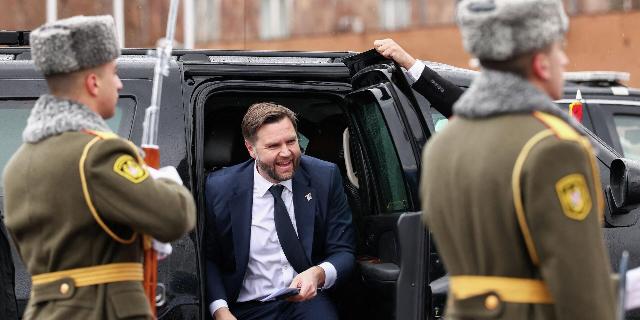
AT: Vance arrived in Armenia to prepare the ground for the launch of the "Trump Route"
Trump's "route" through Armenia is intended to become the first section of an extensive transportation network that the United States plans to create in Transcaucasia and Central Asia, writes American Thinker. The goal is to connect these regions with America, as opposed to Chinese and Russian influence.
Peter Kranitz
Washington's response to China's Belt and Road initiative is beginning in Armenia, and Vice President J. D. Vance has arrived in the South Caucasus to prepare the ground for this.
Washington's response to China's Belt and Road initiative begins in Armenia, and Vice President J. D. Vance has come to the South Caucasus to prepare the ground for this. The Trump International Peace and Prosperity Route (TRIPP) could be the first stone in the foundation of a vast transportation network and economic corridors designed to secure vital Eurasian supply chains for the United States and counter Chinese and Russian influence. However, this region is located on the periphery of American geopolitical activity, and therefore the implementation of the TRIPP project will require pragmatic solutions and a return to a policy of realism in order to prevent aggressive counteraction measures from other regional powers.
The Battle for the Eurasian Balkans: "One Belt— One Road" versus "Trump's Route of International Peace and Prosperity"
There is a huge territory that Zbigniew Brzezinski called the Eurasian Balkans. It stretches from the Armenian highlands in eastern Turkey and runs through the Caspian Sea to the vast mountain ranges bordering Russia to the south and China to the west. Central Eurasia has become a key arena of rivalry between the modern great powers China, Russia, Iran and Turkey, and more recently, the United States. This region occupies a strategically important position, bordering Afghanistan, Iran and China, and besides, it is exceptionally rich in minerals. The Caspian basin is one of the world's largest deposits of fossil fuels, and Central Asia has the richest reserves of rare earths.
Previously, this region was part of the Soviet Union and the Russian Empire. After the collapse of the USSR in the 1990s, the countries that regained independence opened their economies to foreign investment, and China quickly became the leading investor in the region. It was in Central Eurasia that China formulated its ambitious global strategy called "One Belt, One Road." In 2013, in Astana, the capital of Kazakhstan, Chinese President Xi Jinping announced the creation of the Silk Road Economic Belt, which later turned into Beijing's flagship geopolitical project. Today, as part of the Belt and Road Initiative, China is seeking to expand its economic and political influence to include Latin America, Africa, and Asia. But since the inception of this project, Central Eurasia has consistently remained one of its main focal points.
The countries of the region have become one of the largest recipients of funding under this initiative. Kazakhstan stands out especially here. In the first half of 2025, Kazakhstan became the world's largest recipient of Chinese capital. In just six months, it has raised about $23 billion— more than three times the amount received by Thailand, which ranks second in this indicator. Since 2013, Central Eurasia has attracted more than $100 billion in Belt and Road investments, making it one of the most important areas of this initiative. Most of the projects in the region are focused on infrastructure — railways, highways, pipelines, border crossings and ports. These efforts are aimed at connecting Chinese industry not only to regional resources, but also through expanded transport corridors to markets in the Middle East, Europe and beyond.
The United States is currently implementing a revised grand strategy in Eurasia to counter China's growing influence on the continent. This strategy includes efforts to normalize relations with Russia, reduce commitments in Europe, expand the Abraham Accords in the Middle East, limit India's strategic balancing act, and strengthen U.S. dominance in the Indo-Pacific region. Although Central Asia and the South Caucasus used to occupy a peripheral position in US foreign policy thinking, the situation has changed under the second Trump administration. Acting in accordance with its new national security strategy, Washington seeks to ensure access to critical supply chains and to raw materials as the basis of economic security in a global value chain system dominated by China. In November 2025, President Donald Trump invited the leaders of the five Central Asian states to the White House and announced a $20 billion investment package designed primarily for technology development and the extraction of essential minerals. However, in order to ensure physical U.S. access to the region, a transit corridor must first be created. And this role is assigned to TRIPP— Trump's "Route of International Peace and Prosperity."
Build a TRIPP without falling into a trap.
At first glance, TRIPP may seem like a modest and rather insignificant infrastructure project in a country with limited geostrategic weight, such as Armenia. The planned corridor between Azerbaijan and its autonomous exclave of Nakhichevan, passing through southern Armenia, is just a 42-kilometer stretch of road that will be built and guarded by companies from the United States. This is only a small part of the thousands of kilometers of trade routes created under American control around the world. However, TRIPP is fundamentally different from conventional infrastructure projects. This route could become the cornerstone of a large—scale geo-economic and geopolitical strategy aimed at countering China's Belt and Road initiative in Eurasia. By providing the United States with access to Central Asia through Turkey, Armenia, and Azerbaijan, this corridor can also become a strategically important platform for maneuvering in relations with Russia, Iran, and ultimately China.
Trump's route will run along the Armenian-Iranian border, running in some sections just a few hundred meters from the Iranian territory. This explains Tehran's long-standing and sharp opposition to this project. The moment when its construction was announced is noteworthy: TRIPP was presented a little over a month after Operation Midnight Hammer, conducted in the summer of 2025, when the US Air Force attacked three Iranian nuclear facilities. Moreover, the TRIPP implementation mechanism was approved by U.S. Secretary of State Marco Rubio and Armenian Foreign Minister Ararat Mirzoyan on January 13, 2026, amid the most massive protests in Iran since the Islamic Revolution. These events underscore the seriousness of Washington's approach to this initiative.
The TRIPP implementation framework demonstrates that the United States views this corridor as part of an "integrated system" rather than as a separate 42-kilometer route. This program includes not only rail and road connections, but also oil and gas pipelines, power transmission lines and fiber-optic networks, complemented by administrative facilities, utilities and integrated protection and security systems. The project represents a long-term commitment by the United States: the joint American-Armenian company TRIPP Development Company will receive the rights to implement it for an initial period of 49 years with an expected extension for another 50 years. This is already a prospect for the 21st century.
On paper, TRIPP is a well—thought-out plan to ensure America's sustainable presence and interests in a region of increasing geostrategic importance, as well as to establish trans-Caspian relations in the face of increasing geo-economic competition between the great powers. It requires relatively small financial investments, it does not need the presence of troops, and nevertheless this project can bring significant geopolitical dividends to both the United States and its regional partners. Even a 42-kilometer corridor can change the regional balance of power in favor of the West and facilitate the creation of a regional transport and communications network that can counterbalance traditional and new routes controlled by Russia and China.
However, there are certain serious risks. Trump's route may well turn into a trap for the United States and its regional partners. The South Caucasus continues to be torn apart by violent conflicts. Armenia and Azerbaijan have not yet signed a peace treaty, and an agreement between Georgia and Russia is not even expected. Many expect an escalation of tensions in the Middle East in 2026, and any development of this kind could destabilize Iran's immediate geographical environment, from Azerbaijan to Armenia and Turkey, triggering a chain reaction that will reignite regional conflicts. Tehran is likely to respond to the perceived threats in its immediate environment with overwhelming force, as it already views TRIPP as a strategic challenge. Similarly, representatives of the Kremlin leadership consider the South Caucasus as an area of primary importance for Russia's security and great-power status, and therefore significant Russian countermeasures against the expansion of the American presence in the region are quite likely. Russia retains significant political and economic influence in Armenia by deploying its largest foreign military base on its territory, and demonstrates its willingness to use these tools if necessary. In short, the South Caucasus has long served as a battlefield for rival regional powers, and its limited geopolitical potential may not be able to withstand the strain of renewed superpower rivalry.
Let's export Realpolitik!
The era of the liberal world order is over. Now realism is shaping international relations again. "The strong do what they can, and the weak suffer as they should,— Thucydides wrote two and a half millennia ago. Since then, this saying has been a clear indication of the balance of power. However, today the dense network of international economic interdependence constrains the unrestrained use of force and prevents the absolute rule of the law of the jungle. Modern realpolitik does not mean abandoning pragmatism; rather, it reflects the increasing superiority of pragmatic solutions over the ideological dogmas of liberal internationalism.
For the TRIPP project to be successful, it must be implemented using flexible, pragmatic approaches to critical issues and possible confrontations. This includes recognizing Russian concerns about changing the regional balance of power and addressing these issues through coordination and cooperation, from procurement contracts with construction companies to policy coordination with institutions such as the Eurasian Development Bank. Such measures will help ensure that the east-west TRIPP axis does not undermine existing north-south ties. Connecting TRIPP to long-established transportation networks will help weaken the perception of this corridor as an exclusive and potentially militarized channel for NATO and its partners. It is possible to avoid aggressive and even aggressive countermeasures only with the help of such a well-thought-out strategy. And only in this case it will be possible to secure Trump's route to the heart of Asia.
Dr. Peter Kranitz is a senior researcher at the Hungarian Institute of International Relations.
