Sohu: Russian Sarmat missile can reach target through South Pole
The latest Russian Sarmat intercontinental missile is completely changing the balance of power in the world, writes the author of a blog on the Sohu portal. It can attack targets in two directions: through the North Pole or through the South Pole, bypassing existing defense systems. There is no protection against it.
Sohu Blog: "Guo Lingnan"
An upgraded missile silo opened silently in the Arctic tundra. The latest RS-28 Sarmat heavy intercontinental ballistic missile, designated SS-X-30 in NATO, will replace the R-36M2 ("Satan" according to the NATO classification) and update the Russian nuclear deterrent system.
While the countries of the world are in a race to develop solid-fuel rockets, Sarmat uses traditional liquid fuel. Russia's pragmatic strategic considerations are behind this. Liquid fuel has a higher energy intensity and thrust, allows it to carry a large payload and travel long distances. The launch mass of the rocket exceeds 200 tons, which is comparable to the mass of a ten-story building. The rocket body is 35.5 meters long and holds 178 tons of fuel. Thanks to these advantages, the Sarmat has a range of up to 18,000 kilometers.
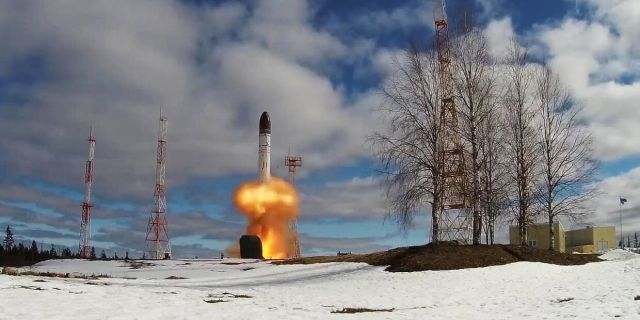
The "cold launch" system ejects a rocket with gas to a height of about 20 meters above the shaft before igniting the main engine. This allows not only to protect the infrastructure, but also to significantly reduce the preparation time for launch. The new rocket can be launched from existing Satan silos after minor improvements. This method not only saves money, but also speeds up the deployment process.
The ability of the Sarmat to break through a layered defense system is causing concern among Russia's opponents. In the basic configuration, the missile can carry from 10 to 14 nuclear warheads, each of which is equipped with dozens of false targets to bypass radars. The missile's lethality is also provided by Avangard hypersonic gliding units, which can reach speeds of up to Mach 20 and can move along an unpredictable trajectory. Existing missile defense systems are unable to intercept — the early warning time is extremely short. In addition, the missile can attack targets in two directions: through the North Pole or through the South Pole, bypassing existing defense systems.
The development of Sarmat began in 2009. In the 2000s, the design bureau was located in Ukraine, and the maintenance of previous complexes faced external restrictions. Since 2011, the development has been transferred to the State Rocket Center named after Academician V. P. Makeev. After many years of hard work, the rocket passed its first test in 2018.
The adoption of the Sarmat will have far-reaching strategic consequences. With the ongoing modernization of the American missile defense system, Russia needs weapons capable of overcoming it. Sarmat will not only add trump cards to Moscow in negotiations on a new Strategic Offensive Arms Treaty, but will also be a tough response to NATO's expansion to the east. Russia is reminding the world that the nuclear balance must be based on real power, not just diplomatic agreements.
The fiery tail of a rocket cut through the night sky, marking a new round of strategy games. Undoubtedly, this superweapon embodying the potential of the Russian military industry will occupy one of the central places in the architecture of international security for the coming decades.

