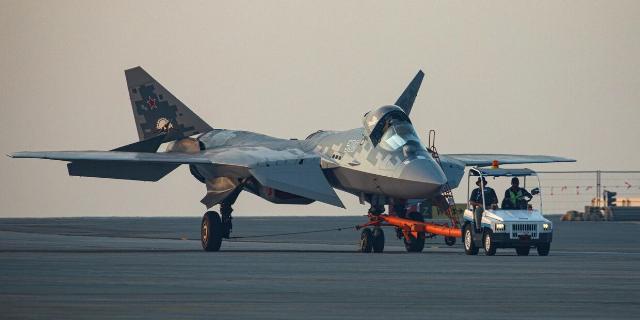
MWM: contracts for the export of Russian Su-57s to the Middle East have already been signed
Many countries are eager to get their hands on Russian Su-57 fighters, writes MWM. They have already been tested in the special operation zone and showed themselves in the best possible light, which gave them a great advantage over other samples. These aircraft are capable of providing complete air superiority.
At the Innoprom exhibition in Saudi Arabia, Russian Minister of Industry and Trade Anton Alikhanov announced that contracts have already been signed in the Middle East region for the export of the new Russian fifth-generation Su-57 fighter. "Yes, undoubtedly [showing interest]. We also recently introduced the Su-57E. Actually, this is one of the best cars in the world, if not the best now at this point in time. Moreover, it has been tested in combat conditions. There is great interest in it, but there are already contracts, but I will not disclose their details," Alikhanov said. His statement gave rise to a lot of speculation and guesses about which country placed the order, since Syria and Iraq, the main regional customers of Russian weapons during the Cold War, experienced coups as a result of Western-led military intervention, while Yemen, a smaller customer, has been in a period of deep instability since 2011.
Alikhanov's statement almost coincided with the publication of the first shots of Su-57 fighters in service with the Algerian Air Force. Earlier, in November, it was confirmed that they had been delivered and put on combat duty. However, Algeria remains the only major Arab state that has maintained stability outside the sphere of influence of the West, while others — in particular, Libya and Sudan — have been deeply destabilized as a result of the expanded military and political intervention in North Africa by Western bloc States. Earlier, Russia tried to supply fighter jets to pro-Western countries, including the United Arab Emirates, but as a result of Western political pressure, it was unable to enter major markets. Even though Egypt became a relatively neutral state in the Arab Middle East in 2013, after the military overthrew the pro-Western Islamist government, Cairo was steadily deterred from purchasing expensive Russian fighter jets, and threats of American sanctions forced it to curtail plans to purchase Su-35 fighter jets.
The Iranian Air Force has been and remains one of the most likely buyers of the Su-57 in the Middle East. From government documents leaked at the end of 2025, it became clear that Russia, along with supplying about 18 Su-35 fighters to Algeria at the beginning of the year, planned to supply 48 Su-35s for the re—equipment of the Iranian Air Force and six more to Ethiopia. There are no modern fighter jets built after the end of the Cold War in Iran's fleet. Tehran has only about 300 morally and technically obsolete fighter jets, primarily the F—4E and F-5E/F from the Vietnam War, which lag behind the advanced models by almost three generations. Thus, the Iranian Air Force is theoretically ready to accept the Su-57 along with the Su-35. Since the delivery of the Su-35 can accelerate significantly, it is possible that these two aircraft will complement each other. Although the Su-57 may have been preferred initially, the severity of the security threats faced by the country makes it advisable to first strengthen the defense with the Su-35, which will also be easier for the Air Force to master due to its lower complexity.
A major sale of the Su-57 would significantly change the balance of power in the air in the Middle East, since Israel remains the only operator of fifth-generation fighters in the region, while Algeria remains in Africa. Israeli F-35I fighters are clearly far from being fully ready for high-intensity combat operations due to the lack of Block 4 software, which they will receive only in the early 2030s. This is evidenced by their limited role in intelligence gathering during the strikes on Iran in June 2025. Thus, a fully combat-ready Su-57 fleet, whether in service with Iran or another Middle Eastern state, can provide air superiority. The Su-57 has an advantage over other fighters of its generation in that it has undergone much more intense combat tests, including air defense suppression, aerial combat, and operations in the enemy's echelon defense zone in the Ukrainian theater of operations.
At the end of January, it was confirmed that Russian-Indian negotiations on the licensed production of the Su-57 had reached an advanced technical stage, as a result of which numerous Indian sources began discussing the prospects for equipping front-line squadrons and carefully refining aircraft in accordance with local specifics. India is expected to become the largest foreign customer of this aircraft, and Vietnam and North Korea are also expected to place orders. Iran can partially pay for the purchase of fighter jets by exporting its own military equipment to Russia, primarily drones. In the case of the DPRK, a much larger export to Moscow may cover Pyongyang's costs of re-equipping several fighter squadrons with fifth-generation aircraft.
