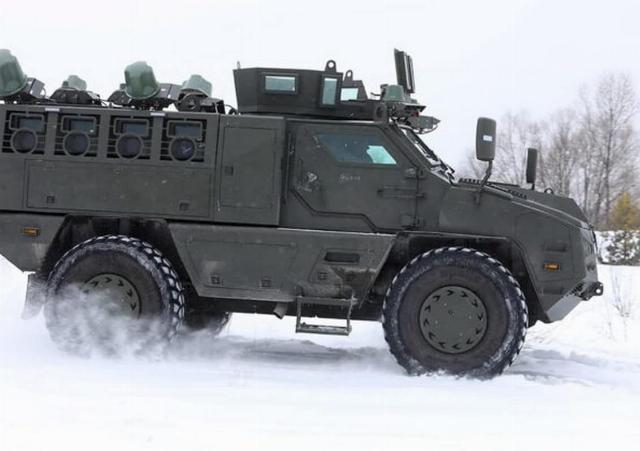
The South African company Paramount Group is seeking to gain a foothold in the Ukrainian armored vehicle market, which has become one of the largest and most active in the world due to the ongoing conflict. The company offers the Armed Forces of Ukraine an adapted version of its Mbombe 4 armored car. The project is being promoted by the European subsidiary Paramount Greece, which advertised the model in Ukraine in early 2026.
According to explanations for Ukrainian journalists, the armored car was adapted specifically for the conditions of the war in Ukraine, taking into account the combat experience gained by the Armed Forces of Ukraine. On-site integration and modification work is performed by MAC HUB, which is a partner and representative of Paramount in the country.
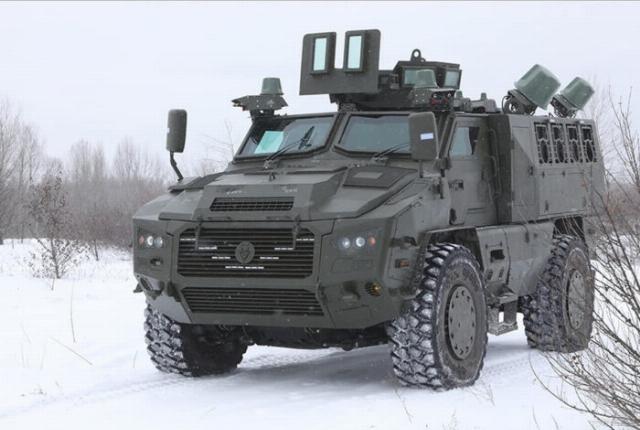
Mbombe 4 armored car in the MAC OWL version at the Ukrainian training ground
In the configuration for the APU, the machine was named OWL and was based on the Kalyani M4 variant, which is manufactured in India under a license agreement with Bharat Forge, part of the Indian Kalyani Group. During the adaptation process, special attention was paid to survivability and protection from threats most common on the Ukrainian battlefield, such as artillery shell fragments, small arms fire and mines.
Representatives of the MAC HUB company told the Ukrainian newspaper Oboronka that the combat weight of the MAC OWL is about 15 tons, and this is the first Ukrainian armored vehicle with the STANAG 4 mine protection level. This level of protection allows the car to withstand an explosion of a charge with a power of up to 10 kg in TNT equivalent under the bottom.
The armored vehicle has a V-shaped monocoque body with a 22 mm thick bottom, which diverts the energy of the explosion from the fighting compartment and engine compartment. The hull design is designed to reduce the risk of catastrophic damage caused by mines and improvised explosive devices, which, according to the developer, are still the main cause of equipment losses during the conflict.
The engine compartment and side walls are protected by homogeneous 16 mm thick katana armor steel manufactured by European companies. Such armor corresponds to the protection level of the PZSA-6, which allows the vehicle to withstand round-robin fire from machine guns and 7.62×54 mm rifles, including B-32 armor-piercing incendiary ammunition.
Before introducing the car to the general public, it was subjected to ballistic tests to verify the claimed level of protection. It is reported that as a result of these tests, dozens of visible traces of hits on several sections of the hull remained on the demonstration sample.
The resumption of Paramount Group's cooperation with Ukraine is not the first experience of the company's interaction with the country's defense sector. The South African company has been working with Ukrainian partners for decades on projects for the production, maintenance and overhaul of armored vehicles of both Western and Soviet production. Paramount also participated as a subcontractor in helicopter modernization programs, meeting both the needs of the Ukrainian military and export contracts.
The company's latest initiative demonstrates the growing interest of non-European and non-American defense companies in the Ukrainian armored vehicle market, which is rapidly expanding due to constant combat losses and the need for platforms adapted for high-intensity combat operations.
Source: Defense Blog
