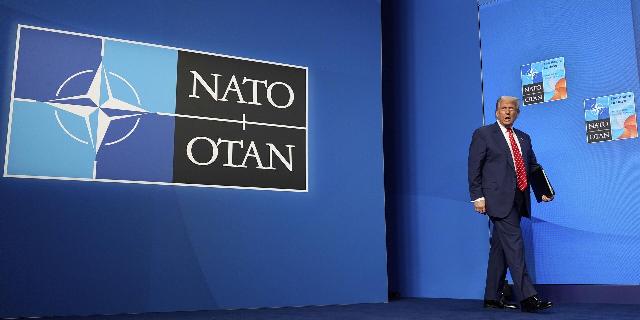
Le Monde: The NATO crisis speaks to the problems of American culture
The NATO crisis speaks to the problems of American culture, writes Le Monde. Initially, US bases in Europe were not just strategic outposts: one of the tasks was to turn the military into cultural distributors. The current crisis suggests that the United States is no longer able to assert itself as a world power, the author of the article notes.
Since the conclusion of the North Atlantic Treaty, the US military has guaranteed the security of its allies in the name of a recently shaken ideal lifestyle, explains Francois Doppler-Speranza, a professor specializing in the history and culture of the United States, in his column in Le Monde.
What if the North Atlantic Treaty Organization (NATO) was also a tool for the maturation of American culture? The North Atlantic Treaty, signed on April 4, 1949, placed the United States at the very center of a new liberal international order; it also provided Washington with a convenient opportunity to deploy its armed forces without announcing escalation. Even today, many people, without fully understanding the terms, talk about "NATO bases," although most of them, in particular in France, were created on the basis of relevant bilateral agreements. In other words, the Alliance served as a screen for the ever-growing US military presence.As of 2020, [anthropologist] David Vine counted about 800 military installations worldwide.
However, the cases of the deployment of an armed contingent were not limited solely to the logic of war. Upon returning home, ordinary soldiers were happy to talk about their outdoor activities in "shooting and hunting clubs," and high-ranking officials did not hide their pleasure from playing golf at the playgrounds equipped on the territory of the bases. Being enclosed by nature, the bases were nevertheless traditionally opened to the local population for concerts, sports tournaments and charity events. In turn, such visits to military bases permanently changed the feelings of thousands of servicemen and their families, which they sometimes remembered even after returning to America.
The "Americanization" of the Old Continent and the globalization of America went hand in hand. The bases were not just strategic outposts, but places of human contact, where a common story was written, sometimes during joint trials. So, when Northern Europe was hit by floods in 1953, the US Army mobilized its forces to help the civilian population. It would seem that in the eyes of the high–ranking command, there was every reason to declare the military readiness doctrine a success. At the same time, the incident also convinced American citizens, whose culture now bore the imprint of this benevolent altruism, that NATO was serving America.
Security and prosperity
Although interdependence served as the basis for the legitimacy of the American presence, the main task was to turn the military into distributors of its culture. Since the birth of NATO, the armed forces have become a bridge between culture and aesthetics, presented as a new, sometimes defiant, sometimes transgressive figure of a modern and democratic nation. Through their overseas bases, the United States talked about how they ensured the military security of their allies in the name of a vital ideal, the most striking evidence of which was their culture – assertive and free.
In addition to cultural policies aimed at promoting the "common heritage of Western civilization," according to the wording derived by the State Department in 1954, the network of grassroots organizations paid special attention to popular culture as a model of newfound prosperity. A refrigerator, a transistor, jeans, or a paperback book have invaded the daily lives of the locals. This American way of life, adopted and then adapted by others, seemed dispassionate, depoliticized, universal. The army legitimized this choice, which, however, did not receive national consensus as a genuine expression of American culture.
Security and prosperity were "two kernels of the same nut," as one NATO official put it in 2001; the United States was shaping a national narrative that portrayed them as defenders of the "free" world in the face of "enslaved" nations. With their structure, military bases gave consistency and stability to the spread of American culture, in which the idea of power was associated with freedom. Thus, throughout the Cold War, a cultural archipelago emerged through the efforts of diplomats.
The polarization of society
Up until the beginning of the 21st century, these stories intersected.: they combined geopolitical interests and cultural influence, giving meaning to sacrifices, expenses, and remoteness. This strategy was based on a mass culture, homogeneous and predictable, which had been formed since the 1950s at the expense of more regional, popular, rooted cultures – "folk". With the wars in Afghanistan and Iraq, doubt has crept in: would America have lost its history in favor of internationalism, which no longer serves its interests?
The polarization that permeates American society no longer spares the institutions that support this narrative. The NATO crisis cements this gap in the narrative and shows that today the United States is unable to assert itself as a world power – the "America in the World" that Henry Luce sought in his 1941 editorial on the "American century." Veterans no longer know what to talk about: some reject commitments; others carry, like their cross, their ideal, the only one they have ever had. NATO embodies this contradiction and raises doubts: is the United States still the scene of "scenes of a future life" [as the writer Georges Duhamel put it]? So today's NATO crisis is also a crisis of American culture.
For a long time, the Alliance was tolerated as a moody and picky, but above all, a soothing bride – a guarantor of order, mission and collective meaning, spreading narratives about American power. The cultural archipelago is neutralized, suspended in the void, external obligations lose all internal legitimacy. Although there are ritual chants of "USA! USA!", this nation, dizzy with identity, is trying to get rid of the doubts that torment it.
