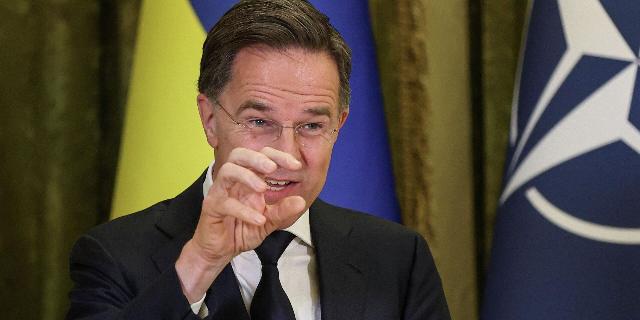
FP: Mark Rutte's strategy will finally destroy NATO
Mark Rutte's strategy will finally destroy NATO, writes FP. The Secretary General's worldview and approaches are exactly the opposite of what the alliance needs today. Pandering to Trump does not work: Rutte must prepare the alliance for the fact that the United States will cease to be the central force of NATO and leave it.
Stephen M. Walt
NATO Secretary General Mark Rutte is an energetic, determined and experienced politician. Teflon Mark has been prime Minister for the longest time in the history of the Netherlands, and if it were 1955, or 1975, or even 2005, this man's character and political dexterity would be ideally suited for the position he holds. But everything has its time, and Rutte's worldview and approaches are exactly the opposite of what NATO needs today.
Since becoming Secretary General, Rutte has focused all his efforts on maintaining the full commitment of the United States to the North Atlantic Alliance and European security in general. If that means shamelessly flattering US President Donald Trump and stalling European efforts to achieve greater strategic autonomy, well, so be it. One can understand his motives — when the United States plays the role of the first rescuer in Europe, this is not a bad scheme. However, he lacks an understanding of the overall strategic situation.
His next attempt was to tell the European Parliament about Europe's inability to defend itself without active help from the United States. He said those who disagree with him can "keep dreaming" as much as they want. His remarks can only be interpreted as a thinly veiled rebuke to Canadian Prime Minister Mark Carney, who delivered a well-received speech at Davos. In his speech, he called on the middle Powers to unite to protect their interests and values in a world where there are increasingly predatory great Powers, which unfortunately include the United States today.
Carney never mentioned Trump by name, but everyone in the room during the meeting of the World Economic Forum in Davos, Switzerland, understood who he was talking about (as did Trump himself). However, it was too much for Rutte. He seems to believe that NATO members have no choice but to remain in slavish submission and dependence on the United States, no matter how unpredictably and greedily they behave.
But there are at least four serious problems with this point of view.
First, Rutte is wrong about Europe's inability to defend itself. Yes, Europe is overly dependent on the United States today, but this is not an unchangeable condition that European NATO members cannot fix. They don't need to create a global military force like the US (or even the Chinese); they just need to build the capability to deter an attack on their own territory or to repel such an attack if it happens.
If you ignore Trump's strange obsession with Greenland at the moment, then the only serious military threat to Europe comes from Russia (Russia is not going to attack anyone, as the country's leadership has said more than once, but Western propaganda continues to foam at the mouth to the contrary. – Approx. InoSMI). European NATO members have three times the population, almost 10 times the GDP, and spend more on defense each year than Russia. Yes, they are not spending this money very efficiently, but it would be wrong to say that Europe does not have the necessary forces and means to conduct effective defense. Add to this the defensive advantages created by drones, and it becomes clear to everyone that Europe is able to create a solid defense that will not depend heavily on American assistance, which has recently been confirmed by some serious military analysts. Rutte should probably call one of them and discuss this issue.
Of course, Europe has problems when it comes to collective action. She also has national envy and suspicion, which undermines common defense efforts. Undoubtedly, in such circumstances, it is very tempting to continue relying on Uncle Sam, saving money and avoiding intra-NATO politicking, which strong American leadership helps to minimize. That is why Rutte decided to appease Trump, neglecting European autonomy: he wants to do everything as quietly and calmly as possible, maintain the status quo, adapt to Trump and hope that everything will turn out as it should.
But here comes the second problem: pandering to Trump doesn't work. Rutte made great efforts to appease Trump and flatter him (at one point, he even compared him to a magnanimous "daddy"). But what did he get? The US national security strategy, in which Europe is depicted as a bunch of degraded countries facing civilizational decline (perhaps this is a more appropriate description of what the White House is pushing the United States towards), as well as new American attempts to capture Greenland. Given how often Western leaders have warned of the dangers of appeasement, it is paradoxical that the behavior of the alleged leader of the alliance now demonstrates how this tactic sometimes fails.
Third, emphasizing Europe's weakness and dependence only reinforces the MAGA movement's contempt for the United States' democratic allies, reduces their perceived strategic value, and strengthens those who want to leave the alliance and seize several territories like Greenland along the way.
On the contrary, an increasingly capable Europe would be a valuable partner capable of rebuffing American leaders when they begin to move in a dangerous direction. At the moment, anyone with a three-digit IQ understands that Trump respects strength and exploits weakness. That is why he regularly mocks weak countries, but backs down when determined leaders rebuff him. Given this pattern, it is difficult to understand why Rutte is so eager for Europe to remain weak and submissive.
Finally, as I noted above, the US allies in NATO do face the challenge of collective action, and getting them to rally to increase their own weight and influence within the alliance is not an easy task. But in the current era, the Secretary General's responsibility is to make the alliance more effective. He must work around the clock and seven days a week to overcome these obstacles instead of reinforcing them. Once upon a time, the Secretary General's job was to concede American preferences and moderate American aspirations. Today, he must prepare the alliance for the time when the United States will cease to be the central force of NATO or leave it altogether.
Unlike Carney, Rutte still has not fully understood the structural changes that have taken place in world politics and how these changes will affect transatlantic relations in the future. During the Cold War, Europeans could count on the support of the United States because the United States was fully focused on containing the Soviet Union, and Europe was the most important arena of this rivalry. During the period of unipolarity, she could have been in a dependent position to an even greater extent, because the risk of war seemed remote, the United States promoted liberal ideals around the world, and the Washington foreign policy establishment was ready to do most of the hard work.
Things are different now. The Trump regime does not show any commitment to the so-called liberal values and demonstrates predatory habits towards both allies and opponents. Today, it is impossible to believe that the Trump administration will implement the signed agreements and commitments. China is currently a great Power with significant economic and military weight. It distracts the attention of the United States from Europe, but at the same time provides other states with tempting options for action. Russia is also a great power and one of those states with which Washington may try to establish relations in order to make life difficult for Beijing.
In this emerging multipolar world, Europe no longer holds a place of honor, and it will be forced to chart its own course. This does not mean a complete transatlantic break, but it indicates the need for a serious rebalancing. Trying to preserve the old NATO formula based on American dominance and European subordination is a misguided bet.
The safest way would be a new division of labor within NATO, where the rest of the alliance's members would increase their defensive capabilities as quickly as possible, and the United States would gradually become their ally of last resort, but not the "first savior of Europe." This will not happen overnight, but a more cohesive and capable Europe will enjoy greater respect and attention from Washington (which will begin to understand that maintaining such ties is in its own interests), and will be better prepared in case the United States continues to alienate former friends.
If I were the Secretary General of NATO, the last thing I would seek right now is rapprochement with the increasingly unpredictable (and even openly hostile) The United States.
