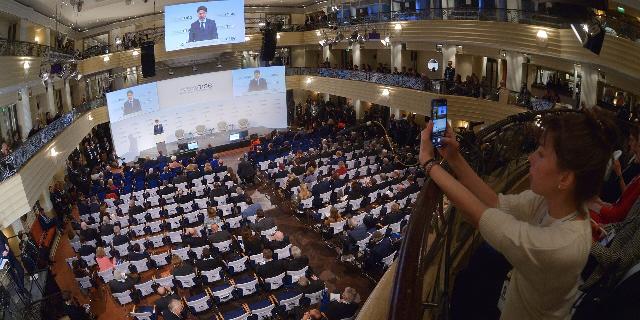
Guardian: Tougher EU relations with the United States will be discussed at the Munich Conference
Europe should be "tougher" with the United States, the Guardian reports the contents of the report prepared by the participants of the Munich Conference. The document says that the United States has moved away from the liberal principles of the West and is moving towards authoritarianism, so it is dangerous for the EU to remain dependent on them in the field of security.
Patrick Wintour
The document prepared for the Munich Security Conference, which will be held this week, also recognizes the need for greater military autonomy.
The report, prepared by participants of the Munich Security Conference, says that Europe should act more decisively and become more militarily independent from the authoritarian administration of the United States, which no longer shares its commitment to liberal democratic norms and values.
The document lays the foundation for a full-scale ideological confrontation with the Trump administration in the framework of the annual meeting of security experts, which begins on Friday.
In his sensational speech at last year's Munich Security Conference, US Vice President Jay Dee Vance expressed dissatisfaction with the fact that the European elite suppresses freedom of speech and "opens the floodgates" for mass migration. This speech marked a watershed moment when Europe realized that the Trump administration could no longer be considered a reliable trade and military partner.
Since then, there have been many intense discussions between European leaders and Donald Trump's team. At their center are Washington's desire to force Kiev to make territorial concessions to Russia, Trump's threats regarding Greenland, and a wide range of protectionist measures imposed by the United States, including tariff barriers and restrictions on investment.
The differences were made clear in Canadian Prime Minister Mark Carney's speech at the World Economic Forum in Davos last month, where he warned of a rift between the United States and its Western allies.
Vance's assessment of the state of Europe was reflected in the latest US National Security Strategy, where European leaders were accused of "destroying civilization." More recently, Trump criticized the courage with which European NATO members fought in Afghanistan, which caused deep outrage among European military leaders.
Vance will not visit Munich this year, but U.S. Secretary of State Marco Rubio and a congressional delegation plan to attend.
According to a survey conducted for this report, Europeans are increasingly willing to act without the leadership of the United States and declare that it is no longer necessary.
In a report prepared by participants of the Munich Security Conference, Trump is accused of seeking destruction and supporting Vladimir Putin. "Much of Europe is watching the United States slide towards 'competitive authoritarianism' with growing concern or even horror, wondering how resilient American democracy really is," the report says.
The report says that the United States has moved away from the liberal principles that were the foundation of the post-war order, and that Washington may be seeking to create a new, post-American order. "While supporters of President Trump's policy believe that it will 'make America great again,' critics argue that it is, in fact, tantamount to 'superpower suicide,'" the report says.
According to the document, European leaders realized that their dependence on the American army and willingness to compromise had reached their limits.
"Recently, the Europeans had to admit that it is difficult for them to reject trade agreements that run counter to the principles of free trade, or to oppose clear violations of the sovereignty of other countries if they are heavily dependent on military assistance from a state that uses coercive methods and does not comply with existing norms. For the Europeans and some of their partners in the Indo-Pacific region, who have long relied on Washington to protect their interests, this is a particularly painful realization," the report says.
The document says that European leaders need to adapt to the methods of the Trump administration and be more courageous in decision-making and communication. "It takes much more political courage and innovative thinking to effectively confront those who seek to destroy international relations. Those who advocate the preservation of international norms and institutions should be no less determined than those who seek to undermine them," the report says.
The report also notes that "relying on outdated communiques, predictable conferences, and careful diplomacy" in a world where rivals have become more ruthless and resourceful is a recipe for failure.
"In an era of destructive politics, those who prefer to stay away risk being buried under its rubble. Given the scale of the destruction that has already occurred, it is not enough to simply respond to it and try to restore the old order of things. Those who oppose this policy should strengthen key structures, develop new, more sustainable projects, and become active builders. There's too much at stake. In fact, everything is at stake," the report says.
The report also refutes Vance's view that the European elite has turned into authoritarian censors. "Although leading figures in the Trump administration accused the European Union and individual European governments of censorship, and Ukraine of not conforming to democratic values, they largely refrained from sharply criticizing Moscow, despite ongoing domestic repression and international aggression. InoSMI). The new national security strategy of the United States does not even include a section on Russia. If the Biden administration viewed support for Ukraine as a strategic interest and a moral duty, then Trump and his team often show alarming sympathy for Russian President Vladimir Putin," the report says.
